
What will be the fate of Columbus' Government Center?
Its tower has loomed over downtown Columbus for 46 years, dominating the skyline.
“It has become an iconic image for Columbus and that has value,” the Historic Columbus Foundation wrote of the city’s Government Center, in a position paper opposing its demolition.
Its architecture combines Brutalist and International styles, the Brutalist aspects evident in its “weight and massiveness,” and the International traits “a lack of ornament” and “windows that look as though they are a continuation of the surface rather than holes in the wall,” wrote the foundation.
On the plaza level, those tall windows are designed to make the inside seem like the outside, as if the walls aren’t there, and the courtyard beyond is just another part of the spacious room within.
“This is how the plaza level should feel – very open – not being blocked by curtains on the windows,” wrote Historic Columbus.
It was an impressive effect, in 1971, when a consolidated city-county government moved into the new complex.
But when people talk about the Government Center today, they rarely mention the design or its intent, or the tower's place in the downtown skyline.
They talk about the danger.
“The Government Center is not safe in an emergency circumstance,” Mayor Teresa Tomlinson said Wednesday, the day after her “New Government and Judicial Building Commission” gave council its report recommending the structure be demolished and replaced.
Of particular concern is the risk of a fire on an upper floor, where the tower has no sprinkler system. The stairwells are not pressurized to keep smoke out, and they’re too narrow for firefighters hauling equipment upstairs to pass people going down to evacuate.
“It would be chaos, to say the least,” said Columbus Fire Marshal Ricky Shores. “We would be fighting that crowd.”
Gil McBride, the chief judge of the Chattahoochee Judicial Circuit with an office on the top floor, served on the mayor’s commission, and recalled a child’s pulling a fire alarm during a meeting, forcing an evacuation down the stairs.
“You could just imagine those stairwells filled with smoke,” he said.
The fire marshal said that because the stairwells are not pressurized, smoke would flow freely through them, rising as though channeled through “a chimney of sorts."
“Smoke is what will kill you in a building like that,” he said, adding it would carry toxic fumes those fleeing in a panic would inhale. Firefighters arriving there would have to use high-powered fans to create the pressure needed to clear the smoke, he said.
In newer buildings, the stairwells usually are in far corners, so if a fire’s on one side of the structure, occupants can escape through a stairwell on the other side. The Government Center tower’s stairwells are in the center, close together.
And unlike newer buildings, those stairwells don’t empty to the outside. They empty into the lobby on the ground floor, causing more congestion in an evacuation, and possibly funneling people into a part of the building that’s on fire.
“It’s not optimal,” said Shores, who called the tower “the elephant in the room from a fire-safety standpoint.”
The fire department doesn’t have equipment that can reach the upper floors. The fifth floor is as far as it can extend. And the windows aren’t made to open, so no one trapped could get out, nor get fresh air.
McBride said he worries that with all the maintenance required to keep the building’s wiring functional, an electrical fire may occur within a wall or ceiling and remain undiscovered until it breaks through.
“For me it all comes back to safety,” he said. “The least we can do is make sure people are safe.”
Among those considered at risk are deputies escorting inmates to Government Center courtrooms from the Muscogee County Jail, four blocks to the east at 700 10th St.
They have no secured “sally port” in which to unload the suspects, so they’re unloaded in the open parking garage, brought inside to an elevator housing a cramped cell, and hauled up to two holding cells on the fourth floor, where the sheriff’s office is located.
The holding cells have a total capacity for 40, and the limited space is an issue when deputies need to separate men from women, defendants from detained witnesses expected to testify against them, and members of rival street gangs.
When called to court, those inmates must again be escorted to the prisoner’s elevator and taken to courtrooms on the seventh, eighth, ninth, 10th or 11th floor. Those floors have no holding cells adjacent to the courtrooms, so the inmates there must constantly be guarded.
“It’s very labor-intensive,” said sheriff’s Maj. Joe McCrea.
Adding a judicial building to the jail block at Sixth Avenue and 10th Street would have streamlined that, eliminating the van transport, but other considerations got in the way.
McBride said the space available is inadequate, and its hemmed in on two sides by railroad tracks, limiting access and adding noise. He noted that Superior Court judges now use an old Recorder's Court courtroom at the jail when they have inmate-heavy dockets, to avoid making the sheriff's office shuttle prisoners to the Government Center.
Another factor the commission considered was Columbus’ history. The courthouse has always been on the downtown block bordered by Ninth and 10th Streets and First and Second Avenues.
As the Historic Columbus Foundation noted in its report:
“Columbus was the last planned city of the 13 original colonies. From the earliest map of Columbus in 1828, the new city’s courthouse is located on the current block.”
The original city plan by surveyor Edward Lloyd Thomas reserved that block for the seat of government, just as it reserved blocks for the churches downtown. It had open commons for public use to the south, east and north.
The south commons remain, where the Civic Center, A.J. McClung Memorial Stadium and softball complex stand today.
The north commons soon were developed as the city grew. Part of that space now is occupied by Linwood Cemetery and The Midtown Medical Center complex.
After the Civil War, freed slaves moved onto the East Commons, originally between Sixth Avenue and 10th Avenue. That became the historic black neighborhood now called the Liberty District. It’s also where the city long put its jail and law enforcement headquarters.
Downtown, the original grid pattern remains much the same. The churches and the courts are still where Thomas put them.
“It was all very carefully planned,” said Judge McBride, and to change it now could change it forever: “What we do will be considered a precedent.”
Were the courthouse to surrender the Government Center block for some other use, and one of the churches follow suit, the end result could be that anything’s fair game in the original city. Then the pat response to preservationists’ objections to radical changes would be, “The city plan is pretty much shot anyway,” McBride said.
Columbus’ first courthouse was replaced with a classic Greek Revival building in 1838, then that was supplanted by one in a neoclassical style. By the late 1960s, that building was no longer adequate. Columbus needed a big, modern building for its consolidated city-county government.
It could have left the block then. Downtown was dying. Its major merchants were moving out to suburban shopping centers, the first in 1965 at Columbus Square on Macon Road, now the home of the library, the school administration building, the natatorium, the city services center, and the fine arts academy.
City leaders chose to stay, McBride noted, and stick with the original city plan.
Now it’s coming up with a new plan, but one that still preserves the historic use of that block for the courts.
The mayor’s commission concludes the Government Center is no longer safe nor suitable for that use, so it should be eliminated and replaced by a building designed for that purpose.
Whether it builds a second structure on that block for other city offices is yet to be decided. On the mayor’s advice, the commission suggested the city see if it can find available office space already on the market, rather than add a second building.
That could save $30 million, Tomlinson said. She pointed to the old Carmike movie company headquarters on First Avenue at 13th Street, which sold for around $3 million. Were the city government to find a suitable, vacant building, the savings could be significant, she said.
One drawback to that is it could further spread different city services across town and cause some confusion. Since Columbus opened its City Services Center off Macon Road in 2013, some residents have continued coming downtown to the Government Center in search of offices that moved out.
Besides judges' offices, court clerks, and courtrooms, the tower houses the mayor, city manager, city attorney, finance, marshal, sheriff and probate judge. The wings have the juvenile court and clerk, human resources, revenue, and additional space for the marshal and the district attorney's victim-witness and rapid-resolution division.
The City Services Center off Macon Road has the tax assessor, tax commissioner, council chambers and elections and registrations. The city could have built in empty space there for future growth but chose not to, Tomlinson said.
So, the proposal the mayor's commission submitted last week suggests this:
Clear the Government Center block and build a judicial center, and a parking deck south of Ninth Street, where the city has a parking lot now.
Seek available space for city administrative offices. If that is not feasible, plan for a second city office building separate from the courts.
Seek funding through a special local option sales tax, commonly called a SPLOST, to take effect Jan. 1, 2021, after a school district tax expires in 2020. That would keep the overall sales tax rate at 8 percent. The tax typically generates about $30 million annually.
Between now and then, start working on a design and a plan to move the courts and other offices to other, temporary locations while the project’s underway.
Tomlinson said the latter challenge is not uncommon, when municipal governments pursue such endeavors. They can use old movie theaters, school auditoriums or other open rooms for courtrooms.
Columbus Council accepted the commission’s report, but made no decision on it. Tomlinson said the city may proceed with a design for the new building as it decides what besides a new courthouse would be on a list of capital projects for the sales tax.
When that is compiled, council would vote on it, and then call for a vote on a sales tax referendum.
What if voters reject it?
Then the government will “keep operating as we have been operating,” she said.
That has happened before, she noted: County voters rejected a bond referendum to fund the Government Center, and then-Mayor J.R. Allen called for a second vote, cutting the county's share of the construction cost. It passed in 1967.
If approved, the entire project, from planning to demolition to new construction, should take about three years, Tomlinson said.
What residents should be thinking about now, she said, are these considerations:
Would they object to moving city offices other than the courts to other buildings?
Would they object to moving the city administration away from the site that historically housed the county seat?
Would they object to wrecking the building that so long has dominated the downtown skyline? Would they rather it be stripped to a skeleton and its interior rebuilt, as would be necessary to upgrade and preserve it?
Would they approve a sales tax for this purpose?
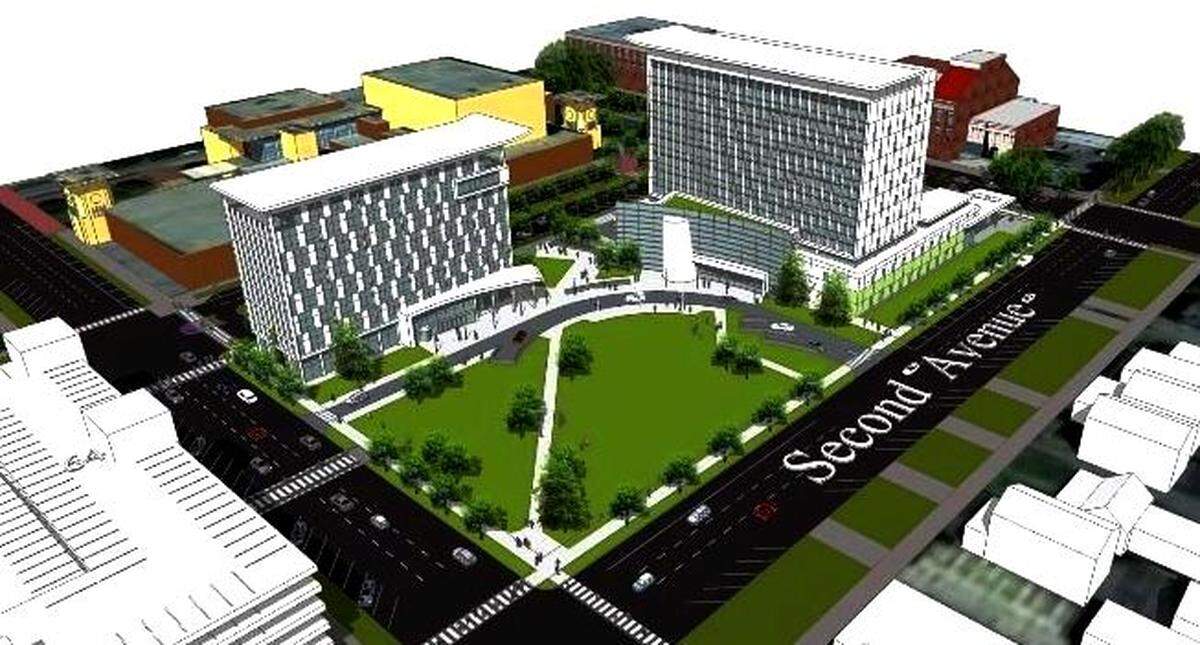
To clear the block and build a courthouse and second city office building, the mayor’s commission estimates the cost at $124,147,320.
The commission chose that option over two others: renovating the existing tower and wings at estimate cost of $109,926,300; or renovate and expand the tower for only court use, demolish the wings and build a new city office building, estimated at $114,095,520.
Several factors made the tower renovation seem impractical.
The big windows in the Government Center's International design are considered a liability now, as they are not insulated and make the interior temperature hard to maintain, now that the building's heating and cooling systems no longer operate efficiently.
Wrote the commission: "Regularly, occupants on one side of a Government Center floor experience 56 degree temperatures and run space heaters and utilize lap blankets to keep warm, while simultaneously the occupants on the other side of the floor experience temperatures above 80 degrees."
At times this has been more than an inconvenience: During emotional jury deliberations in a 10th floor room on the building's west side, the combination of heat from the afternoon sun and the frustration caused by the contentious debate resulted in a juror with post-traumatic stress syndrome asking to be excused.
It illustrated judges' concerns about the safety and comfort of residents summoned to the center for jury duty. As McBride noted, they are not volunteers: They are compelled to be there, and the city is responsible for their security.
Because the building is so energy inefficient, the city could save almost $300,000 annually by replacing it, the commission estimated.
Some other factors driving the commission to propose a new building were:
The building does not comply with the Americans with Disabilities Act, and fails to meet other current building codes.
Pipes throughout the building are corroded and continue to deteriorate.
An emergency generator in the basement no longer works and is too large to be removed, so a new generator had to be added outside the structure.
The commission's full report can found online at the city government website, www.columbusga.org.
This story was originally published December 15, 2017 at 3:16 PM with the headline "What will be the fate of Columbus' Government Center?."