
Flu infections are spreading faster than usual. It's not too late to get the shot.
We've now plunged headlong into flu season, and if the Centers for Disease Control have their numbers right, it's been hitting the country like a ton of bricks.
A national map from the CDC had a wide swath of states across the southern half of the United States, as well as parts of the Midwest and the entire west coast experiencing the highest level of flu activity measured on the scale.
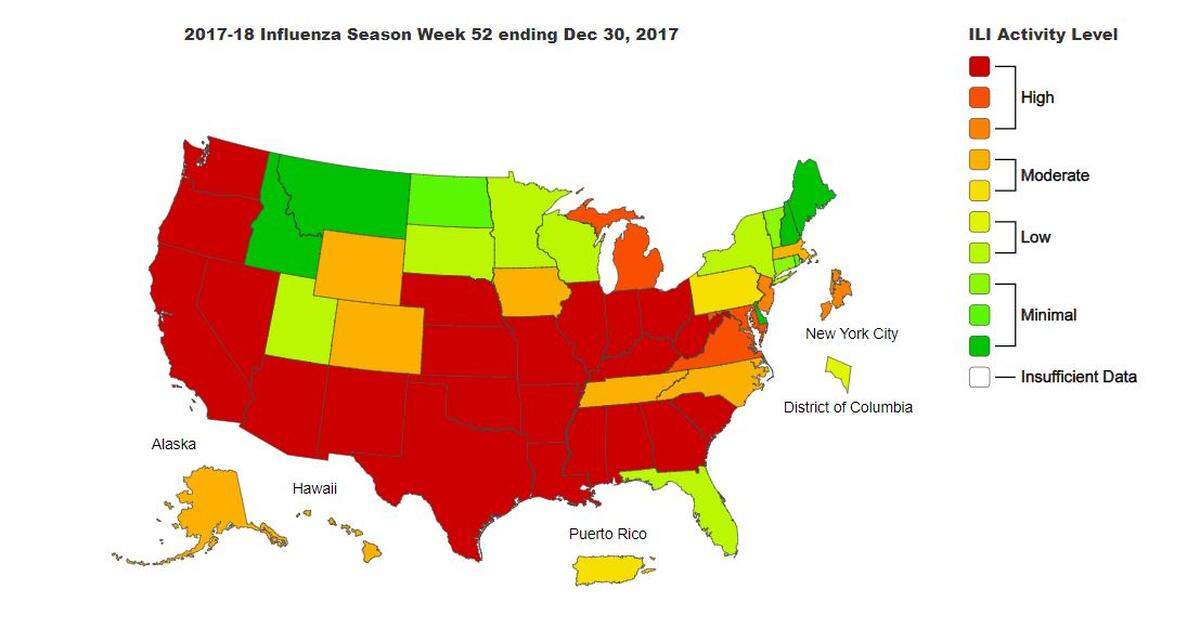
Doctor's visits for flu-like symptoms were up across all regions the CDC monitors as 2017 came to a close. Normally about 2.2 percent of visits are for flu symptoms. Toward the end of the year, it was up to nearly 6 percent.
Scientists have been dreading flu season this year after a particularly nasty outbreak in Australia, which is widely seen as a precursor to what happens in the United States.
This year's flu season is expected to be particularly rough. The News and Observer reported in September that Australia saw record high cases of flu in 2017.
Part of that may be because this year's flu vaccine wasn't especially effective against the virus circulating in Australia. In fact, according to the LA Times, it only worked about 10 percent of the time. Other experts put the current vaccine's effectiveness at around 30-40 percent, slightly less than last year's effectiveness rate of 39 percent, reported Fortune.
But that doesn't mean you shouldn't get the shot, health officials say. Annual vaccines against the flu are recommended for everyone older than six months, and it's especially important for those whose bodies are more vulnerable to disease.
The vaccine takes about two weeks to provide immunity, but the flu could stick around until late May, so you've still got time to take advantage of its protection.
The flu virus can cause fever, cough, sore throat, fatigue, aches and pains and other symptoms. It can be a dangerous disease for those with weakened immune systems or other illnesses.
According to the latest information from the epidemiologists at the CDC, there was at least moderate influenza activity throughout Georgia, with incidences of the disease rising in intensity steadily since the CDC began tracking the season in October.
At least 60 people have been hospitalized around the metro-Atlanta area for the flu, according to the CDC, though Georgia had not reported any deaths yet.
In California, it's a different story. Emergency rooms are reportedly packed and health officials say that 27 people younger than 65 have died of the flu since October, reported the Associated Press.
Still, this year's outbreak is not yet as bad as the last major flu outbreak of 2014. Even though the infection rate is closely following that season, Dr. Daniel B. Jernigan, director of the influenza division of the Centers for Disease Control and Prevention, told The New York Times he didn't see as many hospitalizations or deaths as there were in 2014-2015.
This story was originally published January 10, 2018 at 3:59 PM with the headline "Flu infections are spreading faster than usual. It's not too late to get the shot.."