
Sunday Interview with Chef Mark Jones: 'I do not go into any business unless I have a plan B and C to go along with it.'
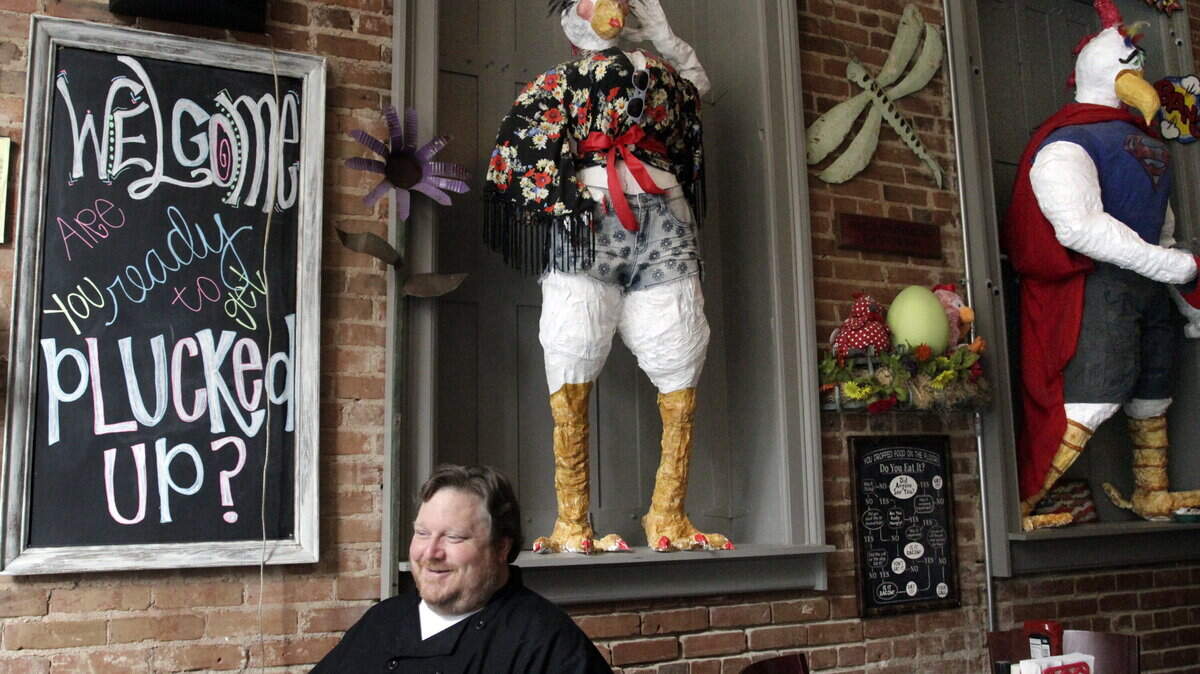
If you eat out much in Columbus or Harris County, odds are you have dined at a restaurant owned or operated by Mark Jones. He owns or operates eight of them from Pine Mountain to downtown Columbus -- and has two more on the way.
The restaurant business is in his blood going back to his grandparents and the Villa Nova, an iconic Victory Drive establishment in the 1950s, '60s and '70s.
Recently, Jones sat down with Ledger-Enquirer reporter Chuck Williams to discuss the area restaurant business. There is a lot of food for thought.
Here are excerpts of the interview, with some of the questions edited for length and the order of some of the questions rearranged for clarity.
The restaurant business has been your family's business for many generations, hasn't it?
Yes. It started back in 1953 on Victory Drive.
Tell me a little bit about your grandparents and what they did.
My grandparents were the original owners of Villa Nova Italian Restaurant. It opened up during the Korean War, so we had many, many troops come through, getting engaged. We did so many engagement parties and 25th wedding anniversary parties. We actually still get a call from time to time saying, "We got married there 40-50 years ago." So, it became pretty well known.
When did the Villa Nova cease to exist?
That kind of gets a little fuzzy with me. I know the one on Victory Drive actually moved down across from the ballpark, and if I'm not mistaken, that happened in the early-to-mid-70's. And I think in 1983, it closed for a few years and reopened, I think, in 1987. And it has been in various locations.
Your mother was also a restaurateur.
Yes. One of the first restaurants I can remember running around in as a child was called The Beef House, and it was on Victory Drive as well.
Was it a steak house?
It was actually a steak house. I think they did breakfast there. I had my third birthday party there, and that's actually one of my last memories of the place. That would have been around 1967-68.
Has that been part of your success in opening multiple restaurants, that you understand the regional flavors, so to speak?
I think that's part of it. I think part of it is the consistency I feel we give our customers, which they know when they come into the restaurant, being that we are not perfect, we try to give you a great product and we try to do it on a consistent basis. We want you to come in and get this one day and be able to come back a week later and get the same dish and it's going to bring back the same feeling you got with the first one.
A lot of your food is comfort food.
Yeah. Everybody loves comfort food.
When you made the decision that you were going to branch out and start these concept restaurants after Hunters Pub, how did you approach it as a business?
My business model is we don't get a large enough restaurant to where we can't manage it. If you have too many moving parts, it's more likely to tear up. So, we try to keep them small, personable, and keep it where they are manageable for us, but not only for us but for the customer.
So, a fleet of economy cars opposed to a Lamborghini?
Yeah, that's a pretty good analogy. However, we want you to get the same feel when you drive a Lamborghini.
As you started growing this, you came into downtown hard. You've got four or five downtown properties?
Right now just four.
Four downtown properties. I can remember when there weren't four locally owned restaurants downtown. What made you see downtown and when did you first see it?
Well, we were actually looking into downtown probably three-to-four years before we ever got here. It started to look up and it started to grow and we felt like now is the time to come this way.
What was the first one?
The first one was about eight years ago, so I'd say around 2007. That was Sumo to Go Go.
That's where Black Cow is now.
Yeah. We did a concept change.
Which shows that if something is not working, you're not above changing ideas.
I do not go into any business unless I have a plan B and C to go along with it.
Explain that.
I don't know if it's a philosophy or not. A lot of things will run its course and a lot of things change. And a lot of things will move forward and sometimes you have to change with them. It's too easy to become stagnant, and it's too easy to say, "This is going to work for a hundred years."
Not even the Villa Nova worked for a hundred years.
Which I honestly believe that it could. There were deaths in the family, and things like that. The Villa Nova should still be around. It was actually that good. I don't know if you know this, but the Villa Nova was the first restaurant in the state of Georgia to serve pizza.
I did not know that.
I didn't know it; it was actually in the Ledger-Enquirer is how I found out about it. I think all of our restaurants evolve to a certain degree, and if you don't evolve with the times and evolve with your community -- because things are going to change -- I think you can become stagnant and that's not good.
In the eight years that you started downtown, things have changed dramatically.
They have.
In the restaurant perspective, how have they changed?
There's a different vibe about downtown. There's a lot more diversity downtown, and a lot of that comes through the military. A lot of the military is living downtown. A lot of young professionals are living downtown that work at TSYS, Aflac and other places. And these people are from all over the country, so it's becoming a little bit of a melting pot, I guess, downtown where you're getting a lot of different flavors. You're getting a lot of different taste buds, to say the least.
I've heard restaurateurs say before that sometimes the more restaurants the better, because all of a sudden it's not "Let's go to Plucked Up," but "Let's go downtown and figure it out." It becomes a destination and you eat here when you get here.
That is. A lot of people are worried about competition moving in, but when you have a lot of different options downtown, it will bring more people into the area. As you can tell in north Columbus, they have what they call "restaurant row."
But those are chain restaurants.
Those are mainly chain restaurants, but they like being there next to each other because it brings a whole lot of people to that one area, and then they make their decision when they get there.
But you have the moms and pops downtown.
Yeah, you have more of a local feel down here, and that's important. Honestly, in the last 10 years Columbus has probably gone from a chain restaurant town evolving into more of a local restaurant town.
Do you think you're part of the reason for that?
I'd like to be part of the reason for that, but I think part of it is people coming in from other areas and craving the local feel and the change of the environment, and people wanting the local feel is the reason for it.
How much has food becoming so popular on TV -- shows like "Diners, Drive-Ins and Dives" -- had to do with that?
I think that has a good bit to do with it because they see other things. Then they go to these chain restaurants and say, "I can't get this here." Chains serve their purpose in certain areas. I think that local ownership of restaurants is where you're truly going to get a memorable meal. You're going to walk out and tell somebody else about it.
Most people can't walk out of a chain restaurant and say, "That's the best thing I've ever had in my life." My goal is for people to walk out of here and say, "Man, can you believe that Chicken Coop? -- (Plucked Up menu item featuring chicken, biscuits, cheese, bacon, gravy and an over-easy egg) -- that's the best breakfast I've ever had." And that's how we want people to feel.
Is this an eat-out town?
It is. It's a very large eat-out town. I would say anywhere from 60-75 percent of people eat out on a regular basis.
Is there room for more locally owned, locally operated restaurants in Columbus? Have we hit a saturation point?
I don't know if we've hit a saturation point, but there's always a need for a great restaurant. And the whole thing about it is -- and what I'd like to do is -- to evolve my restaurants to strive to get better and better. I don't want to stay status quo. But there's always room for another restaurant.
When you don't eat at one of your restaurants, where do you eat at in Columbus?
That's kind of hard to say. Honestly, we would have to go to Mabella's. But my wife actually likes to get out of town and go to dinner from time to time.
Where do you go in Atlanta?
That's a good question. One of our favorite restaurants is over in Macon. It's called Natalia's, Italian-Mediterranean fare, but it's really, really good. As far as Atlanta, we try various places.
You can write off dinner as market research, right?
We don't do that. You can look at me and tell I've already done my research.
Talk about your wife and what role she plays in your business. And your children. What role does your family play in the business.
My wife decorates all of my places for me and she has a great talent for that. I always trust her to come up with the right decor, the right colors, to match the theme of the restaurant that we are doing. I couldn't have done what I have done without her, and I couldn't have done it without my children. A lot of the time they are the ones who give me the drive to get up and go do what I'm supposed to do.
How many children are either part owners or are involved in the business?
Out of the six right now, four of them are working part-time. My son owns Phillyosophy. Two of my daughters work for me as well. And more than likely, the other two will get their fair dose of it as well.
How many employees do you have?
We've got great employees. I love my employees. ... Throughout the restaurants, roughly about a hundred, but the ones we have are really, really good. They really care about what they are doing. The hardest part is finding more and more of them to go along with what we have.
So the service industry's labor market could be broader.
We would love for it to be broader.
Columbus Tech has just opened a culinary school. Jordan High has a culinary school. Are those type of things helping?
I think with Columbus Tech just now getting started, in two or three years, hopefully, it will help.
Will you hire out of those programs?
Yes, I will. But like I said before, when it comes to cooking we look for the people who want a career in that business, that care about what they are doing. We want to take food to the next level, and that's what we'd like to do.
You talk about difficulties finding servers. Could you have more restaurants now if the talent pool were here to staff them?
We could probably open up a few more. Sometimes it's hard to get the right chemistry between all of your staff. And that's what I look for. I look more for the passion of the person and how they will fit in with my other employees and how well all personalities mesh before I even look at their experience. Because if you can get someone who can work with others, we can usually train them to do what we need them to do.
Do you have openings right now?
We have quite a few job openings.
What kind of jobs?
We're looking for managers, a few servers, and quite a few cooks.
That's sort of across the board, right?
It is pretty much across the board.
But if you go into Hunters Pub, you could have the same waitress you had 16 years ago.
There's a good possibility.
The Hunters Pub staff has stayed with you, right?
They have been with me for quite a while. We have some that have been there for nine years, five years. We do have turnover, but it's usually because they got married, moved away. Very little turnover though.
Are you more of a cook, chef or are you more of a personnel manager?
When we first started I was the cook, chef, bottle washer, whatever I had to be. Having the people around me that I have around me now has untied my hands so I can deal with the personnel part of it and building the business and the menus. So, my staff has kind of released me. I still love to cook, still love to create, and I still love to develop menus. And then I like to get in there and either train the dishes or have one of my head chefs train the dishes. My biggest thing is we just want to create the consistency of what we're putting out.
Recently you tied for first place in a burger cook-off. That was a creative burger. What did you put in it?
That was a burger with a black peppercorn aioli, caramelized onions, a little blue cheese and Gruyere cheese mixed together melted over the top, and topped with a homemade peach preserve. We just felt like all of the flavors would mesh together.
Where do you come up with that? Where do you say, "OK, I'm going to put peach preserves on a hamburger with blue cheese"?
It's a balancing of flavors. If you balance your flavors and if you layer your flavors right, they will come together. If you get too much of it at one time, it's not going to taste the same. So, it has to be well balanced. You take your sweet, your savory, your saltiness, your crispiness, when you kind of mix them together, but you mix them together at certain points, to make the whole thing come together.
So, that's what you're trying to do. Is that kind of the same formula you use for your restaurants?
It is. The majority of your menu has to be pretty much what everybody likes. And then you have some creative license to get outside of the box a little bit to put your twist on a particular dish, and to change things around.
What are you going to eat for your last meal?
That's kind of funny. I'm kind of a basic person. I love great foods, but growing up my favorite meal was always roast beef, mashed potatoes, gravy and English peas. And I still love that to this day. A really good cheeseburger would rank second.
Where do you see the downtown restaurant market going in the next 10 years?
I think you will see a little bit more variety. It may grow by maybe 20 percent. I'm not sure how many downtown restaurants there are, but there are quite a few now. I can see anywhere between five to 10 more restaurants downtown. And you'll also see some come and go, too.
You don't have a true Italian restaurant downtown in the Villa Nova style.
Not yet you don't.
Is that one of your ideas?
Not necessarily, but I do think you'll see one within the next year or so.
When you look at people who have been down here for a long time like Jim Morpeth, Buddy Nelms, what do you think about what they've done down here?
You know, they took a big risk and they held on down here when no one else was willing to come down here. I think they have done a great job of being an ambassador for Uptown, downtown, whatever you want to call it. I think they've done a really good job of holding on to the Uptown dream, which made it possible for a lot of others to come down to join in it with them.
So, they played a crucial role?
They did because if they would have left a long time ago, we probably wouldn't be having the conversation we are having now.
What will Columbus State adding the College of Education do to the downtown restaurant market?
It should boost the existing business, but it will probably also create a few more restaurants. I've got them surrounded.
Was that by design or did it just happen that way?
I'm not that smart. It just happened that way.
Do you buy buildings down here or do you lease them?
I'm in leases.
Does that make more sense in your business model?
For the most part I think it does. I would love to own some buildings down here, but I just don't know if we will ever own any.
So, your business is the food and the experience and not the real estate?
Yeah. I'm in it for the creating of the food, customer service, making lifelong friends through the restaurant business, because it is a great way to meet people. It's a great way to make friends, and it is just really nice to see someone come in and enjoy what you are doing.
For you too, it's also a continuation of the family business, right?
I do believe so. We've kind of always been in that business, and I think even throughout the years -- the '50s, '60s -- my family has done a lot for the food industry in Columbus, Ga. They have been as responsible as anybody for growing the food business in Columbus.
Obviously, your kids are in it now. Do you hope they continue this?
Well, that's a yes-and-no question because in some ways I would love to see them carry on some of the tradition that we've started. But it is not the easiest life in the world. It's hard to raise a family. I still to this day work a lot of hours. I have missed things with my family that I wish I could have been there for but just could not be.
I'm lucky now that I actually get to spend more time with my family. But when it comes down to it, there's some part of me that says yes, I would like for them to be a part of it. And then I just want them to be happy, and I want them to do what makes them happy.
This makes you happy, right?
This does, and there's an old saying, "Be careful what you wish for," because this is what I kind of wished for and it's kind of what I got. But it hasn't been easy and it never seems to ever get easier. You just kind of get used to it.
Have you thought about opening a grocery store downtown?
Believe it or not, where we are standing we had thought about a small little grocery here before we did what we did. The grocery business is something I really don't know -- it would probably be a little bit out of my comfort zone. But if you ask me, Uptown could use a nice little corner market.
Where do you get your ingredients?
Like everyone else, we use food purveyors. We have certain guidelines we want to go by, especially with the steaks and poultry -- we're pretty strict on that. A lot of our produce comes from Marvin's Market, and we do get some from distributors out of Atlanta.
Where do the steaks come from?
Our steaks are all Midwestern corn-fed beef, and we have parameters where they have to be aged for a certain amount of time, and a certain size as well.
Where did you come up with the Hunters Pub Sauce?
That was actually my mom's. We really haven't made any changes to it. It's something my mom used to make. We tweeked it a little bit but not too much.
Is your mom still alive?
No, my Mom passed away about three years ago.
And the Hunters Pub Sauce was hers and you use the sauce throughout just about all of your restaurants, don't you?
We use it in every single one. There's not a one I don't think we use it in. It's actually good on just about anything you want to put it on. I won't eat it on a steak but I'll eat it on other things. We actually have one guy who will buy the sauce and keep it in his refrigerator. If he can't get up to Hunters Pub, he'll just go by the refrigerator every now and then and take a big swig of it.
Bio
Name: Mark Jones
Age: 50
Job: Chef/owner of Mark Jones Kitchens. Has owned restaurants in Columbus and Harris County since 1995. His restaurants in the Chattahoochee Valley include, Black Cow, Flip Side Burgers & Tacos, Mark's City Grill Phillyosophy, Plucked Up Chicken and Ready-Steak-Go, all in Columbus, as well as Hunters Pub & Steak House in Hamilton and Aspen's Mountain Grill in Pine Mountain. He is preparing to open two more restaurants, Baked & Confused on Second Avenue in Columbus, and Mark's Pies & Thighs in Cataula.
Education: Glenwood School, 1983; attended Faulkner State Community College and the University of South Alabama.
Family: Sheri, wife of more than 20 years, and six children, Chelsea, Skylar, Arden, Alexi, Aspen and Grason.
This story was originally published June 20, 2015 at 10:17 PM with the headline "Sunday Interview with Chef Mark Jones: 'I do not go into any business unless I have a plan B and C to go along with it.'."