
Sunday Interview with James Worsley: 'I always had the internal determination to want more out of life'
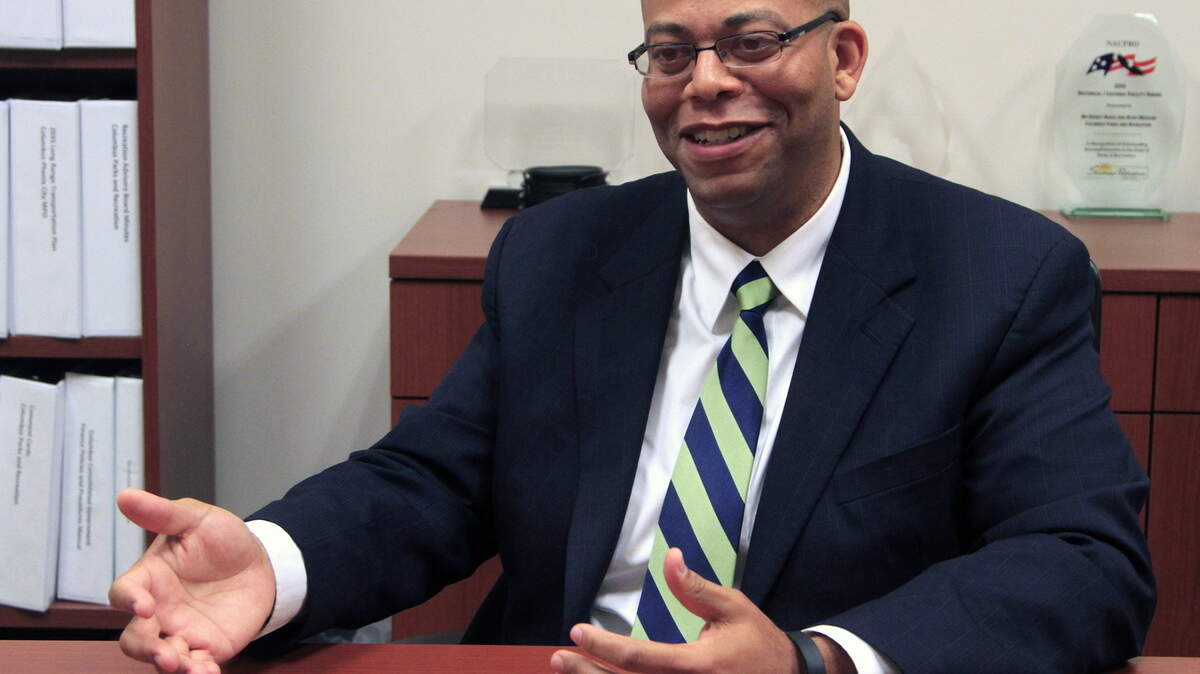
James Worsley took the reins of the Columbus Parks and Recreation Department at a time when it was still reeling from a public financial scandal.
Now, more than four years later, his department has been named Agency of the Year by the Georgia Recreation and Parks Association for the second time.
Last week, the agency received more good news when the National Association of Intercollegiate Athletics announced that the Columbus Aquatics Center would host the 2016 and 2017 men's and women's swimming and diving national championships.
Prior to the announcement, Worsley sat down with reporter Alva James-Johnson and talked about his background, profession and what it's like managing one of the city's largest departments.
Here are excerpts from the interview, with the content and order of the questions edited slightly for length and clarity.
What was life like for you growing up?
I grew up on a farm. That was the first part of my life in Pinetops, N.C., prior to moving to Farmville. I grew up around a lot of older adults, and I think that's why a lot of people say, "Well, you're 37. You're young, but you seem to have an old spirit." ... I grew up in the church, with the hands of my grandmother being a mother at church, and my father is a pastor back home, as well. We grew up in what we call Primitive Baptists. ... It's very old school.
... I had a great admiration for my grandfather, who was a tobacco farmer in the Coastal Plain of North Carolina. It's really where I think I received a lot of my determination, work ethic, family values and principles, because of what I saw him do with little education outside of high school. ... Of course, I saw my own mother working very hard and working early on in life -- working in factories, like textile factories, and also waitressing at restaurants -- then going back to school late in life to get a degree. ... My father owns a business in drywall.
In addition to being a pastor?
In addition to being a pastor, yeah. I call him semi-retired at this point, but the bread and butter growing up was
definitely the drywall business to support myself and my other four siblings. There were five of us.
Was it tough being a pastor's kid?
I think it was tough for my other siblings more so than it was tough for me, because I was always accused of being the model kid. I'm the only one that left home. Everybody else lives in the area. I'm the only one that went away to college. ... I try to be a role model for my family because I'm the only one really that went on to get an advanced degree.
What motivated you to go to that extra level?
Intrinsic motivation, really. Coming up through elementary school on up through the ranks, there wasn't the one person that said, "You can do it. Go seek more." I always had the internal determination to want more out of life, whether it's being involved in (Future Business Leaders of America) or being involved in student government in high school. I always had the willpower and the want to do more. ... Moreover, as I grew older and knew I wanted a family of my own, I wanted to be able to be that role model for my own children so that they could say, "Hey, my dad did this."
I'm proud of my parents for what they did, for the resources that they had, and I think they gave each of the children what they could at a particular time. But I wanted to be able to do more than my family did for me. Just like I want my own children to be able to do more than what my wife and I are able to do for them.
How did you get into parks and recreation work?
I think the farm was my playground. And so I think all my life, I really have been in parks and recreation and didn't even know it -- from going outside and creating play with nature and with the livestock and with the animals on the farm. Really, that was parks and recreation at its very -- I guess -- bare minimum. Then I fell into parks and recreation from what would be considered the professional or the commercial side.
I actually went to school to be a teacher. I was an elementary ed major in college, starting out with a scholarship to be an elementary ed teacher. At the University of North Carolina at Greensboro, you student-taught your sophomore and your senior years. I started student teaching my sophomore year and I realized, "You know, I don't necessarily want to be a full-time teacher. I enjoy working with the children, but I want to do something else outside these four walls." So I started to talk to some people on campus and found out about therapy recreation -- one of my friends was telling me about it at dinner one night.
What is therapy recreation?
Basically, therapy recreation is using recreation and helping people with disabilities to have a better life in terms of being displaced with recreation. For example, now you have a lot of people that come back as veterans from service and they can't do some of the same things they used to because of, maybe, amputations and so forth, or some of the stress disorders. Well, we have the opportunities as ... certified therapy recreation specialists, to work with those people as therapists to get them back into the modalities of being able to work as they were before -- with adaptations, of course. I am certified still as a therapist. ... That was my initial placement in the recreation field. Then it really grew from there. ... I worked with older adults in long-term care and mental health, (as well as) youths with autism. ... After some of those things is when I went into parks and recreation in Mecklenburg County back in 2003 and really got the public sector side of what it was like to work in municipalities of county government. I started out there working as a homeless coordinator building programs for the homeless community.
You earned a Ph.D. by age 33. How did you manage to do that with so many things going on?
By the grace of God and the help of having a strong advocate at home -- my wife -- because I was living in Charlotte (N.C.) and commuted to Greensboro two to three days a week. The travel time was about an hour and a half going one way. I went to school year-round for three years, and during my travels and working there, I had a very, very strong support system at work, too, because I worked full-time.
... I also went to Malawi, Africa, and spent the summer there, while I had been doing some training with the teacher leadership (program.) ... What I found very interesting (is that) the concept of recreation and leisure did not exist for those Malawian children because many of them are working by the time they can really walk and do things for themselves. They're taking care of another child, with literally the baby on the back, because Mom may have died or Dad may have died from diseases and so forth. Some of them may have to work the market. So we did a lot of those things, then took that research and presented it later in Madrid, Spain, at an international conference the same year. It was a wonderful experience.
Why, as someone that runs a parks and recreation department, do you still consider it important to wear a suit and tie every day?
... Sometimes directors and management staff of the parks and recreation profession have gotten the stereotype of being jocks or gym rats. I've heard those terms used throughout my profession. ... Many people, oftentimes, only see us playing basketball or coaching, and all those (things) are great and make up the Parks and Recreation Department. But it's not the only thing that we do. ... Yes, we're coaches. And, yes, some of the staff play basketball. But you have the business mind. You have parks and recreation directors with MBAs, and they have multi-million dollar budgets that they have to oversee.
Your department recently received an "Agency of the Year" award from the Georgia Recreation and Parks Association. So how does it feel to be the top agency in the state?
We're excited about that. I must pause and say that it would not have been possible without the team approach. We have so many valuable people that work in Parks and Recreation here in Columbus that really make it possible, so it's not just the director that won the award. ... This is actually our second time winning that same award within the last three years. We won that award in 2013 as well. Also, that state conference, we hosted it in 2013. This year we won it, but also at that particular conference that was held in Dalton, we won the bid to host the conference to come back to Columbus, Ga., in 2017, which is a big deal. Of course, that brings economic impact back to the city, as well with heads and beds and the ability to bring people in and showcase the great things we have in Columbus, Ga.
What is it about this parks and rec department that you think is so unique?
We are far enough from Atlanta to have our own destination, being on the banks of the Chattahoochee River, and having so many unique elements from food and culture to music and dance. You look at Uptown Columbus ... at some of the private entities like the whitewater or the zipline. In a parks and recreation department, you combine all those things to make Columbus itself unique.
The Columbus Parks and Recreation Department is unique within itself because we do things well, and we are some of the only people in town that do some of these things, like we have 24 after-school programs in 24 elementary schools. We're in four middle schools for before-school programs. Being able to work and train and provide services to so many people is a great opportunity for our staff, as well as the customers that we service.
Let's talk a little bit about your coming to Columbus, because I'm sure you are very well aware that the situation wasn't the best prior to you being here. There had been a big scandal involving an elite basketball program.
That's right.
Your predecessor, Tony Adams, had just been convicted of a felony and two other employees were also convicted of crimes concerning a private bank account where public money was being placed. What was it like coming into a situation like that?
I did know about the situation prior to coming, so it wasn't like I came in blind. For me, coming in as a new director to Columbus was an opportunity to open a new chapter for myself, as well as for the people that live and work here. Really, the pages were blank and you could take the department any direction it needed to go, and the direction it needed to go was up from where it was at that particular time.
For me, the emotions were joyous. The emotions were excitement for myself and my family. To be able to get in to do some assessing of the department was one of the things I wanted to do first and foremost, to assess what the situation really was about and listen to the staff, listen to the community. ... I think that helped make the success of the department by actually finding out who the stakeholders are in the city and in the department, internally and externally, and then adapting those changes from there, which really made us (excel) to where we are today being "Agency of the Year."
In doing your assessment when you first came, what did you find?
When I first came to the department, I think one of the things that I found was, one, that (morale) was low. That was one of the issues we wanted to make sure we could deal with. (And then) public perception and trust needed to be improved. ... One of the other things, I think, if I add a third, was adding more professional development to the resources and opportunities for staff to be able to take advantage of those.
How did you hear about the position?
(I was) coming to the conclusion of my Ph.D. work, and so I was in the market to either excel where I was or to start looking for new opportunities in other cities. Through research I found out about it searching for director positions, and it came up in my search.
Did you find it difficult to re-establish the community's trust in the department?
I thought that it would take a little bit longer than it actually did just because (I am) new to the area, and people don't really know me. Me being a people's person, (I marinated) myself in the community through church. I'm a member of Greater Shady Grove Missionary Baptist Church right here on Second Avenue, and started meeting with some of these stakeholders, like going to public meetings or meeting with groups like Rotary and presenting and those types of things, really letting the community know and get a taste for who James Worsley is and the professionalism that I bring to the city.
What has been your biggest challenge?
Well, I think myself and my staff, we may always have more ideas, innovative concepts, than we have funding for. So our bank account may not necessarily float all our ideas that we have.
How is the department different now to what it was when you first came?
I think the department is different in terms of a couple of different things. From a staff perspective, I think people are ... more engaged in their jobs and have opportunities for more professional growth and development. ... Even from an internal perspective, I think trust in the department has improved.
My understanding is that under Tony Adams there was very much an athletics-only focus. It seems you've expanded into some of the cultural areas, arts and that sort of thing. Has it been a deliberate attempt on your part to expand beyond athletics?
... Although it appeared that the focus prior to my arrival was on athletics, the staff that worked in these other areas were still here. They were doing their jobs, and quite well, and so it was just a matter of where the perceptions lie. Now, I think with the leadership style that we have here, and the people that sit around our boardroom table, everybody has an equal place at the table to bring in and generate ideas.
One of the big projects that has occurred since you've been here is the Aquatics Center, which has had some management problems.
That's correct.
Can you explain what went wrong with that project?
Sure. The Aquatics Center is a 57,000 square foot facility. It's a phenomenal location. ... It has the capacity to seat about 900 folks and has two bodies of water. One is an Olympic-style pool, and then the second body is a therapeutic pool. ... Back when the facility was first built, we hired a management company to manage the facility. Unfortunately, the management company that we hired did not live up to the standards and expectations that we had as a city government and the standards that we had as a department, so we had to let that company go effectively April 27, I believe, of this year.
... In a transitional period, we've stepped in and have been operating it since April 28, about seven months. All staff that work there are Parks and Recreation employees. ... Last Tuesday, I believe it was, I presented to city council what some different models will look like in terms of, one, if we go with another management company, and then various operational hours that we could potentially look at in terms of what the affordability would be based on what the budget is for that location.
Do you think that the Parks and Recreation Department here in Columbus is equipped to handle a facility of that magnitude?
Based on what we have now, we're asking that Council take a look at the company that we presented at Council last Tuesday. ... If the council favors that the Parks and Recreation Department take the facility and maintain it outside of the interim basis, and on a full-time basis, we are asking for the resources that are dedicated to go along with that.
What's the name of the company that you're recommending?
Well, we haven't said yet. I can't say because it's a part of the purchasing process. When we present it at Council, we just present it to them as Company A, so that's what we did. None of the information or details of the purchasing process have been shared yet based on the procurement procedures.
How is the department doing financially?
I think the department is well financially in comparison to some of the other places across the nation. Our budget for the department is about $11.4 million. We're in budget fiscal year '16 at this point, and so we're going to just continue to make smart decisions and be fiscal about the monies that we have here and work with our team within our budget. That is our goal: Work within the resources that we have.
What has been the public reaction to the department raising fees?
Last budget season we did a little fee raising. For example, on Cooper Creek, some of the fees went up there. Most fees went up that had to do with adults' usage, but not youth usage. ... We didn't really have an adverse effect to it. People continue to pay, which we're very pleased about. Actually, I've heard people say, "I think it might be time to even increase fees a little bit more," particularly if we go through the budget year and we see that we might need to do that. That might be something we might need to discuss a little bit further as we go into the next budget cycle.
How many employees?
Roughly, full-time, we have about 101 full-time employees and add to that about 250 part-time employees. I'll be conservative by saying that, because we add even more part-time employees when the summer comes for lifeguarding and some of our summer camp programs.
What about facilities?
As far as recreation centers, we have eight recreation centers. We have four senior centers. We have a multitude of tennis courts, but the largest tennis facility, of course, is at Cooper Creek Tennis Center, which has 30 courts. Two Mondays ago now, we had the groundbreaking ceremony for the new tennis court expansion at Cooper Creek, which we're very excited about. Hopefully that facility will be ready to open in August 2016, if all goes well. That is a public-private partnership between the city, Columbus State University and CORTA. ... We have several, I would say, highlight facilities like South Commons, where you have the softball. Golden Park. A lot of people don't know we have boxing, but we have a boxing facility, Haygood Gym. ... There are a lot of amenities here. You're talking about maybe 52 parks, and we have a dog park in the south end of town near Fort Benning.
Are you getting the level of users that you would like?
Oh, yes. ...I think our facilities are very, very well used.
This story was originally published December 5, 2015 at 12:15 AM with the headline "Sunday Interview with James Worsley: 'I always had the internal determination to want more out of life'."