
National Teacher of the Year, nearly quit after career’s 1st semester, urges educators to be constructive storytellers
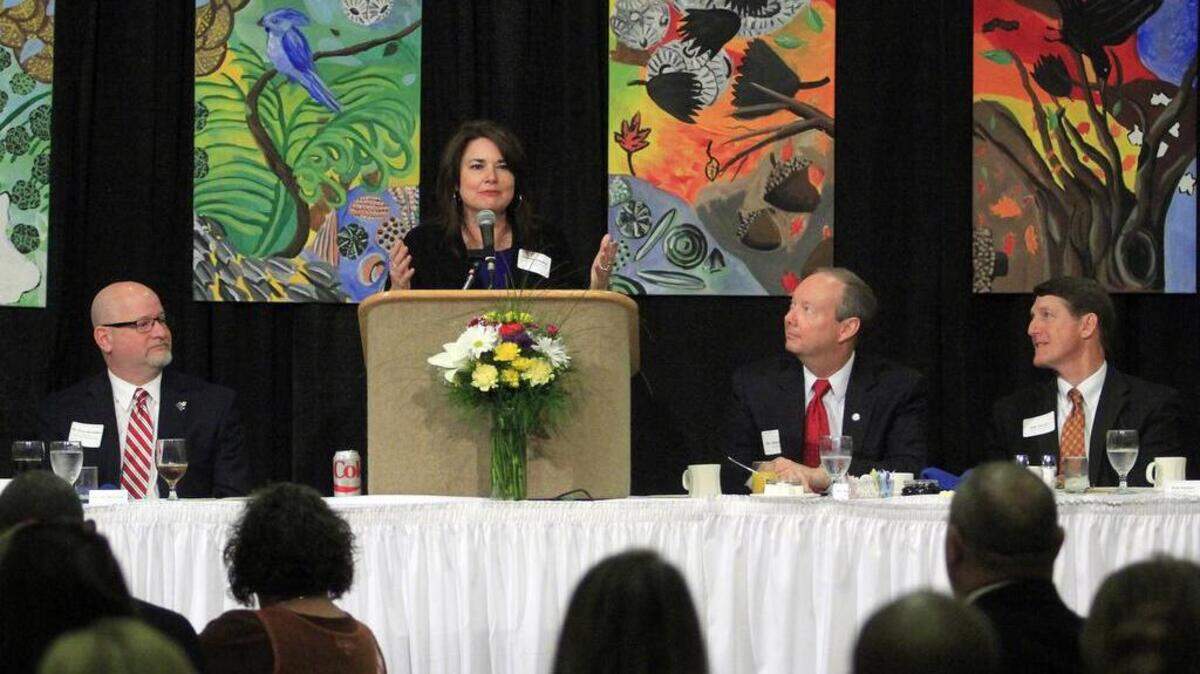
The 2015 National Teacher of the Year wants her fellow educators to advocate for their students by being constructive storytellers.
“Your stories are a political decision in that who you decide to speak about is who you are deciding to speak for,” Shanna Peeples, an English teacher and instructional coach at Palo Duro High School in Amarillo, Texas, told the 56 Muscogee County School District 2016 Teacher of the Year nominees and their scores of supporters during her speech Tuesday morning in the Columbus Convention & Trade Center.
“Your children need you to speak for them,” Peeples continued. “They need you to do what only you can do. I didn’t think I could do it either two years ago, when I was sitting at my (school district’s) Teacher of the Year breakfast. I thought, ‘There’s no way I can do this. This scares me to death.’ And then I remembered who I’m speaking for. If I don’t tell their story, somebody else is going to tell their story, and they’re not going to tell it in the way I want it to be told.”
Since she was named the National Teacher of the Year in April, Peeples has traveled more than 110,000 miles to more than 300 speaking engagements, including the Middle East. Wherever she has gone, she said, too many of education’s storytellers never have taught in a classroom.
“When you tell your story, you are pushing back on a very powerful, well-funded negative narrative,” she told the teachers. “But there is no power like a teacher’s story. Your story is what’s going to stick.”
Then, on Super Tuesday, when 13 states, including Georgia and Alabama, conducted presidential primary elections, she added a not-so-veiled criticism of the prevailing discourse.
Particularly this year, fear is a very potent weapon being used at all levels of our society, because it’s cheap and it’s easy. Anybody can do it. Anyone can tell a ghost story. Anybody can tell a story about everything going wrong. That’s easy. It’s hard to be a creator.
Shanna Peeples
2015 National Teacher of the Year“Particularly this year, fear is a very potent weapon being used at all levels of our society, because it’s cheap and it’s easy,” she said. “Anybody can do it. Anyone can tell a ghost story. Anybody can tell a story about everything going wrong. That’s easy. It’s hard to be a creator.”
Teachers are creators, Peeples said, because “we believe that things can get better. We have to be – or we can’t do this job. In a very real sense, we know that hope can be created, and hope is not just a nice word. It is a very real, concrete thing that we build, day by day, child by child, in our classrooms, and that’s what’s amazing about you.”
Also amazing about Peeples is that this National Teacher of the Year nearly quit after her first semester. But she gave herself hope by giving her students hope. And she did it by sharing her story with them.
Peeples, 50, is in her 14th year as a professional teacher. She was a journalist covering education for the Amarillo Globe-News when she felt compelled to teach instead of write about it.
As a seventh-grade English teacher at Horace Mann Middle School, an impoverished community where she was the only white person in her unruly classroom, she cried when she called her former editor and lamented, “I think I made a terrible mistake.”
She couldn’t connect with her students because they didn’t trust her. They didn’t trust her because they didn’t know she understood them and they didn’t know she cared about them. So they failed her tests and she failed theirs.
“They’re going to push you to see if you’re going to leave like everybody else,” she told the Ledger-Enquirer in an interview after her speech. “They’re going to make it hell on you to see how tough you are.”
During the Christmas break that year, while some of her colleagues quit, she realized she saw a reflection of herself in her students – and she needed to tell them.
“We have similar backgrounds,” she said. “My own trauma, my own sense of growing up poor and in a domestic-violence household could be mitigated by helping these children. So when I say I want them to read and write their way out of where they are, it’s because I read and wrote my way out of where I was.”
As a result, she created her motivation to stay. Instead of allowing her students to view her as a middle-aged white woman who couldn’t have a clue about their experience, she gave them a chance to see her compassion for them.
“I told them I was basically white trash with good grammar,” she said with a laugh, then added in a serious tone, “I got real with them, not in an inappropriate way, which is a fine line, but in this way: ‘I understand when nobody in your family has made it to college. We’re asking you to go to the moon when nobody in your family ever went outside the town.’ That’s super scary, so I can speak to that fear. I was terrified all the time. I realized all the aggression I was seeing (in her classroom) was fear-based. … So, challenge accepted. You’re not going to run me off.”
Here are excerpts from the Q&A the Ledger-Enquirer conducted with Peeples, edited for clarity:
With your national platform, what issue or policy change are you advocating the most?
“I am advocate for students in poverty because I’m an advocate for teachers, and the majority of us now teach children in poverty. It’s sort of a shameful statistic that we have reached now. … When I started out my year, I thought I would focus on something completely different about poverty, but I began to realize that poverty is this huge abstraction, and people tune it out. You’ve got to bring it down to a level that people understand, so began to think about what I used to do as a journalist, which is to put a face on this abstraction and tell these stories in a way that make people understand. Not necessarily in a way that robs our children of their dignity, but in a way that lets them know this is what we’re talking about when we’re talking about poverty. This is what it looks like when it shows up in the classroom, and this is how it’s going affect all of us.”
So what do you want people to know about poverty that you don’t think they understand?
“It’s all high and mighty and grand for us to say that we believe that every child can succeed. But what happens when they don’t? For example, the student I call Haley’s Comet because I’m going to see him only once in my lifetime makes me look very wonderful, but he was born in a hospital with no electricity in Vietnam, and I’m going to his graduation from Harvard. What do we lose when we write that kind of child off and we say, ‘Kids on that side of town, we don’t need to worry about them having advanced coursework and all that other stuff. They don’t want it anyway. They don’t know what to do with it. They’re just going to go to work in the slaughterhouse.’ … What do we lose when we don’t try to create real opportunities for these students, real pathways out of a life that is increasingly more and more desperate, and that desperation is going to spread out like ink in a pool to all of our community.”
Then what’s one opportunity or pathway that you’ve seen created and is working, maybe something that can be replicated elsewhere?
“If I’m going to boil it down to one thing, I think it’s that you trust your teachers. And I think that we have eroded trust in teachers, not only as professionals but as the brilliant problem solvers they have to be every day. I mean, that’s what you do as a teacher. I’ve never been so tired as when I switched over to teaching, because you make hundreds of decisions a day and you solve at least 10 problems before breakfast, before you even get to school.”
How have we eroded that trust?
“I think allowing people outside of education to define what it is and to put it in some sort of business terms. People are not a business. People can’t be standardized.”
You’re talking about standardized tests and state accountability measures?
“Sure, and you only have to look overseas to see what happens when you try to standardize an entire country. You get North Korea, and I don’t think that’s what we want.”
If you were a state superintendent, what would be your idea accountability system?
“One that’s created in partnership with teachers. I think that teachers want to be held accountable. Those of us doing good work want it to be recognized, and those of us who are missing the mark want help in getting better. So I don’t think any real professional doesn’t want accountability, but that’s not what we’re doing. It’s now punishment. … Three years ago was the first year that I took on the class of refugees (mostly from Burma but also other parts of Southeast Asia as well as East Africa) by myself. We did have them in a special class and I co-taught. It was the first time we brought them into a mainstream situation. I was their teacher. It also was the first year that I taught AP English. … Many (of the refugees were) straight from the camps, where they’d never really been in school. But they all had to take the same test for graduation. My AP students took this test and blew the doors off of it. It was the first time in my career as a teacher that I felt like a success because 100 percent of my kids passed and killed it, I mean at high-achieving levels. Then there were my refugee students, and none of them passed. When you factored them in with the scores of my brilliant students, I was the worst teacher on the campus, with the highest failure rate. So which one am I? Am I the best teacher or the worst teacher, and what are you making that decision upon? I’m not even good at math – I’m an English teacher – but I can pretty much make this probability: Who you teach and where you teach says a lot about what your scores are going to be.”
So the evaluation of the teacher should be based on what?
“Based on what a child can do with what they know. Our standardized tests, I’m not saying throw them all out, because we need them for licensure and things like that, but those tests don’t tell us what a child can do with what they know. The world doesn’t care about what you know anymore. I can go on YouTube and fix my dishwasher with a video. I think it should be about looking at each of those children and not viewing in a deficit model of here’s everything they can’t do based on this one set of standards. We’re discounting a whole host of literacies that they come with and a whole host of abilities and talent that are not being valued. In Texas we have this irony. As we’ve pushed for everybody needs to go to college, now we’re in a real crisis: We don’t have enough welders. (Laughs.) We forgot that somebody needs to do this concrete work that they’re quite suited and talented for. I’m always amazed when I call the electricians or plumbers to my house, and I think, ‘I couldn’t have figured out that problem.’ We don’t value that, and those kids know it. They come to school and they know who they are and what they know isn’t valued. They know their chances are better to drop out and pressure-wash cattle trucks for 15 bucks an hour, and that’s a loss to our community because we could have had a taxpaying electrician right there or a physical therapy assistant. … Your measure of success is what you’re going to frame your curriculum around and your vision around, and if it’s framed around this very narrow definition of success, not many people can fit in that. It’s like the one-size fits all rack at Walmart; it’s not going to work.”
When you talk about showing what students do know and their different literacies, do you mean giving them a pre-test in the fall and a post-test in the spring and then evaluate the teacher based on how much the students have improved, regardless of where they started?
“Yeah, I think that’s definitely fair. My first year of teaching, I had a student who had been hit by a car when he was 6 years old, so he had some pretty profound neurological issues and he could barely write his name at the beginning of the year, yet he was maintstreamed into my class of seventh-graders. By the end of the year, he could write paragraph. To me, that’s success. Now, on our test, he’s going to fail it every year, even the special-ed test.”
Do you know of any states doing it that way?
“Yes, actually, the New England (Secondary) School Consortium, and particularly New Hampshire, is going to what they call competency-based learning. … Basically, it’s like looking at each child on a personalized, individualized basis and looking at the standards and holding to really high standards but judging them by performance on maybe national-normed tests like SAT and ACT rather than theses eight bajillion state tests that we have. Then you look at a portfolio of their work, based on their abilities that have been refined. ... Children can do so much more than what we expect out of them, but if all we’re expecting you to do is sit still so you can bubble-in a test, that’s where I think we go backwards, because our edge as America has always been our ability to create and innovate. Bubbling-in a test is not creation and innovation.”
How do we attract more teachers to the profession, teachers like you who didn’t grow up thinking they would be teachers but could be excellent ones?
“The good news is that our Millennial generation is gigantic, and they’re the most idealistic generation, based on their numbers of volunteerism, and teaching is the perfect for them. But they’ve heard this message of (teachers) being demoralized across the country, so we have to show them that, in a very real sense: If you want to serve your country, be a teacher; if you want a life of spiritual purpose and meaning, be a teacher; if you just want a crazy, interesting life, be a teacher, because it’s amazing.”
How do we better retain teachers?
“We have to create these hybrid positions like mine that allow a teacher/coach to work with teachers who are struggling and the new teachers, to really be there for them on a case-by-case basis, like we would for children. … My school was able to do it with no extra money. They didn’t have to hire somebody. It was just a willingness to take on an extra responsibility, and there are plenty of teachers too.”
Your scheduled allowed you to do that, right?
“Yes, they played with time. They didn’t spend more money to do that. And they turned over this idea of inquiry to small groups of teachers and said, ‘Y’all identify a problem in your practice, study it, roll it out, iterate a solution and keep working on this.’ That’s how we developed real change, and it came from trusting teachers to do this.”
It was professional development at no cost during the school day?
“Yes, we did it once a week. Schools have a PLC, a professional learning community, where you meet in a grade-level team. … What it cost was to reframe your thinking and to trust your teachers, because no consultant is ever going to love the kids like we do, and no software is ever going to look in their eyes and know their background and know how to motivate them. Yet we spend $90,000 on a cart of iPads, thinking that’s going to solve this problem. It’s not. It’s a human problem. And only humans can solve it.”
Mark Rice: 706-576-6272, @markricele
This story was originally published March 1, 2016 at 6:18 PM with the headline "National Teacher of the Year, nearly quit after career’s 1st semester, urges educators to be constructive storytellers."