
Female Ranger School graduates paved the way for combat decision
Secretary of Defense Ash Carter said from the Pentagon on Thursday that all combat jobs across the military will be open to qualified women beginning next year.
That decision will impact U.S. installations such as Fort Benning, the home of the Infantry and Armor as well as the often-deployed 75th Ranger Regiment.
Carter said there would be no quotas and the jobs would be open to qualified military personnel.
Carter's order will let women serve in the military's most grueling and difficult jobs, including special operations forces such as the Army Delta units and Navy SEALs, according to the Defense official. Qualified women will also be eligible to serve in the 75th Ranger Regiment.
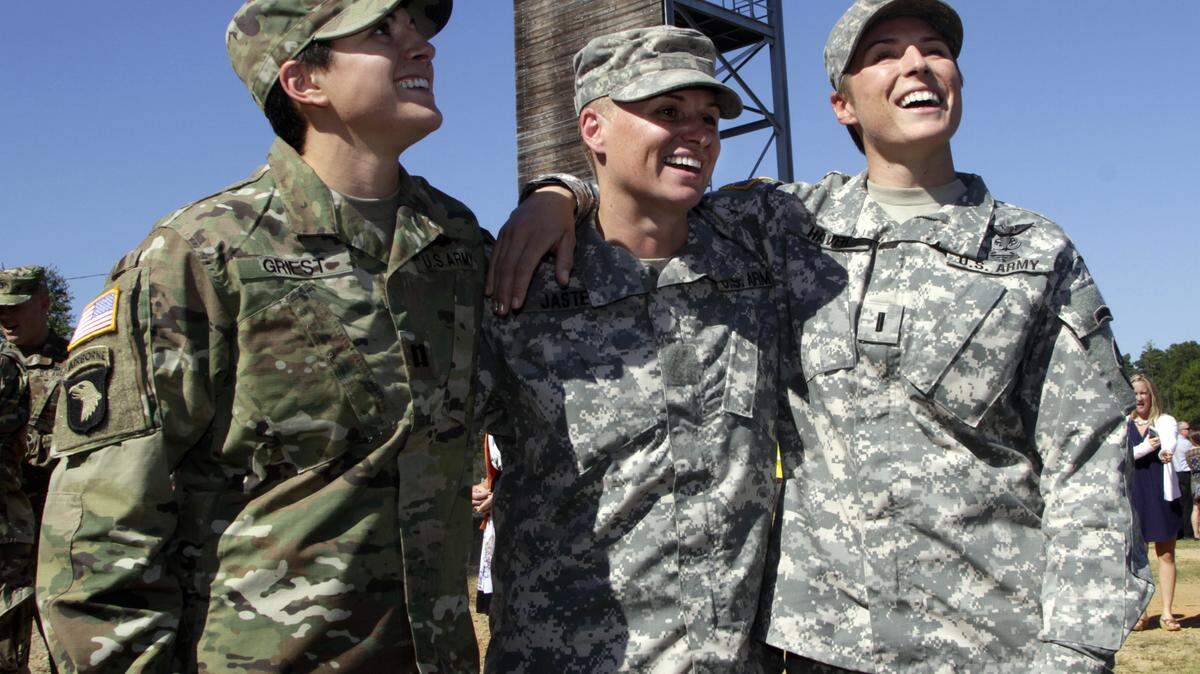
The decision comes after three women — Capt. Kristen Griest, 1st Lt. Shaye Haver and Maj. Lisa Jaster — passed U.S. Army Ranger School earlier this year.
Jaster, a 2000 West Point graduate and Army Reservist assigned to a unit in Huntsville, Ala., said Thursday she was not surprised by Carter’s decision.
“I do believe the Ranger School integrated class was testing an existing hypothesis,” Jaster said.
The fact that three women passed surely factored into the historic decision, said Sue Fulton, the chairperson of the U.S. Military Academy Board of Visitors, on Thursday.
“There's no way that this would have happened today without the Army Ranger School,” said Fulton, who graduated in 1980 in the first co-ed class at West Point. “Without Capt. Griest, Lt. Haver, and Maj. Jaster making the grade, there might still be lingering questions about the capability of women. The fact is that not all women are capable — but many are, and some of those are more capable than the men around them. Getting the best soldiers for the fight means you don't automatically disqualify half the population.”
That was something that Carter pointed to in making the historic announcement.
Right now, women are prohibited from holding roughly 10 percent of military jobs, including some infantry, reconnaissance and special operations posts, Carter said in his briefing.
"We cannot afford to cut ourselves off from half the country's talent and skills," Carter said.
Retired Command Sgt. Maj. Dennis Smith spent 26 and a half years in the Army was deployed 11 times as part of the Global War on Terror.
“I have never looked at it like that before,” Smith said. “But it makes sense. You have half the talent and you have 10 percent of the jobs that are closed, it makes sense to open the pool. But it will come with a lot of growing pains.”
The way the decision is carried out matters, Jaster said.
“I think the next 30 days will be critical to the successful implementation of this decision,” Jaster said. “We must be fair and deliberate as we move forward to ensure an integration that is as seamless as possible for impacted units.”
Retired Maj. Gen. Kenneth Leuer was charged in 1973 with assembling the first battalion of what has now become the 75th Ranger Regiment. The commanding general at Fort Benning from 1987 to 1988, he said the order will change some things but that tomorrow will be “business as usual.”
“I thought it was inevitable at some point,” Leuer said. “It started in the early ’80s when they opened up jump school (Airborne School) and some of the other schools to women. I really don’t think it will have any real impact. This will be just fine.”
Leuer said the numbers of women entering the combat arms positions will be small, initially.
“I don’t think you are going to have trouble counting the number of women in those positions at first,” Leuer said. “I do not think women will be rushing into the combat arms, but they will be there. And if they meet the standard, that is OK by me.”
Leuer would offer specific advice for the men currently in those units who will now be serving beside the women.
“My counsel to them would be take care of themselves,” Leuer said. “Do the professional soldier thing and assist the others in your unit in building the best team you can possibly build.”
Smith put it another way.
“Anybody who is a professional has to adapt to the changes that are in front of them,” Smith said. “If they can’t, they need to leave.”
Congressman Sanford D. Bishop Jr. said he supported the decision.
“Historically, lack of access to combat jobs limited upward mobility for women," Bishop said. "I support the decision to grant equal opportunity for male and female service members, as long as our troops are trained, equipped, and qualified for the mission.”
Retired Command Sgt. Maj. Matt Walker, who now works in a civilian role at Fort Benning, said he favored the decision to allow women into Ranger School but has concerns about Carter’s order to integrate combat arms.
“I don’t necessarily agree,” said Walker, who spent 30 months in combat as part of the 75th Ranger Regiment. “Let me couch it this way: It’s pretty specific that only qualified individuals have the opportunity to compete for the positions. In any way, shape or form, it says some women will be in these (Military Occupational Specialties). I don’t feel that close combat environment — the small unit jobs — having women in those jobs will be beneficial.”
Walker points to what soldiers are asked to do in those situations.
“The job of the Infantry is to close ranks with and destroy the enemy — kill them,” he said. “It is difficult physically and mentally. It takes a different mindset. We play the only real full-contact sport in the world — war. You win now or you don’t.”
Fort Benning spokesman Bob Purtiman referred all inquiries to the Department of the Army.
— McClatchy national correspondent Tony Pugh contributed to this report.
This story was originally published December 3, 2015 at 4:24 PM with the headline "Female Ranger School graduates paved the way for combat decision."