
A Georgia high schooler saw a need for an interstate. His fight helped bring it to Senate
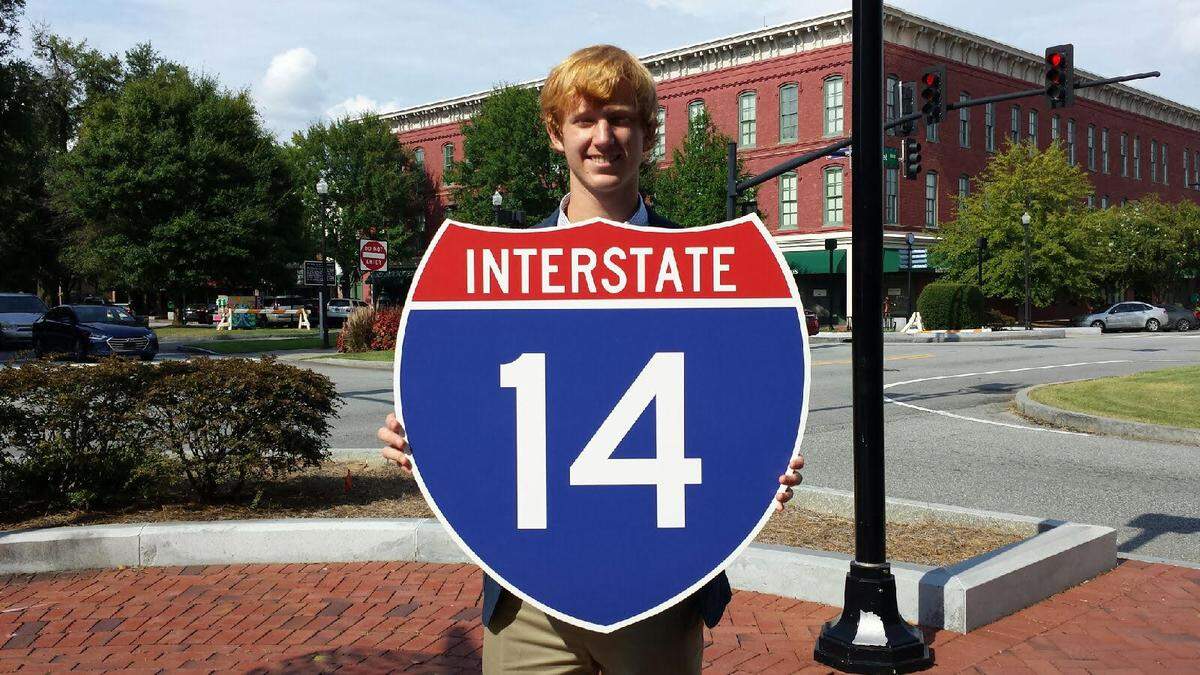
If an interstate makes its way through Columbus, Macon and Augusta, it will be in part thanks to the efforts of Frank Lumpkin IV.
The 23-year-old, second-year University of Georgia law student began lobbying city leaders in Columbus about Interstate 14 as a high schooler in 2017. Four years later, he’d spend a month in Washington D.C., making the same pitch to U.S. Senators.
Georgia Sen. Raphael Warnock and Texas Sen. Ted Cruz added an amendment to the $1 trillion infrastructure bill making portions of the proposed route, including the Georgia leg, a high priority corridor. The bill passed the Senate and is now awaiting approval in the House of Representatives before being signed into law by President Joe Biden.
Similar I-14 language made its way into the House’s INVEST act, meaning the interstate proposal will reach Biden’s desk one way or another.
For Frank the IV, it’s an unreal feeling. He’s the latest in a long line of Lumpkins who’ve advocated for his hometown and the state of Georgia for generations.
“We’ve all just wanted to make Columbus a better place because of the people,” he said. “The people are who made us who we are.”
How Lumpkin got involved with I-14
Lumpkin stumbled upon the I-14 project as an upperclassman at Columbus High School. He was getting his pilot’s license and working on a research paper regarding airports and economic development when he said he began to realize how disconnected Columbus was from the rest of the nation’s infrastructure.
The interstate idea began to develop when Lumpkin participated in the Youth Leadership Columbus program. Teresa Tomlinson, then Columbus’ mayor, spoke during one of the group’s meetings, posing a variety of questions to the students.
One of those questions was: ‘What is holding Columbus back?’ Lumpkin’s mind immediately went to infrastructure. He mentioned the airports and another infrastructure project he’d stumbled across in his research, Interstate 14.
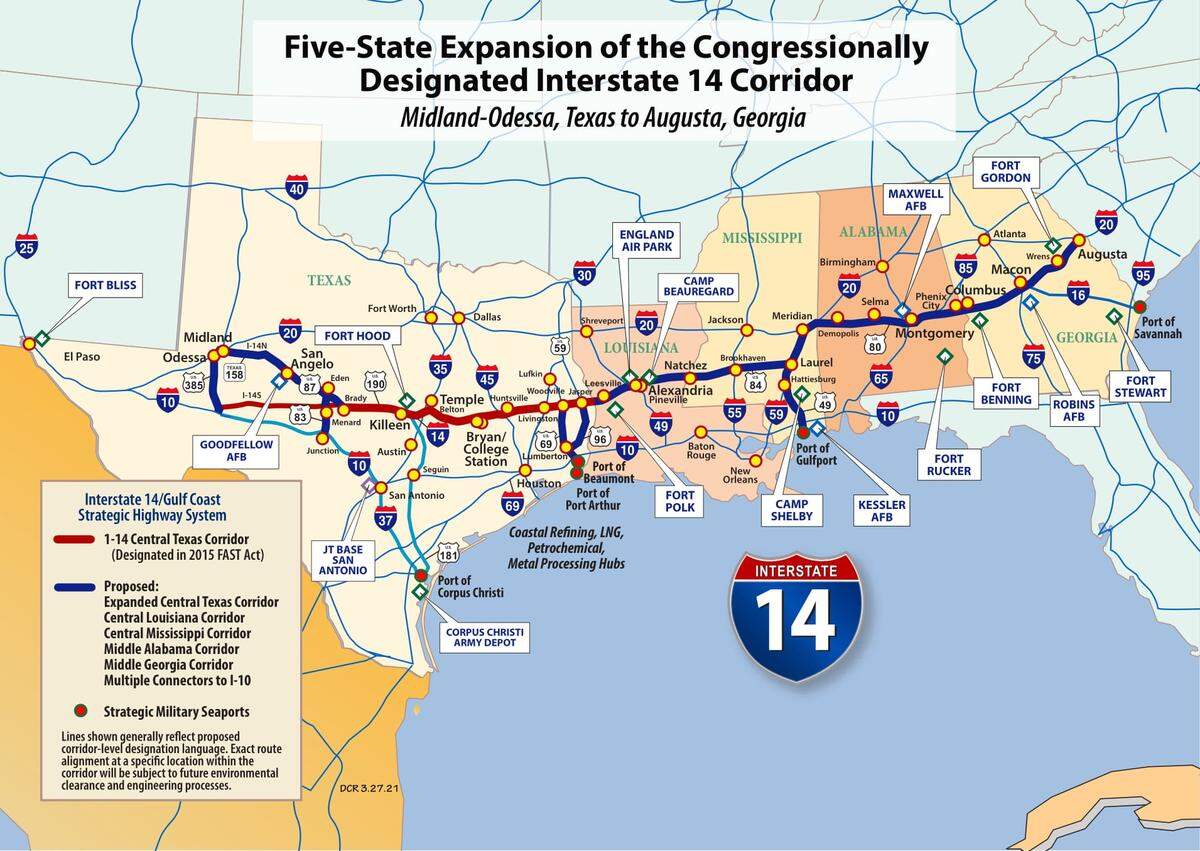
The route would cut through central portions of Texas, Mississippi, Louisiana and Alabama before reaching Georgia. The Columbus to Macon to Augusta leg would connect three of the state’s largest cities and two major military installations — Fort Benning and Fort Gordon. Much of the interstate would be built from existing highways.
The idea was first proposed in 2005. U.S. Rep. Charlie Norwood as well as U.S. Sens. Saxby Chambliss and Johnny Isakson, all Georgia Republicans, led early efforts to study the roadway.
Tomlinson was impressed with Lumpkin’s response, and it led to Lumpkin making his pitch before the Columbus Council.
The first stretch of I-14 in central Texas near Fort Hood opened in January 2017, about nine months before Lumpkin made his pitch to city councilors. Columbus leaders voted to add Lumpkin’s I-14 proposal to the city’s 2018 state legislative agenda.
“He saw this opportunity for Columbus,” Tomlinson told the Ledger-Enquirer. “And where those older and more experienced had given up hope of I-14 actually happening, Frank’s enthusiasm and natural leadership ability only let him see that it was possible.”
Lumpkin, by that time an undergrad at the University of Georgia, reached out to a Texas I-14 group that recommended the young man build up grassroots support for the interstate.
That’s when Lumpkin joined friends Justus Armstrong, Carsen Storey and later, Laura Leigh Haga, to form the Youth Infrastructure Coalition, an I-14 lobbying body, and began making presentations to governments along the proposed route in Alabama and Georgia.
“There’s so many ways to kill a law, and one of the easiest is an angry constituent,” Lumpkin said. “A lot of times, people are angered not because you’re necessarily doing something unjust to them. ... But because you’re doing something that you didn’t inform them properly about.”
Resolutions of support started to trickle in but not quickly enough. That’s when the group followed the advice of one of Lumpkin’s mentors and produced a video in 2018 explaining the I-14 concept. Things started to pick up.
“It made national news,” Lumpkin said. “It was on Fox News and the US News and World Report and in headlines across the United States.”
The pursuit of support from councils, state legislatures, metropolitan planning organizations, federal highways administration, transportation departments and congressional members who represent residents in the path of the proposed interstate took four years, culminating with its inclusion in two federal infrastructure bills.
I-14 in Congress
The push to get I-14 language in Congressional infrastructure bills started for Lumpkin in the summer of 2020. The Georgia law student worked remotely as an intern for U.S. Rep. Drew Ferguson’s office. The congressman’s district includes portions of northern Columbus and its suburbs.
In his off time, Lumpkin pushed for I-14. Texas Republican Brian Babin planned to introduce a language in the Moving Forward Act that would take I-14 from Texas to the Mississippi/Alabama border. Lumpkin wanted to add Georgia and Alabama to the bill.
“I like to call that the most stressful week of my life,” he said.
He was initially told no by another I-14 lobbying group. But Democrats controlled the House, and the bill needed Democratic sponsors to pass. There were only two Democrats on the previously proposed route — Alabama’s Terri Sewell and Georgia’s Sanford Bishop. Bishop’s district includes portions of Macon and Columbus.
Wanting to see the proposal pass, a deal was struck. But there would be another obstacle.
Lumpkin got a text during a D.C. committee meeting that the provision was about to fail. It had to come off the table until they got support from all of the proper governing bodies along the entire route. The group was missing a few they needed, and they had one week.
The Youth Infrastructure Coalition and the Gulf Coast Strategic Highway Coalition, a sister organization that supports the creation of I-14 through Texas, Louisiana and Mississippi, started making calls to hit the deadline.
After Lumpkin tried every contact he had to get the deal done, the Georgia Department of Transportation gave their support one hour before the deadline.
The 116th Congress ended Jan. 3, 2021 with no movement made on I-14. But Lumpkin continued his lobbying efforts, interning with Austin, Texas-based firm Hance Scarborough in Washington D.C. this summer.
Portions of the Moving Forward Act ended up forming the INVEST Act, the House’s version of the recently passed infrastructure bill, Lumpkin said. So, the I-14 language transferred over to the new House bill.
Lumpkin already made contact with Sens. Warnock and Jon Ossoff shortly after their victories in early 2021 to talk about the project. As the infrastructure debate continued, Lumpkin and others began to hear that the House’s bill wouldn’t be the final version. Getting in the Senate bill became key.
“This isn’t something we tried to throw in here at the last minute. This is something that we have bipartisan support on that we could get in the bill,” Lumpkin said.
Warnock, along with Sen. Cruz (R-TX), proposed the I-14 amendment. It was approved by a voice vote with no objections.
The amendment tied no money to the project, but clears a path for the proposed roadway, Warnock told reporters earlier this month.
The hard work had paid off.
“I truly cannot believe that we have come so far,” Lumpkin said. “It blows my mind that a 19-year-old with a dream could join together with some friends and really make a huge difference in the community.”
What’s next for Lumpkin and I-14?
I-14 is still a ways off.
The $1 trillion infrastructure bill must pass the House, and Biden must sign the bill into law. For Lumpkin and his group, the next steps are focusing their efforts on Alabama and Georgia’s transportation departments.
“We have to make the case to GDOT that this is a top priority and they need to fund it,” he said. “We’ll slowly over 10, 20, 30 years build this thing all the way across the United States.”
What awaits Lumpkin beyond law school? He’s not sure, but the current path lines up with the family legacy.
The courtroom and politics are a possibility. His great-great-great-grandfather, Joseph Henry Lumpkin, served as the first chief justice of Georgia. Joseph’s brother, Wilson, was a Georgia governor, a congressman and a U.S. Senator.
Frank the IV’s great-grandfather was part of the group that advocated for the Dixie Overland Highway — now known as Highway 80 — to come through Columbus. His grandfather wanted to see Interstate 85 come through Columbus, but it wasn’t meant to be.
The younger Lumpkin doesn’t want the opportunity to pass Columbus by once again.
“Columbus is in the vision I have for my future and I do want to come back home eventually,” he said.
This story was originally published August 20, 2021 at 6:00 AM with the headline "A Georgia high schooler saw a need for an interstate. His fight helped bring it to Senate."