LaKeith Stanfield initially didn’t want to be ‘Judas’ in new Black Panthers film
Back when LaKeith Stanfieldwas a teenager growing up in Victorville, Calif., about an hour-and-a-half northeast of Los Angeles, he would print out photos of people he looked up to and put them on the walls of his bedroom.
One of those heroes, Stanfield remembers, was the late Fred Hampton, who served as chairman of the Illinois chapter of the Black Panther Party as well as its national deputy chairman until Chicago police fatally shot him in 1969 during a highly controversial early-morning raid.
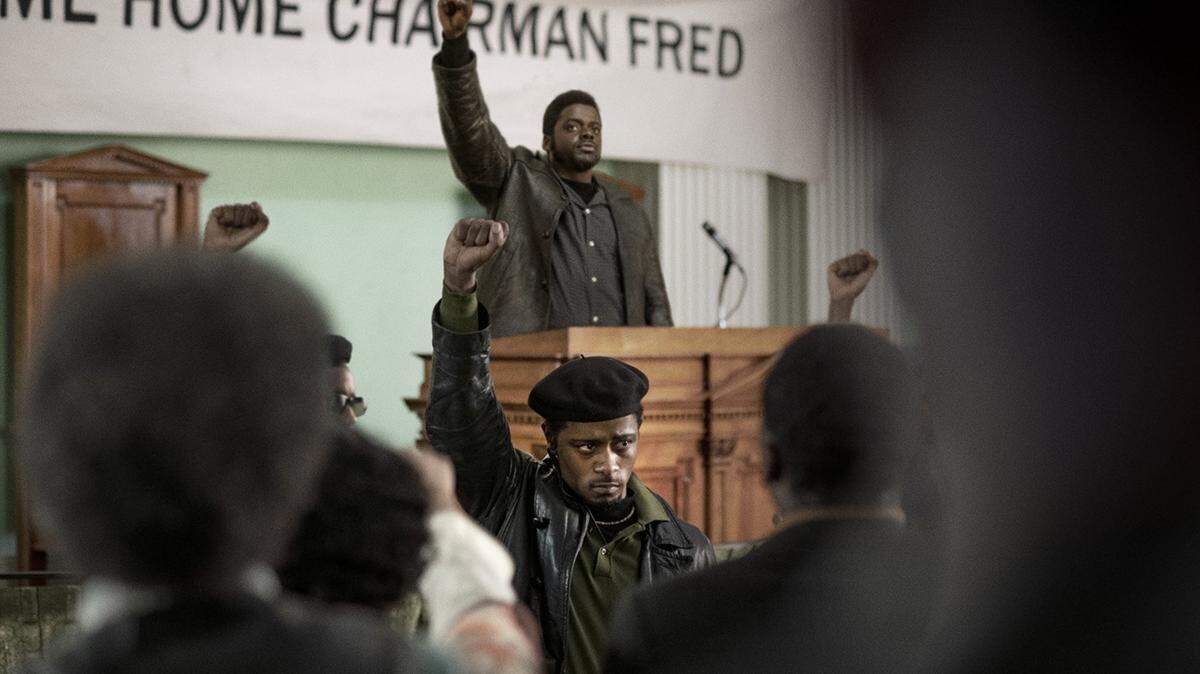
So when filmmaker Shaka King came to him in 2019 with his idea for a based-on-a-true-story historical drama about Hampton, Stanfield was immediately interested. That film is “Judas and the Black Messiah,” which will be released Friday in theaters and on HBO Max.
“As an actor, I wanted to do work that was meaningful,” says Stanfield, who was coming off of playing a detective in Rian Johnson’s whodunit “Knives Out” and previously played key roles in films that have commented heavily on race (including “Straight Outta Compton” in 2015 and “Get Out” in 2017).
“So ... I was very excited and told Shaka ... that I couldn’t wait to play Chairman Fred Hampton and ‘I just can’t wait to get into his speeches.’ He’s like, ‘Wait, wait, wait, wait. We want you to play, uh, William O’Neal.’ I’m like, ‘What? Why??’”
Stanfield is chuckling as he talks. But he’s not completely joking.
He had some general awareness of O’Neal’s role in Hampton’s life, and what he knew was that O’Neal was the undercover FBI informant who had betrayed Hampton — a betrayal that led to Hampton’s death.
“I saw that snippet that everyone sees in that documentary,” Stanfield says, referring to PBS’s “Eyes on the Prize II” interview in 1989 with O’Neal. “But that’s pretty much all I’d known, and from that I was just like, I (expletive) hate this guy. So that’s all I knew.
“I just didn’t think I would ever want or be able to play him. And it was a scary thing. But after reading it a couple times and thinking about it more deeply, I thought it could be a unique opportunity to approach this story in a unique way in terms of a biography. Also, that it could be challenging for me to go against my own code of ethics and morals and to try and take on this character.”
The result is “Judas and the Black Messiah,” which premiered at this year’s Sundance Film Festival and has been a part of the 2021 awards season conversation — although the actor who wound up portraying Hampton is so far the one receiving more notices.
That would be Daniel Kaluuya, the 31-year-old British actor best known for roles in 2018’s “Black Panther” and 2015’s “Sicario,” as well as his Oscar-nominated work in “Get Out,” as a young Black man who finds himself in an increasingly horrific situation while visiting the family of his white girlfriend.
The Observer recently had separate conversations with Stanfield and Kaluuya about “Judas and the Black Messiah,” shortly after Kaluuya learned that he had been nominated for Best Actor by both the Golden Globes and the Screen Actors Guild. Their comments — lightly edited for clarity — are woven together below.
Q. Before you were tapped for this role — before you knew this movie existed — how well-versed were you in the history of the Black Panthers?
Stanfield: Prior, I’d done research in my teenage years about the Black Panthers. I was very curious about what they were. Think we might have skimmed over them in high school for a split second, but it didn’t feel like enough, so I went home, did some research and inevitably came across the Illinois chapter of the Black Panther Party. Eldridge Cleaver (an early leader of the Black Panther Party) and all of these different people, and Chairman Fred Hampton. And so it prompted me to go look up his speeches. At the time, when I was in school, Google was up and running, so I used Google and looked up a lot of his speeches and I was just taken away with it. ... I loved it.
Kaluuya: Knew quite a bit about the Black Panthers. Read a couple books. Watched a couple documentaries. Had a couple conversations in my late teens and just was exposed to it a little bit through just living my life organically. But I always knew that I wanted to take a really deep dive. I mean, I read this book (about the Black Panther Party), in 2016, 2017, just for me. I was just reading it, just for life. And so I can see that I was heading in that direction — like in my free time I would go dip in and then I’d do a job and then dip in again.
Q. How did making the movie change those perceptions you had about the Black Panthers?
Kaluuya: I don’t think it changed. I think it deepened. I think I was more illuminated, with more pathways to understanding more of the truth. ... I was really clear about just how much they loved their own. How much they loved the Black community. And how much they poured into the Black community, and wanted to give them the tools to liberate themselves. With the medical clinic for the sick, with the breakfast program to feed the kids, and educating the kids.
Q. “Judas and the Black Messiah” feels incredibly authentic. How historically accurate would you say it is, based on what you know. And how determined was Shaka King to get it right?
Kaluuya: It was so important. That’s why 18 months before the shoot, they had some meetings with the Hampton family. I mean, we were having meetings with the family for like a year leading up to it, before the shoot. We kept them in the conversation. ... We were feeling like it wasn’t right to not have them involved.
And when they became involved as consultants, with Chairman Fred (Hampton) Jr. being on set the majority of the days, it really helped to enrich the scene with the truth. (Hampton’s only child is president and chairman of the Prisoners of Conscience Committee and the Black Panther Party Cubs.) ... It’s a narrative, and there’s details that you’d love to put in but you can’t because of the pace and the narrative. But they really made sure that we stayed honest about this — about Chairman Fred’s story.
Stanfield: Hmm. ... I don’t know exactly know every single detail of what’s authentic or not. But I can say from what I know, it’s pretty, pretty authentic. And we try to stay as much to the reality of what happened as possible.
Obviously, when you’re making a movie, there are some things that must be granted in terms of the format and how to actually create a story on screen. There are some things that can’t be exactly verbatim and word for word. For example ... there might be some of the rival gangs ... that we didn’t use in the movie just because we didn’t want to implicate the actual gang. ... Just so that no one was directly pointed out in the conflict.
But there are things like the speeches, which are actually his real word-for-word speeches. Chairman Fred Hampton Jr. helped us be able to tell the story from that perspective — and a lot of the real people are represented in the film, like Jake Winters (who was killed the month before Hampton, in a separate shootout with police). These are real people that lived and that were part of the Panthers. So yeah, we tried to stay as accurate as we could.
Q. Obviously it’s hard not to watch this movie and think about the social justice movement of 2020. Having been through the experience of making it — having this story of Fred Hampton seared into your brain — what were your thoughts and feelings as you watched what was going on with the Black Lives Matter movement last summer?
Stanfield: I just thought, “Wow.” We were in a group chat, all the people that helped make the film ... the principal cast and a couple others. So we’re all in a group chat and we were talking about, you know, “See, look what’s happening.” It just so happens that the film we made happens to line up with this stuff and we’re like, “Man, that’s crazy.” ...
But so much was happening in my real life, I didn’t really think about the movie that much. I was like, What is happening in the world? And trying to get a grasp on that and adjust, and help my family adjust. So that was my preoccupation. And then engaging just an internal dialogue and meditation and trying to just be silent in myself, and spend that time as a unique opportunity to be able to reflect.
Kaluuya: You can really see that people are feeling what this film, and these people, were articulating. ... People don’t have the words for it ... but Chairman Fred had the words. Not only the words, he had the strategies. To help in times like these. So I’m so blessed that this film’s coming out at this time.
Stanfield: Timing’s good. Yeah. Unfortunately. It’s perfect timing. Because a lot of things haven’t changed. And I think we’re starting to see that. But yeah, it just so happens that timing’s great for this kind of movie. People will be able to connect and identify. So that’s a really good thing, actually.
Q. LaKeith, how did you come around to feeling like you could connect with the character of William O’Neal, having initially felt so much hatred toward him? (O’Neal, the “Judas” of the title, was facing felony charges but the FBI agreed to drop them after he successfully infiltrated the Black Panther Party as a teenager and ultimately provided information that helped the Chicago police in the raid that killed Hampton.)
Stanfield: Well, for one I had the long-form version of the (“Eyes on the Prize II”) interview. I found access to that. Which is over an hour long. ... It gives a little bit more context into the guy. And in which interview, by the way, he said, “I felt bad about what I did, but I had to continue to play the role.” I was like, Oh, he felt bad about it. Interesting. And then he explained how he tried to come up with things that were bad about Fred to give to the FBI, but he couldn’t come up with them. He’s like, “The guy was a good guy.”
And so it indicates to me that he must have appreciated that, and he must have appreciated at least some of the rhetoric that Hampton was speaking about. He realized very early on that the Black Panther Party wasn’t actually a terrorist organization, that they were talking about feeding kids and stuff. So my interpretation was that he had to struggle with his connection to the party and to Chairman Fred Hampton, and his allegiance to the FBI. ...
You know, once we conspire to deceive, a tangled web we weave. He started off doing little things ... OK, I’ll supply this information here, this information there. And it got to a point where it snowballed and he ended up being in a situation where now he had to make a really tough decision. And it’s really not a decision. You either do this, or you’re done. And so he had to do it.
Q. What are the thoughts or the feeling that you most hope audiences take away from the movie?
Kaluuya: I don’t want to influence what it is, and what it isn’t. I find that really exciting to find out what they felt about it, so I get to learn about it more, and we have a conversation.
Stanfield: I hope they just bring an open mind. I hope to be able to present Chairman Fred Hampton to people who don’t know who he is and what his legacy was about. And the Black Panther Party, and show them in a more accurate light than they might have seen before. And I hope people walk away with the question of “Who am I more adjacent with in my decision-making process?” A person like Chairman Fred Hampton? A person like William O’Neill? Or somewhere in between?
This story was originally published February 8, 2021 at 4:08 PM with the headline "LaKeith Stanfield initially didn’t want to be ‘Judas’ in new Black Panthers film."