
Rotary Club of Columbus remembers history of giving as it celebrates 100th year of service
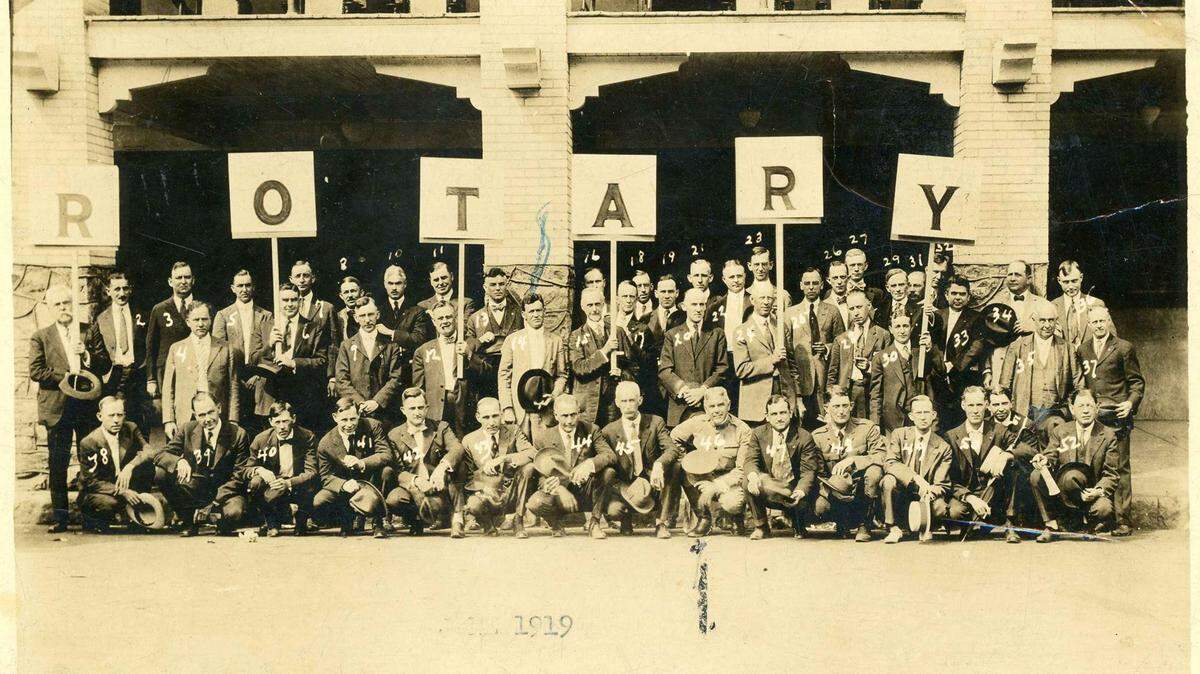
There was not a candlestick maker in the room, but there was a butcher and a baker along with an undertaker and a Baptist preacher from the historic church across the street.
Fourteen city leaders dined together that Monday afternoon in 1915 at the sparkling new Ralston Hotel. After lunch they discussed the mechanics of seeking a charter from a civic club that was just establishing itself on the American landscape.
By the time they adjourned, they had elected a president and a board of directors and voted to petition the Rotary Club in Birmingham to charter them as the organization's 200th chapter. A hundred years later, the Rotary Club of Columbus is the 34th largest chapter in the world with nearly 350 members.
"We have a meaningful, deep history and our members embrace that history," said Michael Silverstein, the club's 100th president. "It is important to us to remember the club's history of giving. We have always had a membership that wants to heal and repair the world."
Such things were far in the future when those forgotten men shared a meal at the Ralston. At the time, Rotary, founded by attorney Paul Harris in Chicago in 1905, was new and growing.
From the beginning, Rotarians were leaders, not followers, and among their early objectives were the exchange of modern business ideas and the promotion of honorable methods in trade.
Charter members were charged a $10 entrance fee and dues were $12 a year and could be paid in $6 increments. A $5 assessment was collected from each member to cover costs of the charter application.
The 20 original members were merchants, manufacturers, men from the legal and medical field, a seed man and a soft drink bottler. But they did not elect a moneychanger as their first leader. They turned to the Rev. Luther Rice Christie of the First Baptist Church of Columbus.
Christie made many decisions during his term but none was more lasting than his suggestion that a blessing be asked before every meal -- a tradition that continues today.
A few weeks ago, the Rev. Jimmy Elder -- who stands in that same pulpit -- talked to Rotarians about the club's deeper meanings, reminding them that Rotary is built on service above self. Elder understands, for 96 years after Christie held the gavel, he presided at the club's weekly meetings.
Christie had been at First Baptist since 1909 and he left an imprint in the hearts and minds of the community. Friends in the club called him "Doc," and when he left the city in 1917 to join the faculty at Shorter College in Rome, Ga., a Rotary resolution praised him as a good mixer.
"He was prominent in all matters -- intellectual, spiritual and civic -- and among all classes he was popular and influential," wrote G. Gunby Jordan, the primary author of the resolution.
A symbiotic relationship
The club has ventured into many landmark projects in the past 100 years, but none has paid more dividends than its role in the decision to locate Fort Benning on the outskirts of Columbus.
"It's not a legend," Silverstein said. "It's a fact."
Minutes show that on May 10, 1917, Rotarian J.E. Chancellor, knowing the Army was planning to build 12 new camps, made a motion to request that one of them be built in Columbus.
A committee composed of J.W. Key, Harry L. Williams and M.R. Flournoy was appointed and by fall they joined other groups in Washington to lobby for the local camp.
Once the decision was made, Rotary led the movement to name the camp for Confederate Army Gen. Henry Benning, a local lawyer who served under Gen. Robert E. Lee. A resolution adopted by the club called Benning "a splendid example of patriotic citizenship."
"Rotary had an impact and the consequences have been great for our community," Silverstein said. "For Rotarians, it has been a symbiotic relationship that we cherish."
As early as 1918, Col. Henry Eames was a member. Future commanders followed his lead and joined the club. Today several former Fort Benning commandants are members.
Every Wednesday, an active duty soldier is presented to the membership and Silverstein's job is to remind that young man or woman how much the club appreciates their service.
Honored soldiers receive a gift bag that includes an inscribed copy of an inspiring book by Col. Ralph Puckett -- a heroic U.S. Army Ranger and longtime Rotarian. Silverstein said Puckett's table at Rotary is known as "Fort Puckett, and that most people who sit there "have worn the uniform."
Early Rotarians were interested in more than the military. They fought for more playgrounds, a Big Brother program to support poor children, improved rail service and construction of a landing place for what club records called aeroplanes.
Members supported minor league baseball and helped secure the annual Auburn-Georgia football game at Memorial Stadium, an event that continued here until 1959. They also gave birth to four other clubs, including East Columbus Rotary in 1965 and Muscogee Rotary in 1991.
For decades Rotary International and the local club have been involved in the worldwide struggle against polio. Clubs have donated $2.5 billion and more than 1.5 billion children have been immunized.
The Rotary Club of Columbus is always generous. "Members have 100 years of philanthropy," Silverstein said. "We have a history of giving."
To underscore that tradition, every member is a Paul Harris Fellow, which means they have accounted for a $1,000 donation to the Rotary Foundation. More than a million local dollars has been raised for the foundation over the years.
That original group would be proud.
Keys to history
L.R. Christie led the club during its first year and the lineup of presidents that followed is impressive. It even includes a Methodist minister. The Rev. Pierce Harris served at St. Luke -- the Baptist minister's next-door neighbor.
Along the way there were mayors, state senators, bank presidents, retired Army officers, school administrators, judges and other names found in local history books.
In 2003, Carole Rutland of Columbus State University was the first woman to lead the club followed in seven years by Betsy Covington of the Columbus Foundation. Elizabeth Barker of the Historic Columbus Foundation is president-elect. The first African American to serve as president was Superior Court Judge John Allen in 2012.
But behind those past presidents is a story best told by the Key family. For nearly a century, they have been important players in the business arena, not to mention local golf courses.
Retired real estate executive Jack B. Key III was president in 1997-1998. He joined in 1984, but he hung around Rotary functions before he could walk. He followed a family tradition that goes back to the founding of the club.
James B. Key, his great-grandfather, was the club's sixth president, serving in 1920-1921. He wasn't a charter member but he joined within a few months.
Harry L. Williams, his grandfather's father-in law, was president in 1921-1922.
Jack B. Key Sr., his grandfather, was president in 1935-1936.
James W. "Billy" Key, his uncle, was president in 1965-1966 and was the youngest in the history of the club.
Jack B. Key Jr., his father, was president in 1976-1977.
In addition to that family tree, his mother's father was the Rotary president in Bay Minnette, Ala., and family members used to make up meetings on the Alabama coast.
His father and his Uncle Billy were dominant performers in amateur golf since their teens and they continued to support the game they loved. They were also devoted Rotarians.
Jack B. Key Jr. died Feb. 7. He was 88. At the time of his death, he had more than 50 years of perfect attendance at Rotary -- more than anyone in a club that values attendance.
And by the way, Jack III has 30 years.
"As a family, we're proud of that tradition. Rotary has meant a lot to our family. When I became president, an article was written about a club that had four generations serve as president. What that really showed was the stability of a club that has endured for that many years," Jack III said.
The Rotary Club of Columbus has endured. A powerful group of charter members set the stage for what was to come and Silverstein does not intend to lose the momentum of 100 years.
A gala ball will be held Feb. 25 marking that significant anniversary. Leaders from Rotary International and regional directors will join the local guests.
An Indiana native who has lived here 31 years, Silverstein talks wistfully about three former presidents coming to talk him about being president.
"It was Nov. 6, 2013, I still remember the date. The three Rotarians were Dr. Carole Rutland, Judge John Allen and Robert George. They wanted to be sure that I understood the significance of this position," he said.
Being in charge of a club the size of Rotary is a challenge. Being on stage for 52 Wednesday meetings is taxing. The fact that he would be the 100th president in club history only added to the impact.
"I truly believe it is the greatest civic honor a person can receive. I know it is the greatest gift I have ever received.
ROTARY AT A GLANCE
Presidents
L. R. Christie, 1915-16
C. A. Johnson, 1916-17
Dan Joseph, 1917-18
J. Homer Dimon, 1918-19
G. Gunby Jordan, 1919-20
James B. Key, 1920-21
Harry L. Williams, 1921-22
A. Howard Bickerstaff, 1922-23
Charles M. Woolfolk, 1923-24
Paul K. McKenney Sr., 1924-25
Laurens H. Crowell, 1925-26
George B. Philips, 1926-27
Abe Illges, 1927-28
Josiah Flournoy, 1928-29
James H. McDuffie, 1929-30
Milo B. Clason, 1930-31
H. Dixon Smith, 1931-32
Frank H. Naylor, 1932-33
Pierce Harris, 1933-34
Charles W. Weeks, 1934-35
Jack B. Key, Sr., 1935-36
Knowles D. White, 1936-37
Carl C. Colbert, 1937-38
Maynard R. Ashworth, 1938-39
Theo G. Reeves, 1939-40
J. Quentin Davidson, 1940-41
Tom B. Sloan, 1941-42
Paul Munro, 1942-43
W. C. Pease Jr., 1943-44
Fred H. Schomburg Sr., 1944-45
Joe W. Blackmon, 1945-46
M. G. Murray, Jr., 1946-47
Bryan W. Collier, 1947-48
J. Arthur Lynch, 1948-49
Clifford J. Swift Jr., 1949-50
Ralph I. King, 1950-51
John R. Kinnett Sr., 1951-52
George S. Murray, 1952-54
Rupert A. Triplitt, 1954-55
Henry Y. Reeves, 1955-56
Frank W. Thompson, 1956-57
Hugh McMath, 1957-58
Oscar L. Betts Jr., 1958-59
R. L. Rudolph, 1959-60
Novel R. Boyd Sr., 1960-61
Henry B. Pease, 1961-62
J. Tom Morgan, 1962-63
William H. Zimmerman, 1963-64
William T. Miller, 1964-65
James W. "Billy" Key, 1965-66
I. W. Gregory Jr., 1966-67
J. Dan Reed, 1967-68
Lee Henkel Jr., 1968-69
T.A. Hamby Jr.,1969-70
Harry C. Jackson, 1970-71
Jac H. Rothschild, 1971-72
J. Steverson Knight, 1972-73
Wilson M. Camp, 1973-74
Jacob L. Riley Jr.,1974-75
George C. Trussell, 1975-76
Jack B. Key Jr., 1976-77
Lovick P. Corn, 1977-78
Louis T. Kunze, 1978-79
Edward W. Neal, 1979-80
W. E. Gross Jr., 1980-81
Thomas B. Buck Jr., 1981-82
E. H. "Bud" Ruffner, 1982-83
Mathews D. Swift, 1983-84
J. Norman Pease, 1984-85
Otis B. Burnham, 1985-86
T. Earl Taylor, 1986-87
J. Thomas King, Jr., 1987-88
William J. Cunningham, 1988-89
Michael N. Herndon, 1989-90
Brown Nicholson Jr., 1990-91
Robert George, 1991-92
Frank Brown, 1992-93
William J. Smith, 1993-94
Thomas Flowers, 1994-95
Ben Williams Jr., 1995-96
Dan Parker, 1996-97
Jack Key III, 1997-98
Ronald E. King, 1998-99
J. Ronald Mullins, 1999-00
Philip T. Schley, 2000-01
Cecil M. Cheves, 2001-02
Joey Loudermilk, 2002-03
Carole Rutland, 2003-04
George G. Flowers, 2004-05
J. Edward Sprouse, 2005-06
George E. Wade III, 2006-07
Carmen Cavezza, 2007-08
Mallon Faircloth, 2008-09
J. Robert Jones, 2009-10
Betsy Covington, 2010-11
Jimmy Elder, 2011-12
John D. Allen, 2012-13
Greg Camp, 2013-14
Ryan Clements, 2014-15
Michael Silverstein, 2015-16
Charter Members 1915
G.C. Shackleford, Retail Druggist; J.B. Everidge, Baker; L.C. Wells, Industrial Insurance; W.W. McKenzie, Life Insurance; C.P. Bush, Hardware; C.L. Torbett, Undertaker; R.J. Crane, Retail Grocer; Howell Hollis, Attorney; C.A. Johnson, Hotel.
P.R. Puckett, Office Supplies; J.C. Smith, Seedman; L.R. Christie, Minister; C.E. Lorenz, Osteopath; J.F. Pou, Coal Dealer; Dan Joseph, Broker; C.A. Sears, Soft Drink Manufacturer; James Johnson, Theater; Hans Mozwn, Telephone; Thomas W. Peters, Light & Power; L.L. Dozier, Telegraph.
Founding Officers
L.R. Christie -- President
C.A. Johnson -- 1st VP
Hans Mozen -- 2nd VP
Thomas W. Peters -- Secretary
L.C. Wells -- Treasurer
P.R. Puckett -- Sgt. At Arms
Board of Directors -- J.R. Everidge, C.A. Sears, Howell Hollis, J.F. Pou, J.C. Smith, C.E. Lorenz, W.W. McKenzie, R.J. Crane, and Dan Joseph.
Rotary Comes to Georgia
Rotary Club of Atlanta -- 1913; Rotary Club of Augusta -- 1914; Rotary Club of Savannah -- 1914; Rotary Club of Columbus -- 1915; Rotary Club of Marietta -- 1919.
This story was originally published February 20, 2016 at 9:34 PM with the headline "Rotary Club of Columbus remembers history of giving as it celebrates 100th year of service ."