
‘This reduces risk,’ Aflac CFO says of alliance and Japan Post’s large stock purchase
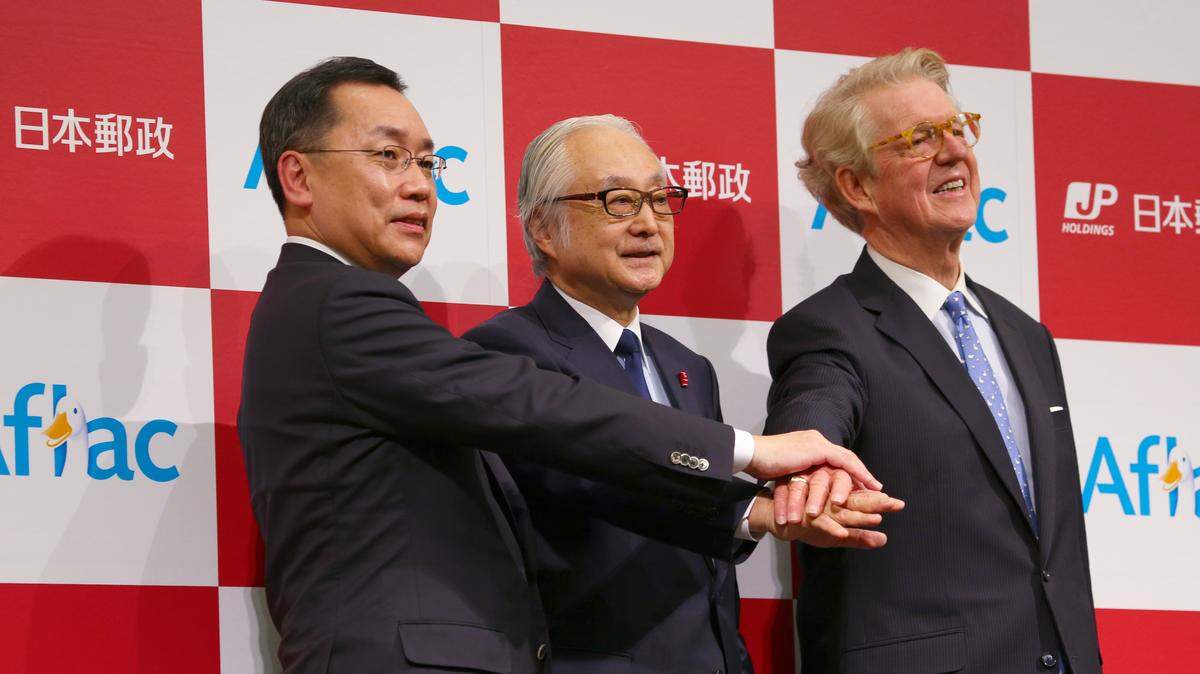
A decade after establishing a relationship in which Japan Post Holdings began selling Aflac insurance policies in its post offices throughout the Asian nation, the two on Wednesday took their connection to a higher and — what they hope to become — much more profitable level.
Aflac Inc., which is headquartered in Columbus, and Tokyo-based Japan Post Holdings — which is 60 percent owned by the government there — unveiled a strategic alliance in which the Japanese entity will purchase a significant amount of Aflac common stock over about a year’s time.
They both also will work to increase awareness of cancer and the need for insurance protection, while also exploring ways to develop new products and digital technology with an eye toward possible global business expansion.
“Since initially forming our partnership with Japan Post Holdings in 2008, we have enjoyed continuing to develop our alliance with Japan Post Holdings and its subsidiaries,” Aflac Chairman and Chief Executive Officer Dan Amos said Wednesday in a statement. “Together we have paid claims and benefits in excess of 13 billion (yen) on cancer policies sold by Japan Post Holdings’ subsidiaries since the inception of our alliance. We look forward to continuing this relationship in a way that benefits both companies and their stakeholders.”
The nuts and bolts of the alliance include Japan Post Holdings pumping about $2.6 billion into the purchase of up to 7 percent of Aflac’s common stock in the open market, making it a very large minority-interest investor in the American company that does about 80 percent of its business in Japan. That stock ownership will come with limits on the power Japan Post can wield with those shares.
Aflac Chief Financial Officer Fred Crawford, in an interview with the Ledger-Enquirer, laid out why this move makes sense for the firm founded in 1955 in Columbus by the three late Amos brothers — John, Paul and Bill — with Dan Amos, the son of Paul. Amos, who became CEO in 1990 and chairman in 2001, also was at the helm for the creation of the popular Aflac duck advertising campaign that has propelled the firm’s financial fortunes upward.
For shareholders and investors concerned about the possible risks associated with such an alliance that allows the deep-pocketed Japan Post Holdings to get a foothold within Aflac’s stock ownership, Crawford said there is nothing to be concerned about with the transaction.
“This really reduces risk,” the CFO said. “What I mean by that is it really provides for the security, commitment and longevity of a very important distribution relationship for us in Japan. Without this type of alliance, there’s not as thick of a relationship. It also reduces risk in that both parties are aligned economically. We’re obviously trying to manufacture and sell (insurance) product that meets the consumers’ needs and meets the policyholders’ needs, but it does it in a way that generates profits and value for our shareholders.”
Restrictions are part of Japan Post’s shareholder agreement
There also are safeguards being put in place for the alliance, which is subject to regulatory approvals both in Japan and in the United States. For Aflac, that includes getting the go-ahead from regulators in the states where it is officially domiciled, including its primary regulator in Nebraska, and in New York, where it has set up a global investment operation.
Crawford said those approvals are expected to be completed in the second half of 2019. The boards of directors of both Aflac and Japan Post Holdings approved of the alliance and its details on Wednesday.
“Having said that, we feel comfortable and confident that we can get those approvals, particularly because of the financial strength of both parties,” he said. “Both parties are highly rated and highly respected, both in Japan and, of course, Aflac in the U.S. So we feel comfortable about moving forward.”
Details of the alliance include Japan Post Holdings — which is publicly traded despite the Japanese government’s 60-percent ownership — purchasing about 7 percent of Aflac’s common stock through a trust. There will be no additional Aflac stock issued at the time. Instead, the firm maintains that it expects to buy back between $1.3 billion and $1.7 billion in shares of its own stock in 2019.
“That’s very important to understand. This is in the open market,” Crawford said. “There’s nothing that’s been pre-arranged. We are not issuing any shares. There’s nothing dilutive. We’re not raising capital. They’re simply like any other institutional investor going out into the market and buying shares in the open market between willing buyers and willing sellers.”
Japan Post will not be able to vote on sensitive issues
That new shareholder relationship will come with an agreement, however, requiring Japan Post to hold the stock for four years before receiving 10-for-1 voting rights on matters pertaining to Aflac. Existing shareholders already can attain 10-for-1 voting rights. Furthermore, the voting rights of Japan Post Holdings are limited to no more than 20 percent, with “standstill” restrictions that prohibit it from voting on specific issues or influencing management of Aflac.
“Standstill provisions is just like it sounds,” the CFO said. “It means they’re required to stand still on certain sensitive issues. Most sensitive would be change in control issues. So any votes around change in control, mergers, acquisitions, a change of Aflac control, they are not allowed to vote.”
Crawford noted that a benefit to Japan Post achieving voting rights of 20 percent is that it gives the entity the ability to report a portion of Aflac’s financial results under what is called the “equity method of accounting.” That’s important for the Japanese conglomerate, which is looking to grow its own revenues steadily.
“Qualifying for equity method of accounting means that every quarter they can take 7 percent of our earnings, if you will, and consolidate it into their results,” he said. “The reason they want that is because that’s a way to take their investment and actually grow and align the growth rate of Aflac and the growth of our earnings and franchise with their financial results. … So you can imagine in four years both parties are eager and motivated or aligned to build the franchise and build the earnings.”
Renewed focus on cancer awareness and sales planned
A portion of the alliance that shouldn’t be overshadowed by the stock purchase is the plan by Japan Post and Aflac to focus on what Crawford called a “renewed commitment” to the current cancer insurance distribution operations between the two entities. Aflac insurance policies are sold through about 20,000 postal outlets and 76 sales offices operated by Japan Post.
That renewed commitment includes investments to help grow and expand sales of cancer insurance, while also promoting cancer awareness, education, screenings and other philanthropic efforts throughout Japan, said the CFO, who expects that effort to both help cancer policyholders deal better financially with their illnesses, while also bringing more business in insurance sales.
“The third major piece is really where we look to the future and expand the alliance,” Crawford said. “There are no specific plans around the expansion efforts, but the categories of expansion that we are entertaining include exploring collaboration on product development, exploring how we leverage digital technology for an improved customer experience, and then jointly explore domestic and overseas business expansion opportunities.”
Aflac’s chief financial officer said conversations on Wednesday’s announced strategic alliance began in late May, but intensified entering November as details were hammered out on terms and conditions, as well as Japan Post Holdings’ accounting goals and how it all would mesh to receive regulatory approvals without any major problems.
CFO says stock deal is ‘nothing out of the ordinary’
“This minority interest in our stock is nothing unusual, nothing out of the ordinary. What makes it different is it is toggled to a broader strategic alliance by both parties and it is wrapped in a shareholder agreement,” said Crawford, mentioning that a “leak” last week about the alliance by media in Japan caused a stir because it indicated Aflac might somehow be on its way to being partially owned and managed in some way by Japan Post. This is not that sort of arrangement at all, he said.
“Most importantly, this is really about the alliance,” the executive said. “This is all about securing and formalizing and aligning the economics of our alliance in Japan. What both parties are motivated to do is not around ownership control and oversight, it’s really around working together to build the alliance and build the growth rate of our mutual franchises in Japan.”
In Wednesday’s release on the alliance, Masatsugu Nagato, who is president and CEO of Japan Post Holdings, echoed that sentiment while also noting the bond that has developed between Japan Post and Aflac.
“Aflac Japan and Japan Post Holdings have established a strong relationship of trust as business partners over the years through the various initiatives regarding cancer insurance,” he said. “This strategic alliance aims to create sustained growth for both companies, and our investment in Aflac Incorporated reinforces our mutual economic interests.”
The Japan Post group is comprised of Japan Post Holdings and three operating subsidiaries — Japan Post Co., Ltd.; Japan Post Insurance Co., Ltd.; and Japan Post Bank Co., Ltd. The subsidiaries handle typical postal services, while also selling a variety of financial products in the post offices throughout Japan.
Aflac will be reporting its fourth quarter and full-year 2018 earnings on Jan. 31. For all of 2017, the company posted a profit, or net earnings, of $4.4 billion, or $10.96 per diluted share. That was up from $2.7 billion, or $6.46 per share, in 2016. The 2017 profit came on total revenues of $21.7 billion, down slightly from $22.6 billion in 2016.
This story was originally published December 19, 2018 at 7:05 PM.