Here’s how experts expect the economy to perform in Columbus and the state in 2023
Economists say the nation is likely to experience a short recession in 2023, but expect the strong labor market in Columbus and Georgia overall to withstand the downturn.
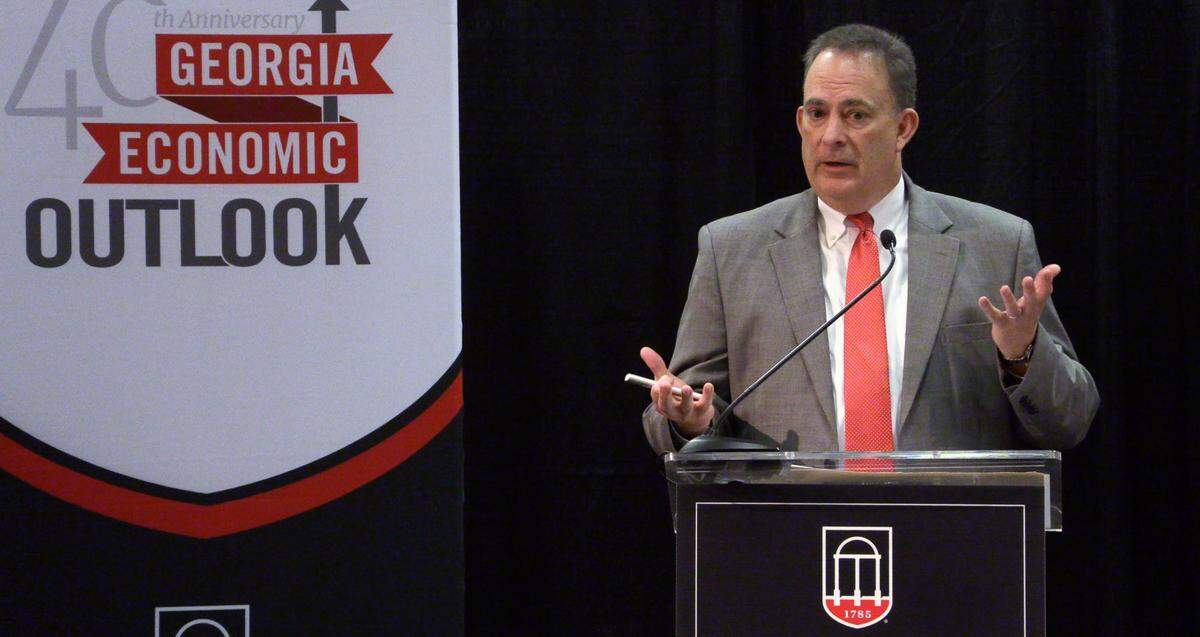
Business and civic leaders in Columbus attended the University of Georgia’s Economic Outlook Wednesday to hear the 2023 economic forecast for Georgia and the Columbus region.
Benjamin Ayers, dean of the Terry College of Business, delivered the state’s forecast while Jerald Mitchell, president and CEO of the Greater Columbus Chamber of Commerce, provided the forecast for the Columbus region.

Here are key takeaways from the economic report.
There is a 75% probability of recession
Economists predict a short, mild recession because of the rapid shift of the Federal Reserve’s monetary policy, energy prices and negative wealth effect or the decline in asset values such as stock prices.
The gross domestic product (GDP) in Georgia is not expected to decline as much as the nation’s, Ayers said. Georgia’s GDP is expected to decline 0.2% this year, while the nation’s is expected to decline 0.7%.
“It’s not a guarantee (there will be a recession),” Ayers said. “But we do think there is a high likelihood of a recession beginning this year in the second quarter.”
A strong labor market
There are four main reasons the recession will not be reminiscent of what happened in the Great Recession, Ayers said.
These include a strong labor market, industries rebounding from the pandemic, households’ balance sheets are in decent shape and the Federal Reserve’s dual mandate to stabilize prices and ensure full employment.
Development projects in Georgia are contributing to achieving a strong job market, including pet food manufacturer AFB International’s decision to build a new facility in Columbus which is creating more than 100 jobs.
Columbus has a larger than average proportion of Gen Z and Millennials, Mitchell said, which is a benefit for the city’s workforce. Additionally, Fort Benning is the largest employer in Georgia, he said, and accounts for over 20% of the region’s non-farm-related jobs.
Despite the positive aspects of Columbus’ labor force, Mitchell said, slowing population growth is a concern along with ensuring workers have the education necessary for the jobs available.
Housing market suffers the most
The housing market went into a recession in mid-2022, Ayers said.
“High mortgage rates, run up in home prices and low confidence in the economic situation unfortunately will prolong and steepen the housing downturn that began to take hold in 2022,” he said.
As of mid-2022, Georgia’s existing home prices were 46% higher than prior to the COVID-19 recession, Ayers said. In the second quarter of 2022, single-family home prices in Columbus were 29% above the pre-pandemic levels, Mitchell said.
“The home price gains in Columbus were smaller than those posted by the state, helping us to remain, generally, affordable,” he said. “That’s mainly due to the slower population growth.”
The silver lining in Columbus’ home prices is that the local market isn’t overheated or overvalued, Mitchell said, which will soften the blow as the city comes out of the economic downturn.
Mitchell predicts that by the end of the 2023 recession, housing activity should recover quickly and contribute to overall economic growth in Columbus.
“The fundamentals do support home prices now much better than they did during the Great Recession,” Ayers said. “So, we’re not expecting a repeat of the housing bust.”
Economic recovery going into 2024
The recession should be short if the Federal Reserve slows raising interest rates once the inflation rate gets down to 3%, Ayers said.
“If the Federal Reserve insists on a 2% inflation rate, then the recession will be more severe and last longer,” he said. “But that’s not our expectation.
Georgia’s economy is expected to outperform the nation this year and in coming years, he said, and economic recovery is expected to begin in early 2024.
The state remains poised for economic growth driven by technology such as electric vehicles, Mitchell said, and officials are working to find opportunities in this area to bring to Columbus.
“I don’t think that this report is bad,” Mitchell said. “It’s filled with positive opportunities for our area.”