
Job Spotlight: Don Thomas, financial management counselor with Operation Hope
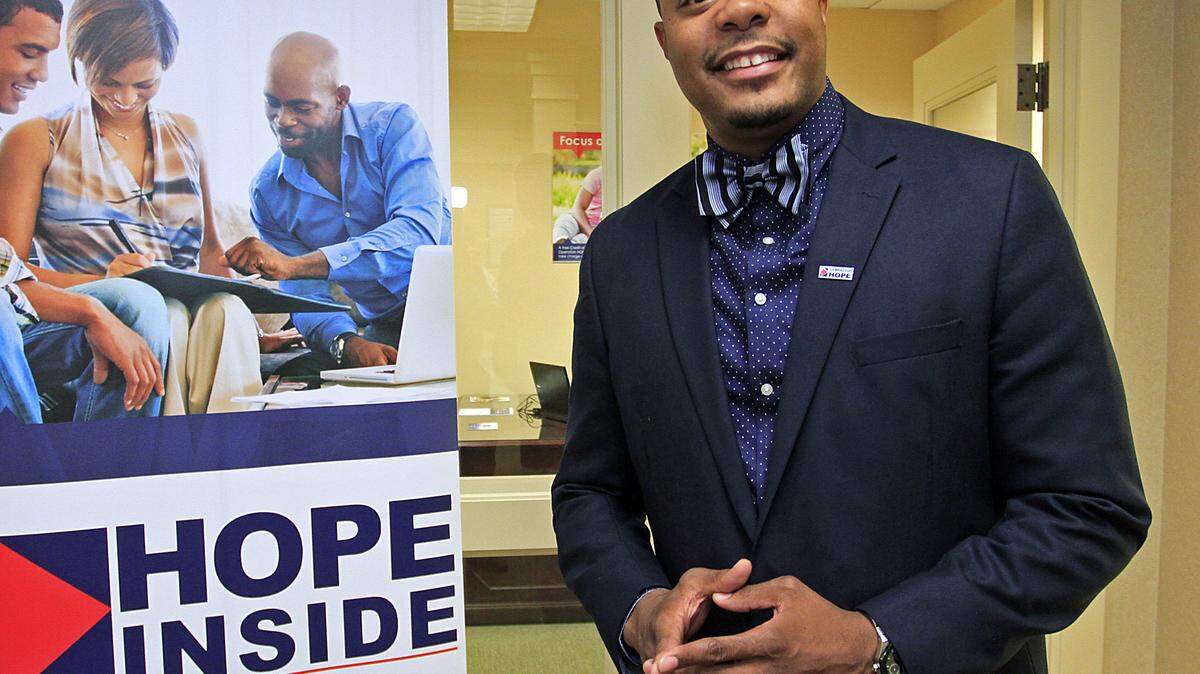
Hope comes in many forms and is sought for numerous reasons. For Don Thomas, it's about giving those who need it hope that they can pay their bills on time, purchase needed items and live life without unnecessary financial stress.
That's why he began to explore Operation Hope, a program founded in 1992 by businessman John Hope Bryant in the aftermath of the police beating of Rodney King, a chilling moment caught on video.
For Thomas, 35, a Columbus native who had earned a paycheck at Verizon Wireless and then Wells Fargo Bank, the mission that Operation Hope has in empowering people through improved financial literacy hit home.
He decided to seek the job of financial management counselor for the organization, which was setting up a Columbus office inside the Columbus Bank and Trust office at 1535 Benning Drive. The bank is a division of Columbus-based Synovus Financial Corp., which is sponsoring the local office.
The Operation Hope location opened here in July, with Thomas now getting the venture up and running. He expects to make an impact not only in south Columbus, but on the area as a whole. The goal is to give residents the tools they need -- first and foremost a realistic household budget -- that will put them on the road to better credit scores and a financially healthy, and less stressful, future.
The Ledger-Enquirer visited with Thomas recently at his office inside the CB&T branch to discuss his job and what it will take to make a difference in the community. He can be reached at 404-863-5188 or at donyea.thomas@operationhope.org.
This interview has been edited for length and clarity, with an expanded version at www.ledger-enquirer.com.
How did you get to this point in your career?
I'm a native of Columbus. My background is for 13 years I worked for Verizon Wireless, and I decided to get out of that industry because of the long hours. I then got into banking and worked for Wells Fargo for about a year and a half before running into a colleague of mine who told me about this opportunity, and here I am.
What did you do with Verizon?
I worked for Alltel about eight years, and Verizon bought Alltel out. It was a sales-type job. The last couple of years, I was in management. I actually kind of rose through the ranks and learned how to sell and learned how to manage people as well.
What did you do at Wells Fargo?
I was a personal banker. My role included essentially every aspect of the client interaction. When the clients came through the door, I met their needs as far as opening a checking account, opening a savings account. We would do an analysis of the customer to understand what their needs were, such as if they needed an auto loan, needed car insurance. We were just like a one-stop shop there.
It sounds like you developed some good people and financial skills?
Yes, I have.
Why did this job appeal to you?
What essentially intrigued me about this position is there's no selling to it. It's basically about education. That's really the main thing that attracted me to it. What I realized through working with Verizon and Wells Fargo is the average person does not understand the language of money. They don't have the financial literacy level that is needed to make a way for this American dream that we're looking for in life.
People need money, they earn it, they want it, and can spend it, but don't always manage it well?
That is correct. As I began researching Operation Hope, I saw that our chairman John Hope Bryant -- he's a native of Compton, Calif. -- he started creating this organization in 1992 at a pivotal time in American history -- the L.A. riots. What he found was a lack of financial literacy and he realized that if we could put something together, an initiative where we could educate the masses, we could actually prevent a disaster like that from happening again. And that was really brilliant to me.
As this position came about and we started talking during the interview process, I realized that this was my passion. I saw customers get declined on a checking account or get declined on a loan that they really, really needed, and the reason was their credit was not where it needed to be. So I had to deliver that information to them.
Now I have a solution for them. We have things in place where we can actually change their lifestyle around, because it's not just credit repair. That's not just what we do. I call it a lifestyle change. We take that client and we educate them on learning how to utilize their money and their credit and leverage that credit to get them the finer things in life.
You do that inside a working bank?
That's why we have the Hope Inside locations, where we can take the client that's come in to get that loan, and they can come in here if they have some issues with that. I am an independent contractor. I don't work for Synovus, but they can set up an appointment with me and we can go about figuring out a way to get that client's credit score where it needs to be so the next time they need that loan, they can get it.
You're trying to prepare them for the future?
That's right. What we do is take a very, very pragmatic approach towards looking at the credit of that customer. We sit down through a one-on-one counseling session and ask them those heartfelt questions. We get into the budget. We learn where the customer is spending their money. Then we look at the actual credit report. I have access to Equifax, Transunion and Experian.
I can sit down with the customer and show them where the areas of opportunity are and ways to actually get their (credit problem) eradicated.
Why the assistance from Synovus?
Mr. Allan Kamensky is on our board of directors. He's actually an executive (executive vice president and general counsel) here at Synovus. He was listening to a symposium one day with Mr. John Hope Bryant, our chairman, and he really, really was impressed with the leadership and the initiative of Mr. Bryant's Operation Hope and what it's doing for the country. And he decided this is something that Columbus needs. They have been negotiating back and forth, I think, close to a year about ways to bring this to fruition and bring Hope Inside to Columbus.
This branch is in an area of the city that can use the assistance, with it not being the most affluent area. That's by design I take it?
It is strategically placed because this is an area of most opportunity. There is so much wealth of opportunity here. The dollar in south Columbus is very powerful, and if we can go ahead and harness that dollar with the education, we can lead Columbus to greater success.
This office is right across from the Walmart Supercenter, so there will be lots of spending right outside your door?
That's right. When we look at the spending, the budget is one of the most critical pieces of my counseling session. The budget shows the customer where they're spending, so it's a prime opportunity with Walmart being right there ... If you spend a lot of money there, there are all types of ways we can show a client how to stretch that dollar.
What I tell all of my customers is it is a lifestyle change. You have to commit yourself to a lifestyle change -- something as simple as your cell phone bill and thinking of ways to lower that, like going to a different carrier or dropping to a cheaper plan. Or your cable bill; a lot of people have a lot of cable channels. So you have to think outside the box to eliminate costs.
The three major goals I try to achieve with all of my clients is number one, I want to increase their savings. Number two, I want to increase their credit score, and number three, I want to decrease their debt. If I can accomplish those three, then we have set that customer up for a good future.
What's the biggest obstacle in getting that accomplished with someone?
The willingness to understand. That's the main thing we run into. As we begin to get into it, we see where the opportunity is at. What I tell all my clients is every month that we go through this counseling, you may have a budget and go over your budget and think that's a setback. But it's not. That's a prime coaching opportunity. I tell all of my clients, you created a budget, that was the big thing. So it's just keeping them pepped up and keeping them energized, and to keep pressing on to see the light at the end of that tunnel.
So you meet with clients on a recurring basis?
Yes. Typically, what my program does is I offer a monthly credit and money management workshop. It basically gives you a high level overview of what Operation Hope is, the programs that we offer, what are the aspects of what we're trying to do. We discuss creating a budget. We look at a credit report and break down how a credit report is read, and go over 'what is credit?' and 'what is a credit score?'
It's a no-judgment zone. When clients come to us, we're not going to judge you, I'm not going to judge you. Typically, I like to have between 15 and 20 people in the workshop. Then we set up a one-on-one counseling session. I meet with them once a month, basically, whether it be through email or physical face-to-face conversation. I prefer face-to-face conversation because that way I can look you in the eye, and we can work together better.
Are credit problems a big issue in south Columbus? Do you expect to be busy?
We're placed here in south Columbus, but that doesn't mean our reach does not go beyond south Columbus. I service the whole Tri-city area. This is just where my office is at. So I have a lot of opportunity out there. A lot of people in this area need financial literacy.
When we say credit counseling, that is a very, very broad term and I don't like people to really caught up on just credit repair. I can have clients come to a workshop and they really just want to understand how to create a budget. I've had customers come to me and their whole aspect was: My credit is fine. For the life of me I cannot create a budget and stick to a budget.
So we serve people from all walks of life, and anybody within this area.
You want to get clients' credit scores sharply higher?
At least 700. That is a turning point that we're looking for with all of our clients. If we can get them to that 700 credit score, essentially, the majority of things that they want in life, they can actually get them at that point. That doesn't mean that we want to stop at 700. It's just getting to that point.
And I'm not going to charge you anything to help you do that. That's another beautiful thing about our program. It's absolutely free to the public. The only thing we ask from you is your time, and your willingness to change.
What's your day-to-day life like in this job?
It's very, very hectic. We're always in a conference call here and there with my partners in Atlanta and throughout the nation. I'm always visiting different businesses, different organizations similar to what I do, just trying to hammer out partnerships with them, alliances with them to service the community. And, then, throughout the day I have customers who come in for their one-on-ones. I have a schedule pretty much set up about a month out.
What's the most rewarding part of your job?
The most rewarding part is helping that client who didn't see a way out. They were overwhelmed. They were overburdened. It's just life. Life throws you a curve. But when we systemically strategize and get that customer above water, get them to where they can actually go out and purchase what they want to purchase, and they have money in the bank, money saved for the future, that's where the reward comes in.
How many people do you hope to assist in your first year?
My first year I want to assist anywhere between 180 to 220 people. That breaks down to my goal of maybe 15 to 20 people per month. Now I'm probably going talk to a lot more than that. But the ones that actually have the willingness and spend the time to go through the program, those are the ones, the hard numbers, I want to achieve through the year.
BIO
Name: Don Thomas
Age: 35
Hometown: Columbus
Current residence: Columbus
Education: 1998 graduate of Hardaway High School; earned bachelor of business administration degree from University of Phoenix in 2012; now working on his master's degree in business administration from Troy University
Previous jobs: Assistant manager at Verizon Wireless; personal banker with Wells Fargo
Family: Two children
Leisure time: Enjoys reading, spending time with his children and following the Atlanta Falcons and Georgia Bulldogs
This story was originally published September 19, 2015 at 4:32 PM with the headline "Job Spotlight: Don Thomas, financial management counselor with Operation Hope ."