
Job Spotlight with Holly Beasley Wait, executive director at National Civil War Naval Museum
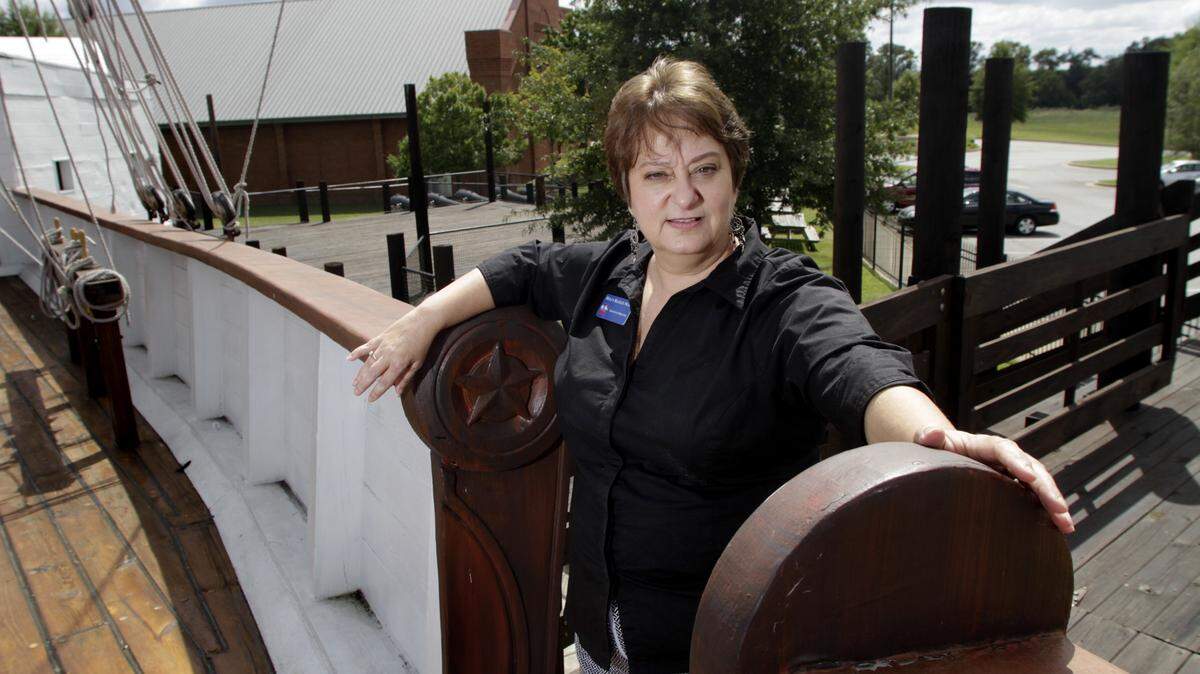
Holly Beasley Wait has a battle plan to improve and expand programming and activities at the National Civil War Naval Museum in Columbus. She truly believes if she accomplishes her mission, they -- as in thousands of additional visitors -- will come.
With an extensive background in history museums, Wait took the helm of the 1002 Victory Drive facility in early April. She now is intent on steering it to the smoother waters of financial stability and higher visitation.
At some point down the proverbial waterway, she says, an expansion of the museum will take place. The current complex opened overlooking the Chattahoochee River in 2001, an $8 million project that relocated it from the original site just east of Golden Park. It had been there since 1962.
"It's a building process," Wait, 54, said of her long-range plans. "It's not quick and it's not easy and it won't happen overnight. But I firmly believe it will happen."
The Waycross, Ga., native is confident she already has terrific pieces in place to get her journey under way. Artifacts include the CSS Jackson, the largest surviving Confederate warship, and wreckage from the CSS Chattahoochee. Exhibits include a full-size replica of the USS Water Witch and a portion of the USS Hartford, complete with a berth deck, ward room and captain's cabin. There also is a replica of the USS Monitor's turret.
The museum, which covers both Union and Confederate naval history, welcomed about 26,000 visitors in its last fiscal year ending June 30. Wait would like to get that number up to at least 35,000.
Part of the strategy includes more events, such as the Southern Pirate Festival that will take place Oct. 24-25, with Wait hoping to draw around 2,500 visitors that weekend alone. The facility also is capable of hosting gatherings and events, such as wedding receptions, in the evenings, giving it additional cash flow.
The Ledger-Enquirer visited with Wait recently, discussing her job and her plans for the museum, which has a staff of five. This interview is edited a bit for length and clarity.
Your museum background is heavy on improving visitation and revenue?
It is. That's a little bit of everything that we're doing here. We're trying to redevelop our education programs to tie directly to curriculum standards of Georgia.
You have a lot of school students coming through here?
We do have a lot of students, but we would certainly like to have more. With bus fees as high as they are, and school budgets also under attack, it's almost easier to get the big bus groups from Atlanta and some of those tour groups ... than it is to get more local kids. That's because the school systems really have to prove the need for their field trips in order to pay for the buses.
It's a challenge to get local schools to visit?
It's a challenge. It's the way teachers have to fill out all of their forms to get permission. From our viewpoint, we have to be certain that we, as best as possible, fit the curriculum standards that they're using as a (learning) check-off, in essence, so that we can have every advantage and every opportunity to get field trips to come here.
It's obvious history and museums are in your blood, a passion of yours?
I've been in museums all my life. I went to Valdosta State College and got my BA in history, then down to Florida State and got my masters in history and public history. My first job was at Jekyl Island Museum over on the coast as the registrar, which is a museum collections position. Then I went back to Tallahassee to work at the Museum of Florida History, where I was for 12 years. I was an educator, ran the museum travel program, ran the museum traveling exhibits program. Then I was promoted to grants manager, so I was directly responsible for grant funding to other museums in the state.
Then I went upstairs into historic preservation, which was part of my background school-wise, and did the same thing up there with grants and ran what was called the special category grant. The last year I was there, I was responsible for $17 million worth of grant money. So I have been on all sides with the grant process, the manager of the grants. I've also been a reviewer.
Grant writing is really tough, I've heard?
It is. I've been a reviewer and sat on numerous panels for grants in Florida and Georgia and Texas. I've also written my share and, yes, it's very hard. It's a 50-50 opportunity every time. You never can tell (if you'll get the grant approved).
The challenge is to show why you need money?
I think the challenge today is there's just not enough money out there. Back when I was running the grants program in the early '90s, we were offering operating grants to museums. Today, you won't find an operating opportunity anywhere. You have got to have a project. Your project has got to match the grant or vice-versa. You've got to have, oftentimes, matching money, cash, already in the coffers. Then you submit your grant and there's umpteen million people doing the same thing, and there's a limited amount of money. You can have the best grant application in the world and not get money.
Who gives grant money today?
There are certainly state and quasi-state organizations that still give grant money. For example, the Humanities Council, and so does the National Endowment for the Humanities. There's the Institute of Museum and Library Services, those are federal grants. Then you go to foundations and corporations. From my point of view, as a history person, you'll find an odd grant for energy efficiency or something like that and you just go, oh, there's a whole other world of grants out there that I didn't know about. (laughs)
Have you sought a grant since your arrival here?
I did submit a grant to the Columbus Arts Alliance and received full funding for that, which is what we are doing our Southern Pirate Festival with. That is matching money as well and I got just over $15,000, so we'll be spending on that event somewhere close to $30,000 with the match. We're bringing performers and people in from all over the country.
Will that draw a big crowd?
That will draw a big crowd. We have several bands, musical entertainment. We have a number of different people who will do theater-type things. We have fire twirlers. We do this jointly with a pirate group called the Cursed Few. Apparently there are pirate re-enactors out there just like Civil War re-enactors. There are different groups all over the country. These people are based in Georgia and they make contact with other pirate groups at other pirate festivals, so they bring an audience with them. So all of these people come to the festival, and then locals will come to the festival, and it will be fun.
How many folks should come to that event?
We have not done it the last two years, apparently. But prior to that, we had about 1,500 a day. So that's my goal this year is to have 1,500 on Saturday, and because Sunday is a shorter day, I hope to have 1,000 people.
And keep your fingers crossed that the weather is good?
We will not have rain. (smiles) It's inside and outside, but there's a big stage outside, and all of the pirates will be camping out there and we'll have food vendors, food trucks set up, and pirate merchants and all sorts of different activities -- sword fighting and firing the cannon and a huge treasure hunt. We're going to have kids activities.
That's the biggest event of the year for you?
It is the biggest event this year.
There will be more events down the road?
Since I've only been here since April, this is what I'm considering our fund-raiser. It's a big weekend event. We certainly hope to make some money for our budget. Next year we'll have more of a traditional fund-raiser for the museum. We'll have a band bash on April 16, which happens to be the 151st anniversary of the last battle of Columbus. We'll also do that outside. It's older area bands from the '60s and '70s, kind of that area of rock 'n' roll, country, some blues. There will be four bands.
That event is designed specifically to raise money for museum operations?
That's right, because as you know, the city, in cutting their budget this year, cut our budget by $135,000.
What is your total budget?
Our total budget is about $500,000 a year.
How much was coming from the city?
$135,000 of that.
They cut it completely?
Completely. So we are finding all sorts of different ways to raise money in order to maintain these wonderful one-of-a-kind artifacts. You won't find the Jackson anywhere else. This is it. You won't find the Chattahoochee. You won't find many of the other artifacts in here anywhere else in the country. Certainly, we have the largest collection of naval flags anywhere.
Is there anything rivaling this facility anywhere else?
That relates strictly to the navies? No. We are the National Civil War Naval Museum. (laughs) There are certainly other Civil War museums. I came from a Civil War museum in Texas. There are other museums that focus strictly on a particular ship, like the Hunley or the Monitor, or even the Cairo in Vicksburg. But we talk about both the Union and Confederate navies, about the men and women that were involved in that at the time, and the major battles, the major events. It's very balanced and equally represented here.
Do you have any projects on the horizon?
We have some big plans for the museum in the long run, certainly. I want to do an expansion of the museum. That is long term, of course. I don't know dates or times. But I've threatened them and said I will not leave here until it's done. (smiles)
You want to get things stabilized financially before an expansion, obviously?
Oh, yes. There are a lot of things that have to happen first. We have to be financially stable. We have to have a good connection with the community. We have to be able to provide for the visitor, for the community, what they need -- curriculum-based programming, appropriate events, care of collections, which is major for me with the collections background that I have.
So all of those things have to happen -- upgrades, improvements, rethinking things. We're rebranding ourselves. We just redid the store. We're looking at making some changes to text panels, things like that. So there's a lot of building to be done before we can go to a capital campaign.
In the interim, though, we would like to design and install an exhibition on Columbus in the Jackson Gallery, because that would really be our local history component for serving a lot more schoolchildren at the museum. It would give them a lot more opportunity to learn about their community and about the role Columbus played in the Civil War. So (the exhibition) we'll talk about development of Columbus. We'll talk about the building of the Jackson. And then we'll go to the battle of Columbus and have a little bit about that.
What's the most challenging aspect of your job?
Oh, raising money. Yeah, that's what keeps me awake every night. Making up that drop in budget this year is a real challenge. We're doing well, but I need every dollar I can get. But I also need to get it the right way. We need to provide the proper programming. We need to provide what the community needs. We need to have the artifacts cared for so that when they're on exhibit we are telling the story and doing it properly. In that regard, as we keep our museum standards up or improve upon them and the public comes in, whether they recognize that subliminally or not, they'll see a healthy, professional institution and then they'll want to be a part of it.
What was your visitation this last fiscal year?
We had right at 26,000. That is up from several previous years. I think they had dropped to about 18,000 or 19,000.
That needs to increase?
I would certainly like to increase our visitation. I've never been anywhere that this is not true. When you live in a town, you don't go to the museums. You don't know about the museums. It's like living at the beach and you don't go to the beach. It's the same thing. I've never been anywhere where that was not true.
So part of our goal is to provide something that is important and makes a connection with the local citizens, and I think development of a local history gallery, in conjunction with the Jackson as an artifact, is a great way to do that.
BIO
Name: Holly Beasley Wait
Age: 54
Hometown: Waycross, Ga.
Current residence: Midland
Education: Bachelor's degree in history from Valdosta State College, 1982; master's in American history and public history, Florida State University, 1986
Previous jobs: Museum registrar at the Jekyll Island Museum; museum educator at Museum of Florida History; grants manager for the statewide Historical Museums Grants-in-Aid Program in Florida; helped run grants program at Bureau of Historic Preservation; director of the Heritage Museum of Northwest Florida; directed the Okefenokee Heritage Center in Waycross, Ga.; executive director of the Beaches Area Historical Society in Jacksonville Beach, Fla.; and director of Pearce Museum, a Civil War and Western art museum at Navarro College in Corsicana, Texas
Family: Husband, John, eight cats and two dogs
Leisure time: Enjoys growing vegetables in her garden, traveling and reading
This story was originally published September 27, 2015 at 12:00 AM with the headline "Job Spotlight with Holly Beasley Wait, executive director at National Civil War Naval Museum ."