
Job Spotlight: Jewell Rowell, speech-language pathologist at R&R Rehabilitation
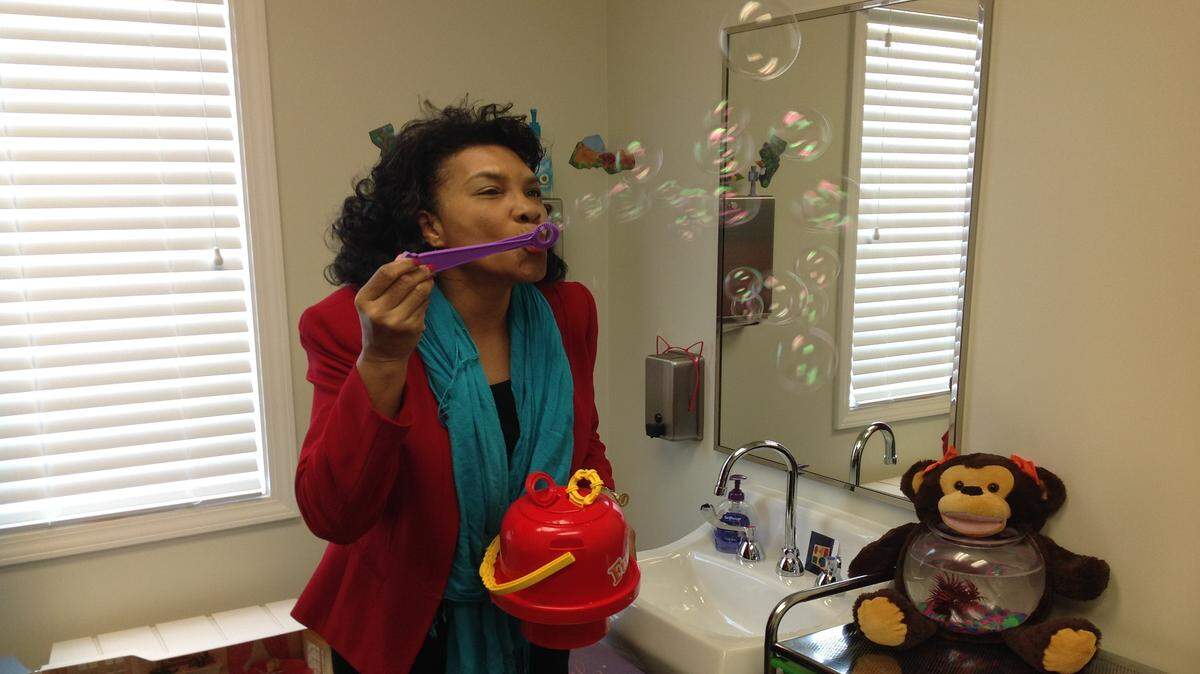
Jewell Rowell remembers vividly her decision to enter the world of speech-language pathology. She was in the 11th grade and a “career day” had been scheduled at school to help students get a feel for what they wanted to do with their lives.
“A speech pathologist came to the high school and I knew I had a gift of gab,” Rowell said in a recent interview. “I was always getting in trouble at school (for talking) and I absolutely loved helping people. But I didn’t know how I was going to blend the two. So this speech therapist came bopping in with a very similar spirit, very vivacious, and she was energetic. She spoke about what she did and I said: That’s what I’ll do. And I have never wavered. I have never regretted it. So thank goodness for career day.”
Rowell’s professional road has taken her around the world, literally, with the Maryland native marrying her husband — now retired U.S. Army officer and physical therapist Robbin Rowell — nearly three decades ago and moving from assignment to assignment.
It was in January 2008 that the couple decided to launch a health-care company called R&R Rehabilitation (Facebook page) in Columbus. It had been operating on Gentian Boulevard until the grand opening in late October of the Rowells’ freshly constructed facility at 6079 Knology Way, just off Moon Road.
The couple went from about 1,200 square feet in the old spot to 7,500 square feet of space in the new location. R&R’s services include speech therapy, physical therapy, occupational and hand therapy.
The Ledger-Enquirer visited with Jewell Rowell recently at the clinic to discuss her job, the types of patients she sees, and why she loves doing it. The facility has a dozen staffers, including the Rowells, with it also offering aqua therapy, services such as golf posture assessments and, in the future, yoga, zumba and pilates classes.
Speech-language pathology is an in-demand career field that is growing “faster than average,” according to the U.S. Bureau of Labor Statistics. The agency says there are about 134,000 people in the profession, earning median annual pay of nearly $70,000, with a need for 26,000 more pathologists or therapists by the year 2022.
Pathologists diagnose and treat patients young and old with speech problems, difficulties with swallowing, and disorders caused by everything from stroke and brain injuries to delays in development and emotional conditions.
This interview is edited a bit for length and clarity.
Was it easy for you to map at how you would become a speech pathologist?
I knew I would have to get an advanced degree just to practice. And, even now, you need a master’s just to practice. I knew nothing was going to derail me. I stayed focused, with lots of prayers. I went to undergraduate and graduate school, and then you have to do an internship, what’s called a clinical fellowship year, which is pretty intensive. After that you have to take the boards and pass those. And then you can practice.
How did you find your future husband?
He was in the Army stationed at Walter Reed (Army Medical Center) and I was working there. As a matter of fact, we were sharing a stroke patient. He was always monopolizing the time and I said: Hey look, I’m supposed to see this patient also. So we need to figure out a time for both of us to see the patient. That’s how we met.
A little tension it would appear?
It was. (laughs) ... But when we were in the military, traveling every 18 to 20 months, I was always blessed to be able to get a job. I had flexible hours, still keeping my skill set, still working and practicing and doing what I love, and it was perfect.
What types of patients do you see?
I like working with a variety of age groups with different diagnoses. On any given day I can work with a 3-month-old who has communication problems on up to a 77-year-old who’s had a stroke. That keeps me challenged. It’s not only rewarding, but it’s also challenging.
So you see patients at just a few months old?
That’s right, because at three months they’re localizing to familiar voices, which at that time is their mamas and daddies. They’re cooing, they’re social, they’re interactive. And if they're not, we have to find out why. A lot of times it could be a hearing loss and we have to refer them to the audiologist. Or maybe they’re just not getting the stimulation they need. So as young as two or three months we can start speech therapy.
Do you have a preference in treating younger or older patients?
I love my seniors, those in their 70s, 80s and 90s, but I love my toddlers — and everyone in between of course — but I've always been drawn to those populations. You can learn so much from both age groups.
What are you looking at in older patients?
Typically, it’s rehabilitation because they’ve had speech and language and they’ve lost it. It can be a head injury or a neurological disorder, Parkinson’s or MS (multiple sclerosis). But for the younger ones, it’s habilitation, which means they've never had the speech or comprehension.
Is one age group more difficult to treat?
They both present their challenges. Kids are more active and you have to provide structure when you’re doing therapy. I like to have my parents come in and we’re all doing floor-time therapy. That’s so they can see how I’m doing therapy and imitate me and they can go home to do the same thing and get the same result ... I do a lot of educating.
What’s a typical day like for you?
I come in at 7 and prepare for my day, and I’m leaving here at 6:30 or 7 o’clock in the evening, because there’s the business part of running R&R also. I see anywhere from 10 to 14 patients. It’s a lot, so I have to be structured (overall) and structure my therapy sessions, too.
How long does a session last?
Thirty minutes. I treat anywhere from once to twice a week. The parents, or for my (patient) adults, the spouses, see them the rest of the time. So you can see how important it is for them to stimulate, stimulate, stimulate in the home setting and other environments to get the same results that we get here in therapy.
Describe techniques and things you use to help people.
I’m a seasoned clinician, so I like to blend old school traditional paper and pencil therapy activities with the high-tech techniques, to include the (smartphone) apps, the iPad and computer-generated activities. We use them with all of our patients. A lot of these kids already have socialization problems, issues with turn taking, problems with focusing and concentration. So they would love to be left alone to work on that iPad. I have to structure my therapy session so that I can incorporate high-tech with doing some other kinds of traditional therapy. I really, really try to work with the moms and dads and reinforce that we don’t want to leave them alone on an iPad all day.
You mentioned a sensory room. How does that come into play?
We have a lot of kids who have problems processing their environment, the lights, the sounds, the smells, the temperatures. So we have to calm them down (in the sensory room) first before we can begin therapy, before we can even begin treatment.
Any other particular challenges you face?
Our clinical staff is the best staff in town, we feel, but finding staff with not only medical and clinical training, but also education training in the academic setting has been difficult. We do incorporate both the medical and academic models in our treatment protocols and goals. So we are always looking for outstanding speech-language pathologists, physical therapists and occupational therapists to treat all ages.
Can you generally help everyone?
I like to say everyone can be helped. Now, not everyone will develop speech. With that we have sign language, picture boards, we have speech-generating devices to supplement speech. Everyone wants their child to talk just like every stroke patient would like to regain speech. But we also have to provide other means of communication. So if they’re using signs or they’re pointing to pictures of a cup, that is great. That is communication. I’m making progress. If they can sit and look at you and imitate what you’re doing, that’s progress, as opposed to running around the room, getting under the table, hiding under my desk.
Older patients have health problems that can be very sad, correct?
For me, it’s not sad because I've also worked in hospitals and nursing homes. If you can still walk, what a blessing. If you can still eat and swallow, what a blessing. Now with some of these progressive neurological diseases, you’re absolutely right. There will come a time when they won’t be able to talk or be able to chew or swallow, and that’s when we really come in to help provide other ways to do those kinds of things. It’s to improve their quality of life.
Are there times when you are near tears when dealing with patients?
No, because that’s not how I’m wired. Not every day is a good day, but there’s good in every day. So I’m always upbeat. That’s how I’m made. ... These cases are challenging, and that keeps you current, keeps you cutting edge, because I like to think we do cutting edge, state-of-the-art therapy here.
What should someone considering your profession be thinking about in terms of skills, etc.?
I think they need people skills, because you have to interact with adults and babies, little ones. If you don’t like to talk, this is not the field for you. And you have to have so much patience, because progress in a lot of cases is not quick, it’s not fast. You also need the ability to go with the flow. You might have a lesson plan in your brain or written on paper — what you’re wanting to do — but it may not always happen that way. So you have to be able to modify and adapt and go with the flow.
BIO
Name: Jewell Rowell
Age: 59
Hometown: Rockville, Md.
Current residence: Midland area of Columbus
Education: Earned a bachelor’s degree in speech pathology from Towson State University in Towson, Md.; earned a master’s degree in speech pathology from Tulane University in New Orleans
Previous jobs: Has worked in a variety of medical and academic settings all over the world to include Walter Reed Army Medical Center (where she met her husband); clinical supervisor at Howard University; and worked at the Korean Military Academy in Seoul, Korea (their equivalent to West Point)
Family: Robbin, her husband of 27 years, son, John, daughter, Joanna, and their pooch, Cesar
Leisure time: Has not had much leisure time over the past two to three years since she and Robbin were working on the design and development of their new clinic; does attend Fourth Street Missionary Baptist Church; she hopes to get back into piano lessons, pull out her sewing machine, hop back on a bicycle and enjoy the beautiful trails, do more gardening and enjoy more date nights with her husband
Of interest: A passionate and adventurous person, she has climbed the Great Wall of China, has driven on the German autobahn at 180 mph (which was exhilarating), and recalls listening to her 106-year-old grandmother, who passed away last year. She loves babies and toddlers, but also has many friends in their 70s, 80s and 90s; her favorite quote, by Eleanor Roosevelt, is: “You must do the things you think you cannot do”
This story was originally published November 28, 2015 at 9:58 PM with the headline "Job Spotlight: Jewell Rowell, speech-language pathologist at R&R Rehabilitation."