
Job Spotlight: Marc Heileman, owner, Treadstone Climbing Gym
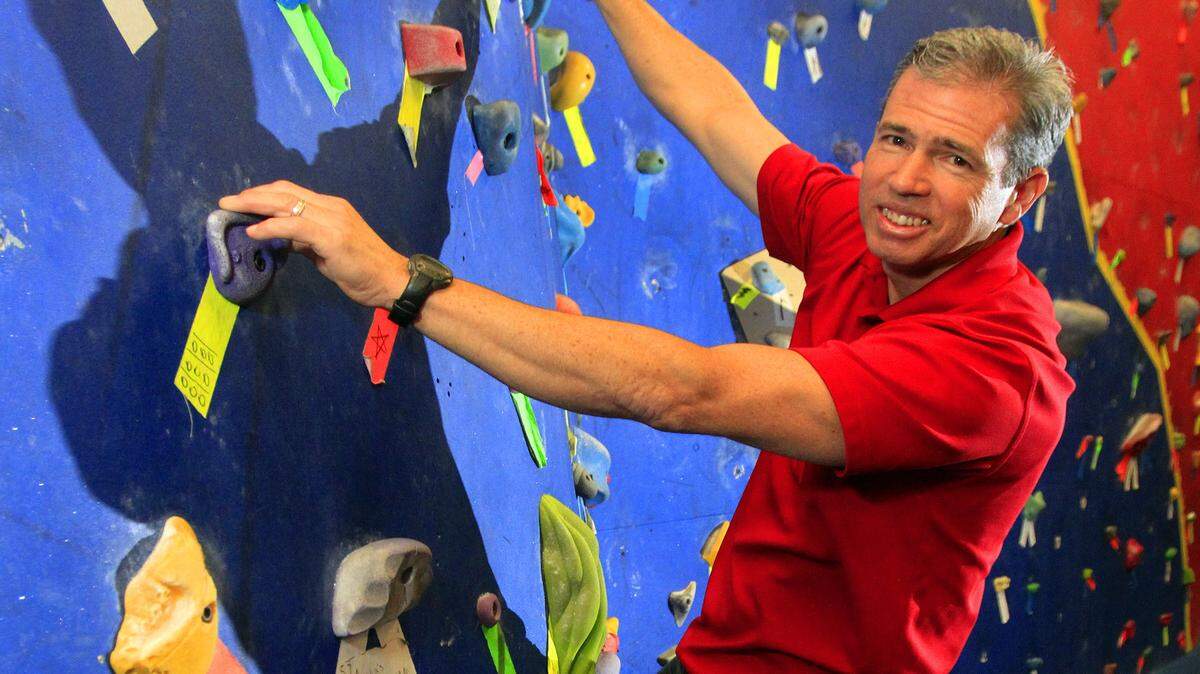
Marc Heileman has served his nation, spending plenty of time at Fort Benning and elsewhere. So it's a natural that he would turn to those military organizational skills when operating a business.
The Texas native, 48, and his wife, Gaylene -- he's the vision master and she's the financial person -- opened Treadstone Climbing Gym on Milgen Road in Columbus nearly two years ago. Since then, about 8,000 people have visited the rock-wall climbing facility, which is tucked in a former warehouse space across from Christ Community Church.
Treadstone, however, is more than a gym geared toward fitness fanatics. It's a place for birthday parties, recreational enthusiasts and team-building programs, all wrapped up in a culture that includes the "Treadstone tribe," with staff not putting up a wall, or dividing line, between themselves and those using the facility, said Heileman.
There also is a another line of business for Treadstone. It has a construction arm that works with clients -- be they churches or cities or other entities -- to install climbing walls, ropes and boulders that can be used in fitness programs. Instead of constructing something from scratch, there also can be the option of converting space, such as an old racquetball court, into a climbing area.
The Ledger-Enquirer visited recently with Heileman, a Columbus resident, at his gym to discuss his career path, why he enjoys the business and what the future may hold for the company. This interview is edited for length and clarity, with an expanded version at www.ledger-enquirer.com.
How did you come up with your gym's name?
It is sort of a reference to the Jason Bourne movies, I guess. But it's also descriptive of what we do. We tread stone.
Initially, we were operating under the name 'Cliff Dweller.' We rebranded in 2011, when I came back from the military, and started calling it Treadstone. I rewrote the entire business plan based off a military organizational structure, which works very, very well. Commanding officers are not that much different than a CEO. And their staff officers are not that different from the vice presidents of different sections and departments (in corporations).
How did you come to do this here in Columbus?
I had been climbing at the time (we opened) about 23 years, 25 years now, of course. Because of Fort Benning, we came to Columbus about six years ago. We didn't really have to stay after that, but we liked the community. We liked what they were doing with Uptown; all of that renovation really attracted us to stay.
As a fitness business, you fit in with downtown's move toward healthier recreation.
We do. And we do a lot of cross marketing. We're a big believer in that, between Ride on Bikes, Outside World, Big Dog Running. There are so many businesses here that are unique to Columbus and we developed a real network with them.
Do you bring businesses into this rock-climbing gym?
We do a lot of the team-building stuff. In fact, the team-building is how I started in rock climbing 25 years ago. I went to Berry College, which has a ropes course that is funded primarily by Chick-fil-A. I literally was not a big climber until I did that program. What's really interesting and fun about that is it's come full circle and I now do a lot of work with Chick-fil-A, doing operator training. In fact, I just climbed El Capitan a month ago for a Chick-fil-A produced documentary film that they're doing for their operator training.
Your business goes far outside Columbus?
Yes, sir. We've got 17 climbing walls or gyms, things that we've built or provide service to around the world. We've got three clients in Manhattan, clients in Brooklyn, and in New Jersey. We actually have a New York office of Treadstone. We've got a Kentucky outpost as well with a big rope course, right there in one of the top three climbing areas in the world ... It's at Red River Gorge in Kentucky. For climbers, that's a big destination ... It's kind of a second home for me.
But you have work outside of the U.S.?
We do. We have an outpost in Kenya where we work with an outfit called Blue Sky. That is also something affiliated with Chick-fil-A, and we've continued our association with it. We went 16 years ago and built their first ropes course and climbing gym, just outside of Nairobi.
That's the construction part of your business?
That's exactly the way we should break it down. There's the climbing gym where you're sitting right now. We have only one gym, but we're packaging for franchising right now. We've got two locations that are spinning up to franchise at this moment. And we also are looking at other locations that will be in the chain that my wife and I will operate, outside of franchising.
And, of course, we work with other (operators of) climbing gyms, who simply want us to come in and build for them. There's a full suite of consulting that every client gets that's unique to Treadstone. We have a very unique culture that we're excited about.
Describe that.
It goes very much into organizational leadership. That's a passion of mine. It's a lot of team-building that we continue to do with companies and churches and school groups, and military groups that come here a lot.
Which do you enjoy more, building a gym facility or operating one?
It's hard to say. Here's the career progression ... I was a professional rock climber all through the '90s. In the year 2000, I was the No. 9 ranked competitive rock climber in the U.S. I competed at the international level a few times and placed there, too. It came from that.
When I first got married, I went and got a full-time job at a church at an activity center, running their gymnasium. Their first question to me was: What can set our activities apart? This is 1997 by the way, a while back. Rock climbing hadn't really gone mainstream at that time.
Climbing gyms have been in existence out West since the late '80s and early '90s, but you could count them on one hand at that time. Then they really grew, and around the mid-'90s, you started seeing one climbing gym in every major city. It's proliferated a lot since then to the point where Atlanta, for example, now has eight climbing gyms, and two of them are gigantic. One of them was the largest in the country -- the second largest in the world -- when it was built.
How does this gym compare to others out there?
It's smaller. The way we look at it is there are basically four sizes of climbing gyms that are appropriate for various size cities. There's the big-box gym that any large city can support, like Atlanta, San Francisco, Denver, Colo.
Then you get into regional size cities, which I consider Columbus to be one of those. You do a smaller build; this is an 8,000-square-foot facility. I think anywhere between 8,000 and 12,000 square feet works. You can do taller; I think you can do a 40-foot-tall climbing gym in a regional size city. This is a standard warehouse height, 22 feet.
And then you've got small-town America, which right now is pretty much untapped by the climbing industry. An example of that would be a Eufaula (Ala.)-size city where you would have a bouldering gym, and it would be in a space you could probably pay $500 a month to rent.
Beneath that, we have what we call outposts. These might be outdoors in a public park, such as a bouldering arch along with the chin-up bars. Something like the Nantahala Outdoors Center would support an outpost.
How long did this Columbus gym take to set up?
This took three months to build. ... It is welding for the most part. We do steel frames, and then we put in high-quality plywood surfacing for the actual climbing walls, which is typical, and those are tied back to the steel frame. It makes it very sturdy.
Why did you pick this location in the city, and did you look elsewhere?
We did. We looked in Uptown but didn't find a suitable building. The old mill buildings, some of those are large enough, but they take a lot of renovation work to get them up to code. I personally believe that it's better to just do a build-to-suit with a steel frame. That's what we're going to be doing next, and we are actively seeking spots in Columbus for that next gym.
Does your day-to-day job involve running around quite a bit?
My day-to-day job is not usually here at the gym all that much. I make a point to be here on Mondays to train the staff and to work with our cadet program and our volunteers and our senior project kids who are doing rock climbing for their senior project. Then on Tuesdays and Thursdays, I'm usually in here training for myself, so I get to mix and mingle with our members. But for the most part, you're right, I'm usually away somewhere else (meeting with clients and building gyms).
What's the most challenging aspect of your job?
I'm sure it's the same that every business owner says and that's just time management. The military structure helps us a lot with that. But if you've read the Jim Collins book, "Good to Great," you know it's also very challenging to find the right people to put on your bus to help you with that, and then make sure they're in the proper seats.
What's the most rewarding part of your work?
Our culture. Our people make up that culture. But I'm addicted to all of those organizational leadership books, (authors) Simon Sinek and John Maxwell, and Dave Ramsey's leadership podcasts and all of his books, and Michael Hyatt. All of those people are who we read and listen to on podcasts.
Intentional living is what we inject into the way we operate our businesses. The organizational excellence that they seek and try to pass on to people is something we're always integrating into what we do and trying to tweak our operations.
What's your mix of clientele here?
It runs the gamut. That's the great thing about rock climbing, kind of like skiing, you're still skiing whether you're on the bunny slopes or on the black diamond. So climbing speaks to that, too. You can come in here as a 5-year-old and have a great birthday party, climbing around on the walls and doing something that's more active and fit than watching video games. So there's that aspect of it.
If you have kids and you walk in here, there's a tendency to think of this as a kids program. But what you forget is this (climbing) is the highest strength-to-weight ratio on earth. So if you're a fitness fanatic, this is the place where you can come to crank that up to 11 ... Also, some of the best longevity in sports is in rock climbing. You can do it a lot longer than most sports, partly because it's not as high impact as something like running or backpacking.
What's your five-year plan and how many gyms might you have?
The five year plan -- the big hairy audacious goal, as they say -- is for us to be a chain that's worldwide. I would like to have 60 gyms by the time I'm finished (years from now). Within five years, I think three is realistic.
This story was originally published December 11, 2015 at 10:40 PM with the headline "Job Spotlight: Marc Heileman, owner, Treadstone Climbing Gym ."