
Job Spotlight: Jay O’Neal, executive director of the Disability Service Center
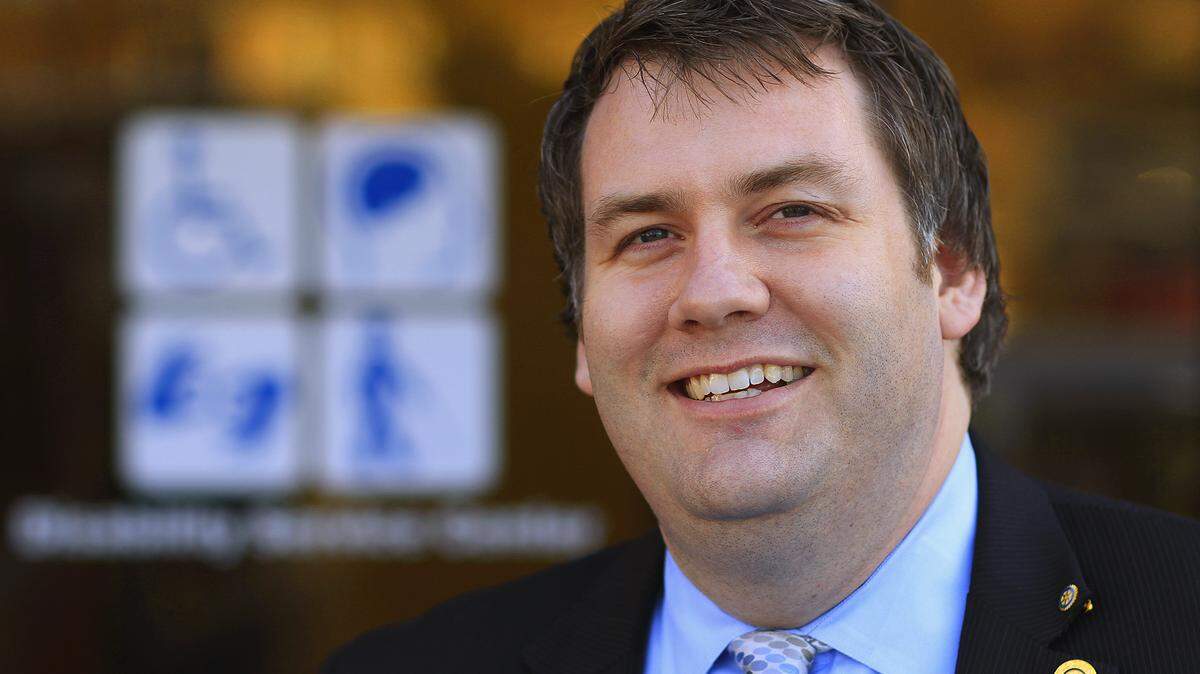
Jay O’Neal has been told by a lot of his doctors that he’s a “walking modern miracle.” That’s because he not only survived having his body crushed by a drunk driver in 2006, but he took an excruciating recovery and ran with it.
At one point, in the aftermath of the traumatic moment, simply trying to brush his teeth was a goal. But he would eventually earn a communications degree at Columbus State University and nearly three years ago became executive director of the Disability Service Center, 216 10th St., in Columbus.
In that job, O’Neal and his staff of educated and trained volunteers work to improve the everyday lives and futures of those in the area who have a disability, either from health problems or from horrible incidents such as a car wreck or other accident.
The nonprofit center, which moved from the Midtown area to its current downtown location about 18 months ago, offers an array of services and assistance. Those include workshops and seminars on preparing for a job, learning sign language and braille, and developing life skills.
The 3,200-square-foot facility and its staff also helps those with disabilities obtain home modifications to make their dwelling safer and more comfortable, assists businesses with obtaining technology in order to hire staff with special needs, and offers an incubator for other agencies that wish to help others.
A spinoff of sorts from CONTACT USA last July, the Disability Service Center is partnered with various organizations — the Fountain City Chapter of the National Federation of the Blind, Autism Adventure Travel, the National Alliance on Mental Illness (Columbus chapter) and the ARC of Greater Columbus.
Vernon Humphrey, legally blind and chairman of the center’s board, puts the mission of O’Neal and his staff in unique perspective: “The disabled community is the only minority that exists that anybody can become part of at any time, and without your permission. Jay and I never figured we were going to be disabled. Jay was walking down the street and got run over by somebody. I just won the wrong (blindness-causing illness) lottery. So people active in the community tomorrow may be disabled due to no fault of their own.”
(Click here to see how you can help the Disability Service Center help others)
The Ledger-Enquirer visited with O’Neal, 30, a Phenix City native and resident, to talk about his job, the experience that molded his outlook on life, and the organization that he has a passion for growing one step at a time. This interview is edited for length and clarity.
How did being struck by the car influence your current path?
After sustaining a traumatic brain injury in 2006, I spent years in recovery and therapy regaining the ability to walk, talk, read and write. It was through my recovery that my relationship with my family and God grew to levels that I had never seen. I decided then that God had bigger plans for me than I ever would. I love to be involved within my community and helping folks that may be in similar situations as myself 10 years ago. The Disability Service Center allows me a platform to offer help and resources to a community that helped me in my time of need.
Tell us about the building the center is in.
This portion of the building we use as an incubator for other nonprofits in the region. We’ve got Autism Adventure Travel, which is a special needs travel and community entry program, providing therapeutic services for families that have children on the autism spectrum. We’ve also got a satellite office here for the Shepherd Center out of Atlanta, Ga.
Vernon mentioned Autism Adventure’s mock plane flights for autistic children, which take place at the airports in Columbus and Atlanta. Tell us about those.
We go through baggage claim, we go through check-in, we go through TSA. We’ll even eat there and explore the mall to let people know how crowded it can be. We actually board planes, 747s and 757s, to let folks know what it’s going to be like to get on a plane and what’s going to happen, such as the captain’s going to speak to you and you may not see him.
Part of Autism Adventure Travel as well is they plan vacations for families. Our office provides them with nursing staff and a live behavior analysis therapist. Sometimes when you have kids with special needs, it’s not easy to pack up and go to Panama City for the weekend like most of us do. It just doesn’t work that way. So Autism Adventure Travel and DSC will provide the staff so that mom and dad can actually get a break. They can go on vacation because we’ll have 24-7 trained therapeutic and nursing staff there. They’ll take care of the kids at the vacation site.
We’ve got a cruise coming up in April. We’re going down as a missions trip to an autism center in Cozumel, a seven-day cruise. We’re taking our autism families from here in the states to Cozumel, Mexico, and providing services to other families there. The families do not pay at all. It’s all done through fund-raising and partnerships.
Describe some of your key services.
Our big focus here at DSC is helping to create an inclusive community for everyone. The classes that Vernon teaches here deal with resumes, interview skills, employment skills. We also have local businesses that help us — Ruth Ann’s Restaurant, Samurai, Meritage café, several of our attorneys, such as Mike Smith, and (Chattahoochee and the Valley Publisher) Mike Venable right next door.
We’ll do this training weeklong. First, we’ll create a nice professional-quality high-grade resume. Before you go off, we’ll talk to you about what an interview is like. This may be your first job and you may feel really overwhelmed. So we’ll go through this process and do mock interviews here at the office. Then we’ll send them out into the community with resumes.
You help educate employers about hiring people with disabilities. But you mentioned there can be resistance.
Many times businesses and employers, first of all they’re afraid of lawsuits. That blind guy right there, you want him working in my warehouse doing what? ... They see him as a guy with a disability that could be a physical disaster in a workplace. You have to get them to look past that first.
Then there is the equipment. Most accommodation in the workplace place, about 90 percent, costs you little to nothing. People assume when you use the word accommodation, it means really expensive technology or equipment. But that’s not the case.
How many people do you help at the center in a year’s time?
A ballpark estimate of between 2,500 to 3,500. That’s assisting folks coming into the office or us going to them. We’ll make referrals out the wazoo. Some folks walk into the doors and get assistance. Some people just call us. We have a resource program here at the office in our computers. They call and say ‘I need this.’ We type it in real quick and tell them, ‘Great, call these folks,’ or ‘Here, do this.’
One of the big things here is we want to help individuals become self-advocates. If you call, we’ll fix it. We are going to find a solution for you. However, we always invite you to be a part of the process because one day we’re not going to be here. One day you may move. One day I may die ... So we want to have taught you how to assist yourself, how to research certain groups, how to communicate properly, how to carry yourself ... We’re trying to help people break those molds, break those stigmas. Don’t just hold your hand out and expect something. This is what you’ve got to do to get it. This is were you’ve got to go to get it.
I know your services are confidential. Can you offer an example of someone’s disability experience?
We have to be careful with that, so I’ll use my personal example. When I sustained my traumatic brain injury in 2006, our first stop was Columbus Regional and the area’s trauma center. I was there for 31 days and, at that point in time, Columbus Regional says we’re a trauma center, we’re not a neuro unit, we can’t help you. That was pretty much what they were telling my family. They said there was a place that could, the Shepherd Center in Atlanta.
Then we had to get the community support to get the Shepherd Center. When we got to the center, it was a hospital unlike no other. It’s amazing. They are the world’s leading catastrophic care hospital for head and spinal cord injuries. When I was unloaded from the ambulance there, I was met by a team of specialists who announced who they were, what they were doing, this was their goals, let’s do it, and hit the ground running, that type of thing. I was at Shepherd for two weeks and I got used to this unlimited source of resources, this unlimited bank of knowledge.
When I came back home to Columbus, that’s when I realized that Columbus wasn’t Atlanta. Columbus wasn’t Shepherd Center.
You were seeking assistance for your recovery?
We had to find it. We had to search. Here I am still trying to learn to brush my teeth again and at the same time we’re trying to track down a licensed speech pathologist that had worked with traumatic brain injury. Or one of only three physical therapists in the area that had worked with traumatic brain injury. There were a lot of tables that had to be turned.
We finally found Columbus Speech and Hearing and Dr. Susie Ford. She really focused on my life skills, my speech, my language .. I had a four-quadrant traumatic brain injury, so every lobe of my brain was injured, affecting everything from speech to memory to emotions, balance and coordination, you name it.
At the same time we found Carson Pass up at Roosevelt Warm Springs for my outpatient physical therapy. That’s because not only did I have a four-quadrant traumatic brain injury, but I had a pelvic ring fracture, a hip replacement, rods and screw and bolts. The lower portion of my body was shattered.
So you had this combination of physical and cognitive (issues) and Carson had actually worked with that type of injury before, or something similar. Then on my last day of physical therapy, Carson looked at me and said, ‘Are you ready to run?’ I’m like, huh?
When I was there we went from a wheelchair to a walker to a four-pronged cane to a single-prong cane to running and bowling. They had a bowling alley there at Roosevelt. So we were doing things in therapy in ’06 and ’07 that back in early ’06 was a very far-fetched dream. The dream would have been coming out of the coma.
To a lot of my doctors, I’m the walking modern miracle. To me and to folks that know me and work with me and live with me, there’s still some deficits.
You obviously were blessed in many ways.
I had an amazing team of health-care professionals, an amazing circle of support with family and with friends and with educators and with mentors. And I think a lot of that had to do with my recovery.
That’s not always the case, however. Here at DSC, we see it all the time, a lot of folks fall through the cracks after having an injury. We’ve got a young man, he’s the family member of a personal friend of mine who contacted me. He had a head injury and she said, Jay, he’s back home and something is not right, they didn’t keep him long enough, they didn’t keep him like you. I said hold on, not all head injuries are like mine. I said folks get minor concussions all the time. But she said, no, there’s something wrong, something’s not right.
Head injuries are missed. They don’t always happen immediately. Swelling can occur days after the original blow happens.
If you’ve ever heard stories like ... Bob and Susie, they were great. But Bob had that wreck one time and the next thing is Bob got addicted to drugs, he lost his job, they got divorced. Chances are Bob may have had a head injury in that wreck back in the day, and the next thing the emotional changes caused the issues at home. Those issues may have caused things at work. He was probably over-prescribed stuff. When you have a head injury they don’t like to put you on meds because the brain can interact differently with it. But they didn’t know he had a head injury, so he’s taking all of these meds.
How does your center help people in other ways during recovery?
We offer a case management program out in the community. Once you leave Columbus Regional or St. Francis or East Alabama (Medical Center) or any other facility, their case managers can only go with you so far. They give you that long-term care plan and then it’s all you. We come in and we don’t care which doctor you see. For us, it’s what do you need help with? We sit down with you and go over all of the stuff that your doctor gave you, that your therapist gave you, that your case manager gave you.
Our case managers will actually follow folks. Our longest running consumer, who is active today, came into our service three weeks after I was hired, and he is one of the biggest community activists that we have out there. He will call us and say, I found this new workshop. Are y’all going to be there? I’ll help you get there.
Money for operations can be a challenge for you?
Yes. I’m the only paid employee. Everybody else is a volunteer. We just submitted our application to GVRA, Georgia Vocational Rehabilitation Agency, to try to get vocational rehab funding. We offer a lot of classes here, braille, sign language, computer literacy, employability skills, and VR will actually look for agencies that can do that stuff. But you have to be a (approved) VR provider. Now we’re going through the process of trying to be a provider.
We had somebody at VR who told us, Jay, you have one of the most overqualified, underpaid staffs that I’ve ever seen. They said three of your counselors have master’s and they’re volunteering? ... We’re hoping to hear something back around the first of March and they’ll say what’s next.
But that would get us funding and we then could offer more services. We already are offering an exorbitant amount of resources and programs and projects now, on a budget of practically zero. All of our money comes from fund-raising, donations, and building those relationships with community businesses. ... We have an amazing partnership in Uptown Columbus.
Looking back, do you marvel at where you’re at now?
I never would have imagined that after my TBI (brain injury) I would have gone back to get a degree in communication, after I was told I would never speak again. I never would have imagined that after that I would turn around and say, man, I can use these two (education and injury) together and mold them like glue and it would be great. Things just kind of fell into place.
I’ve mentioned so many people that have come into my life due to this. It’s too miraculous to be anything else. But I’m a firm believer in what God has planned for me. I have no idea what it is yet. I’ll find out what it is when I get there.
Your future path?
I’ll go where the wind takes me ... This gives me a platform to offer the services that I want to give the world, at least for now in the Chattahoochee Valley region.
Finally, what’s the most rewarding aspect of your work?
I know it’s going to sound corny as all get out, but it’s simply helping people.
BIO
Name: Jay O’Neal
Age: 30
Hometown: Phenix City
Current residence: Phenix City
Education: 2003 graduate of Central High School Healthcare Academy; earned associate’s degree (EMS) from Southern Union State Community College in 2005; earned bachelor’s degree in communication from Columbus State University in 2013; earned master’s degree in communication, culture and technology from Georgetown University in 2015
Previous jobs: Began working in the hospitality industry in 2003 while working on a degree in emergency medical and sports medical services. That later helped to spark his interest in business and community development through a degree in communication and public relations. After sustaining a traumatic brain injury, he began to use those skills while providing community advocacy and education support through the Shepherd Center in Atlanta, which is the leading rehabilitation facility for head and spinal cord injury Family: Single; mother and father are Andy and Denece O’Neal; and brother Adam O’Neal
Leisure time: Loves to travel and learn about new cultures and people; is active in his church, Cascade Hills; enjoys spending time on community projects through Columbus Rotary and other civic groups; enjoys the arts and music, and at one time volunteered at a local Christian music venue and has performed as well, both singing and spoken-word poetry; also loves spending time with family and friends
Of note: Holds professional certifications in applied behavior analysis; personal care aide, family caregiver, Alzheimer’s and dementia; and special needs (both certified accessible travel advocate and caring for chronic illnesses; also is involved and holds leadership positions with several civic groups and associations, including JDF, March of Dimes, St. Jude’s, Health Occupations Students of America, Columbus Mayor’s Committee for Persons with Disabilities, Columbus Mayor’s Commission for Persons with Disabilities, National Registry of Emergency Medicine, American Disability Association, American Communication Association, Southern States Communication Association, Public Relations Society of America, Aging and Disability Resource Centers, Professionals Serving Older Adults, Chattahoochee Valley VOAD, National Federation of the Blind (Fountain City chapter), Chattahoochee-Flint Transition Alliance, Rotary Club of Columbus, Greater Columbus Chamber of Commerce, Russell County Crisis Center, and Columbus State University’s Department of Communication
This story was originally published February 20, 2016 at 7:38 PM with the headline "Job Spotlight: Jay O’Neal, executive director of the Disability Service Center."