Meet the first female oncologist at the John B. Amos Cancer Center at Piedmont
Working as a hematologist oncologist isn’t much different than any other job to Dr. Srividya Maharaj.
The hours are longer, there’s more responsibility, and she has a lot more sleepless nights. The job sometimes wakes her up in the middle of the night, worried that she’s forgotten to do something.
Characterizing the bond she builds with her patients as fulfilling is an understatement, Maharaj said, because cancer may be the most terrifying diagnosis someone could get.
“So, being able to be trusted to walk with the patient during that journey is a privilege,” she said.
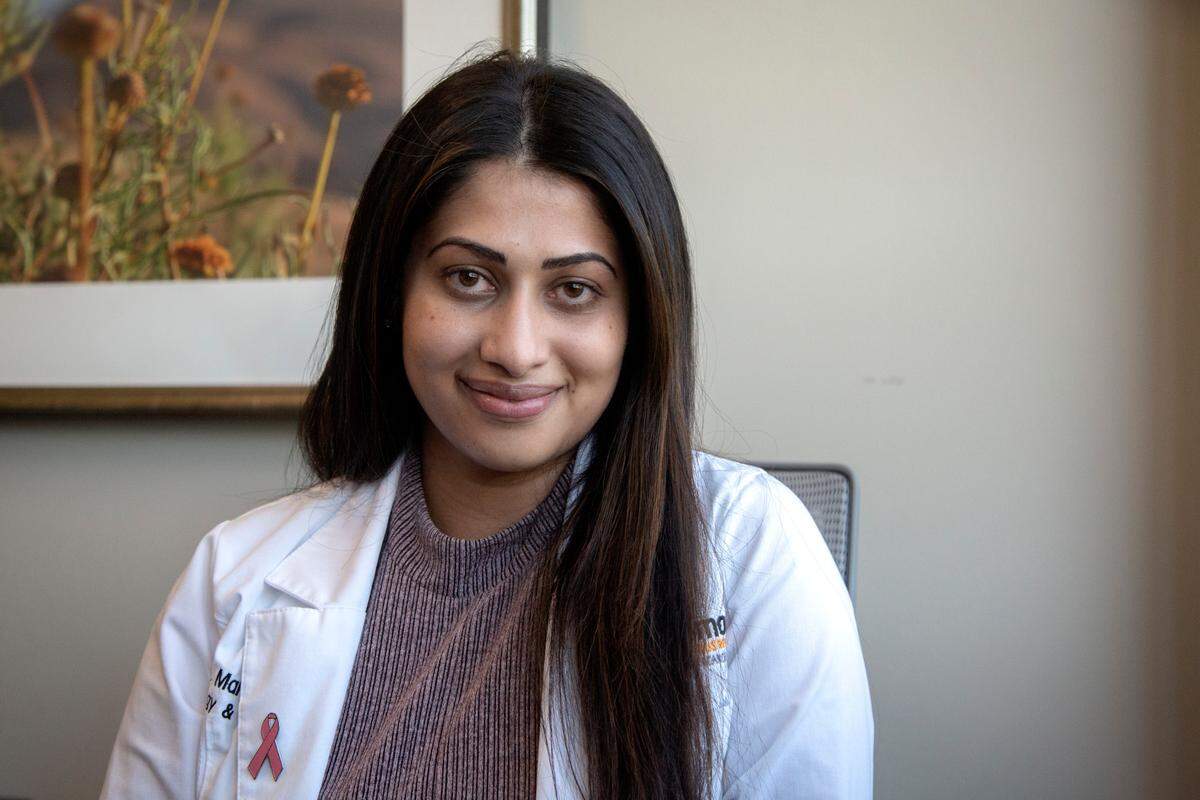
Maharaj became the first female medical oncologist at the John B. Amos Cancer Center since Columbus Regional Health merged with Piedmont Healthcare when she began working at the hospital last August.
Prior to the merger, Dr. Wendy Mahone-Johnson, a medical oncologist, and Dr. Vetta Barnes Higgs, a hematologist oncologist, worked at Columbus Regional Health.
Because breast cancer is one of the most common kinds of malignancies and an area of interest for her, Maharaj was thrilled to learn that she would be an option for women in the region.
“A lot of women, especially some of the elderly women, would be more comfortable with a female oncologist,” she said. “They’ll be able to discuss things that they otherwise wouldn’t with my male counterparts.”
The highs and lows of being an oncologist
Maharaj’s work days begin around 5:30 a.m., when she takes her dogs out to play fetch or tug of war. The 4-year-old shiba inu and 9-month-old lab shepherd mix rescues are an important part of helping alleviate the stress of her work, Maharaj said, along with her faith.
“I don’t think I can do my job without faith,” she said. “I think that carries me the whole time during this process.”
After playing with her puppies, she comes into work around 7 a.m. and sees her patients until the early afternoon, before doing paperwork and going to the hospital to do a round of patient visits. Her work day typically ends around 5:30-6 p.m.
Seeing her patients through their course of treatment and helping them reach their next birthday is one of the most fulfilling parts of the job, Maharaj said.
“I think it’s a huge deal for me,” she said. “It gives me a joy that I can’t otherwise describe.”
But with the highs, there also come lows. The worst part of the job is the feeling she gets when looking at a computerized tomography (CT) scan and seeing the patient’s disease has progressed.
“I have to tell them about this,” she said. “And what are we going to do next? I think that’s the hardest part of my day.”
When this occurs, Maharaj focuses on figuring out ways to help those patients’ quality of life, even if that means hospice.
Another challenge that comes with being a woman in medicine is the subconscious bias Maharaj has faced when doing her job. She’s had several instances of walking into a room with her white coat on and people not recognizing her as the doctor.
“A nurse with the badge saying RN would be addressed as doctor,” Maharaj said. “And I, standing next to the nurse, would be addressed as nurse.”
The education about feminism and equality has made strides, she said, but it’s not quite where it should be yet. Maharaj is hopeful that it will be better. Around 34% of oncologists are female, according to a 2020 report published by the American Society of Clinical Oncology Journal.
An arduous process
The journey to becoming a doctor is an arduous process, Maharaj said, and may take some over 15 years to complete, depending on the chosen specialty. Choosing to go into medicine is not something people should walk into lightly, she said.
“We have to recognize that, as females, it takes up a lot of our prime years where we would spend time saving up money to buy a house, buy a car, finding your significant other or bearing children,” she said.
When she was getting her education, Maharaj focused on the next steps to get to her end goal rather than the finish line. Becoming too focused on the ultimate goal might have taken away from her drive, motivation and momentum, she said.
Maharaj’s husband, Dr. Dhruv Chaudhary, has been her rock as she’s grown in her career, she said. The couple met during the first day of her residency internship at the University of Louisville, Maharaj said, and since then he’s supported her as her “cheerleader and strongest supporter.”
Maharaj and Chaudhary moved to Columbus because they wanted to get away from the rainy Pittsburgh weather and have more time in the sun in the South.
“I still can’t get over the weather,” Maharaj said. “The people here are wonderful. I love my job. So, I couldn’t really ask for anything better.”
She hopes to continue growing her practice in Columbus, Maharaj said, and plans to look into extending screenings in Georgia for breast cancer. Ensuring that underserved communities in Georgia have access to breast cancer screenings is one of her areas of interest, she said.
Maharaj also looks forward to more women being represented in medicine.
“It’s very important for women to have the opportunities that men do without the discrimination that women face on a routine basis,” she said.
This story was originally published April 1, 2022 at 6:50 AM with the headline "Meet the first female oncologist at the John B. Amos Cancer Center at Piedmont."