
LifePoint Health completes deal, purchases St. Francis Hospital
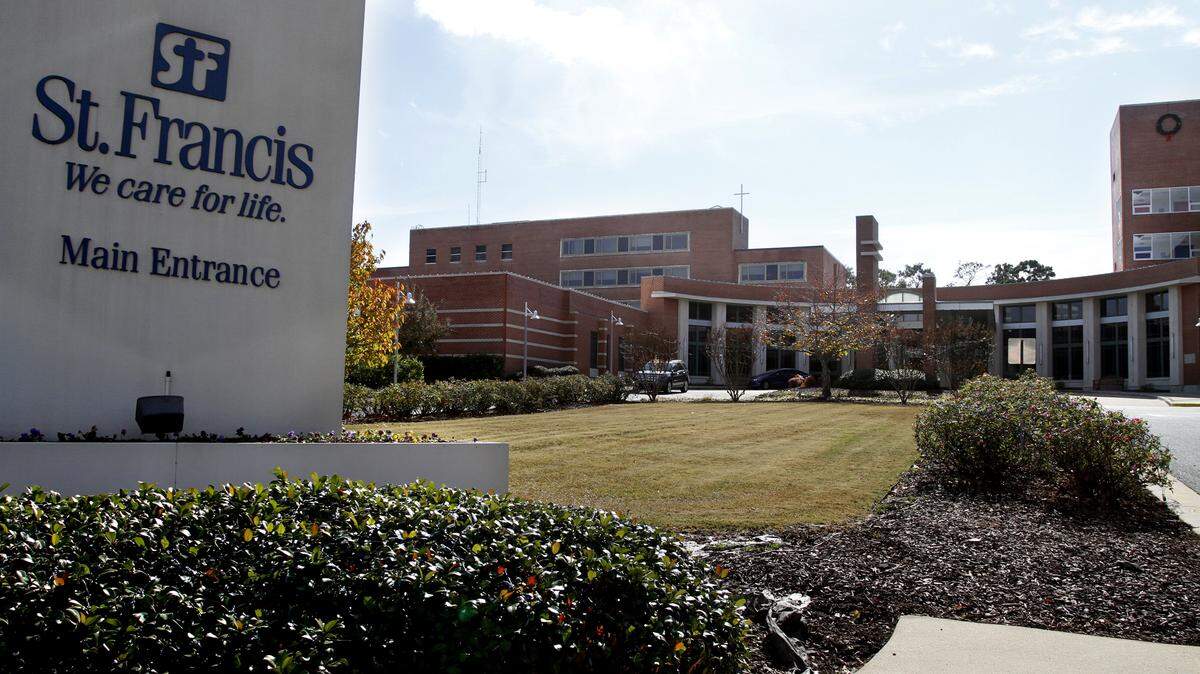
The much anticipated deal to sell financially troubled St. Francis Hospital to a Tennessee corporation was completed as expected late Thursday, LifePoint Health confirmed in a brief statement.
St. Francis has operated as a non-profit hospital since its founding in 1950. That changes with the sale to a for-profit corporation.
“We can confirm that the transaction has been completed, and an official announcement with additional information will be made on Monday morning, Jan. 4, following the holiday weekend,” stated the email from a LifePoint spokesperson in response to a Ledger-Enquirer question about the status of the deal.
Representatives from St. Francis and LifePoint had been saying for two months the deal would be final before the end of the year.
The sale to LifePoint ends more than a year of financial hardship for the hospital, located on Manchester Expressway. LifePoint has been a potential buyer since late July. On Oct. 2 the St. Francis Board of Trustees announced it had reached an agreement in principle to sell the hospital to a subsidiary of LifePoint. The deal had to be approved by the Georgia Attorney General’s Office because the board was selling a non-profit entity to a for-profit hospital corporation based in the Nashville suburb of Brentwood, Tenn.
Terms of the deal are not known, but LifePoint officials have recently told the Ledger-Enquirer they are assuming and paying off about $240 million in debt acquired by St. Francis. LifePoint will also fund the deferred compensation plans that could have been at risk. All of the hospital’s accounts payable will be satisfied.
St. Francis’ largest creditor is the U.S. Department of Housing and Urban Development, which has a hospital financing arm. St. Francis borrowed about $220 million from HUD for a major expansion and to consolidate other debt. That debt has been at the center of the hospital’s problems.
The HUD Office of Inspector General completed a nearly six-month audit in June and found St. Francis and its management did not comply with federal regulations and a regulatory agreement connected to the financing of its $252 million expansion and campus renovation completed in 2013.
Specifically, the audit report dated Sept. 3, 2015, said the hospital “submitted inaccurate financial information, improperly disbursed mortgage proceeds, incurred an unauthorized liability, and subjected mortgage funds to bank sweeps.”
The HUD audit confirmed issues the hospital had been dealing with for months.
In November 2014, St. Francis executives termed a nearly $30 million financial hole an “accounting inaccuracy.” St. Francis publicly disclosed at that time it had suspended Chief Financial Officer Matt Moore and that he had been “permanently relieved of his duties.” Longtime President and Chief Executive Officer Robert Granger, who had been a chief financial officer prior to coming to St. Francis, resigned in March 2015.
In July 2014, Granger was questioned by the Ledger-Enquirer about financial issues at the hospital, including issues with paying some vendors. He strongly denied there were any financial problems.
Granger repeatedly denied it and responded with a July 24 memo to his board that stated: “Clearly someone in the area has an agenda to smear our good name, and it is quite disappointing that an individual has chosen to do this. We will continue to operate as normal and enjoy the high road. The view is much better from there.”
LifePoint was the third suitor to publicly court St. Francis during the financial crisis. In January 2015, St. Francis officials announced they had entered into “exclusive discussions about a potential relationship” with Atlanta-based Piedmont Healthcare. Like St. Francis, Piedmont is a non-profit corporation. That agreement ended in March.
By early April, St. Francis was in “exclusive discussions” with a subsidiary of Franklin, Tenn.-based Community Health Systems. Those talks ended in a federal lawsuit filed by CHS seeking to recover more than $5 million invested in a deal that collapsed.
CHSPSC, a subsidiary of Community Health Services, said St. Francis “has intentionally hidden and lied about material facts regarding the hospital’s problems.”
That suit was still active early this week.
Despite the lawsuit, LifePoint continued to pursue the deal with St. Francis.
The St. Francis Board of Trustees has been primarily represented by two Atlanta law firms. Morris, Manning & Martin with Michele P. Madison as lead counsel and Troutman Sanders LLP led by Pete Robinson and Harris B. Winsberg have provided legal services during the complicated process.
St. Francis opened 65 years ago as the result of a community-based fund-raising effort as a 154-bed hospital. Today, it has 376 beds and employs more 2,700. The hospital has more than 100 physician/partners. LifePoint executives had said they will retain the current St. Francis workforce, pending completion of the company’s hiring process.
LifePoint was founded in 1997 and has grown into a leading healthcare company with more than $5.5 billion in revenues. The company owns more than 65 community hospitals, nearly 40 post-acute service providers and facilities including home health and hospice services, long-term care services, nursing homes and assisted living facilities and more than 30 outpatient centers, including urgent care centers, diagnostic imaging centers, ambulatory surgery centers, and radiation oncology programs.
LifePoint employs more than 1,300 physicians and has more than 40,000 employees.
Share of its stock are traded on NASDAQ. LifePoint, nearly a $3.3 billion company, closed Thursday at $73.40 a share.
This story was originally published January 1, 2016 at 7:01 AM with the headline "LifePoint Health completes deal, purchases St. Francis Hospital."