
Job Spotlight with Tricia Llewellyn, vice president of mission services at Goodwill of the Southern Rivers
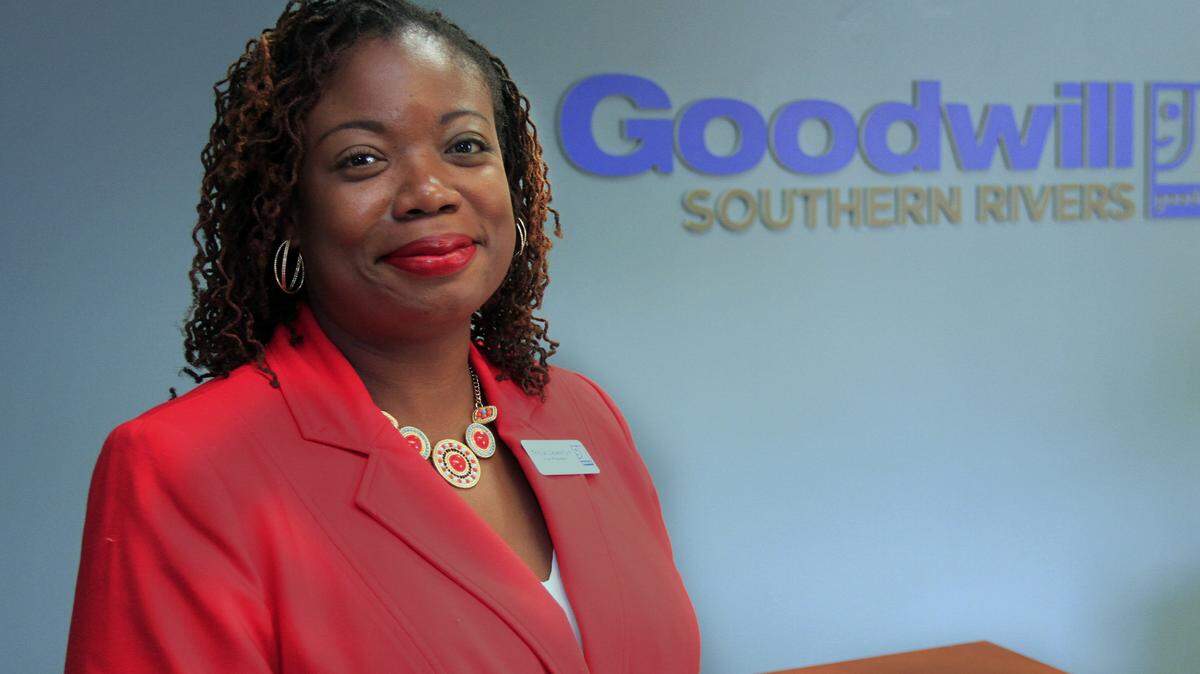
When Tricia Llewellyn left Michigan in April of last year to relocate to Columbus, there were two inches of snow on the ground wishing her farewell. Needless to say, she's found warm weather here to go along with the warm welcome she has received.
Nearly 18 months later, the New York native has also warmed up to her job as vice president of mission services at Goodwill Industries of the Southern Rivers. The nonprofit organization serves 50 counties in Georgia and Alabama, offering through its career centers job coaching, assistance with finding work, skills training and access to the Internet.
Goodwill, headquartered just off Macon Road near Cross Country Plaza, also works with employers to help them find qualified employees. And the organization operates retail stores to help fund its varied and critical tasks in the communities it serves.
The environment is the flip side of the one Llewellyn, 39, experienced upon launching her career with Chrysler Corp. many years ago, spending more than a decade with the automaker in sales and marketing. She also has worked with a state agency and a college in Michigan, helping to round out her own professional skills.
While she was born in Jamaica and grew up in Yonkers, N.Y., near New York City, Llewellyn says she's right at home in Columbus, working with Goodwill of the Southern River President and CEO Jane Seckinger to make a long-term impact on people's lives and help reduce poverty in the region.
"Honestly, my hometown is where my suitcases are at that time, and right now they're all unpacked right here in Columbus. I am appreciating it for what it is," said Llewellyn, the daughter of a retired schoolteacher and U.S. Postal Service employee.
The Ledger-Enquirer visited with Llewellyn recently at the Goodwill office on Cross Country Drive, discussing her job, the career path she took, and the need for the services her organizations offers. Goodwill throughout its 50-county area, employs about 600 people itself.
This interview is edited a bit for length and clarity.
Has your career, which included a major automaker, been by design?
I remember in college being told that we should all be prepared to have at least seven career changes in our lifetime, and I probably took that a little too literal. (laughs)
But every piece of it has led me to where I am now. I kind of like to talk to people about how I've pretty much sat at each leg of the stool. We talk about having social impact, whether it be in private sector, government, education or nonprofit. For me, it's all just kind of come together, and each piece of that journey helps to inform the next step. It allows me to bring a lot to the seat that I'm in now, some different perspective, understanding of how things work in different areas.
I like to say it makes me a pretty good translator, so I can speak between industry and sector and can truly understand and appreciate the challenges each area has.
What was it like with Chrysler?
Chrysler was a great place to start a career. I started out in their management training, so I started in New York where I grew up, in the regional office there. Then everyone has to go through Detroit at some point in their career. I went through Detroit, I think, four times (with stops in Eugene, Ore., Seattle and Chicago).
That's a lot of travel, isn't it?
Yeah. It was a corporate career, so there is quite a bit of relocation that happens. But it all allows you to continue to hone your skills, get different perspectives and, for me -- born in Jamaica, grew up in New York -- I got to see at least the northern part of this country. This is my first time spending significant time in the South. But literally, from one coast to the next, all in a northern swath, I was able to really fall in love, quite frankly. America is a beautiful country that I don't think many people get an opportunity in their lives to appreciate and spend time seeing. So I've been very lucky, very blessed.
At Chrysler, did you feel like a cog in a machine, with it being such a big company?
I would describe feeling like a big part of that well-oiled machine. When I say big part, one of the things that I appreciate about the private sector is that it's very clearly and easily delineated with the direction you're moving in. When you're dealing with a for-profit, your output is very clear. Your shareholders are your number one client.
And there's a lot of pressure?
There's a lot of pressure, and that pressure allows everybody to be extremely focused on the work that we're doing. I was there about 11 years, so you find your way in that machine. You understand that role you play. So, yeah, it was a great place to grow up, in corporate America, lots of wonderful experiences, and people that I treasure today, still communicate with today, an invaluable experience. It was wonderful.
That travel got you used to traveling in the 50-county area you work in with Goodwill?
I'm on the road quite a bit here as we travel between the nine career centers we have and to our retail locations in the region, not only in Georgia, but in eastern Alabama.
What's your day-to-day life and duties like here?
I travel throughout our territory, visiting the centers ... So it's being in the centers, participating in community events, meeting our (workforce) partners ... There's a series of administrative duties and responsibilities that I have here in the office, as well as out in the community.
And then nationally I do travel for the organization, keeping us connected to what's going on with Goodwill International and other Goodwills, my colleagues and some best practices. I'm often looking at and engaging in, firsthand, how we can better improve the services that we have and, quite frankly, share some of the great things that we're doing. So it's a really good mix of my administrative responsibilities, being able to connect with our team members, not only from a mission perspective, but on the retail side as well. We have 13 retail locations.
And it's being out in the community with our partners, be it Georgia Vocational rehab or (Veterans Affairs) or the local workforce board or economic development board or community college and university partners.
That's a lot of nonprofits to be working with?
The reality of this work that we do is that there's enough for everyone and no organization can do it alone. And we play really well, for the most part, in the sandbox, and trying to have an impact on the community.
Do you get to meet people that Goodwill helps, or is there too much office time?
That's what I like to do when I'm in the career center, even if it's talking to somebody as they're looking at our job board or coming out of a workshop or looking for a job on the computers or coming in on the weekends and helping people through VITA get their taxes prepared. I do get a good amount of interaction with our clients. I wish it was more, but I have a great team in the field working at the career centers everyday diligently on the front line.
The retail stores, with donations and sales, are critical for your operation?
We wouldn't be a nonprofit without the work that we do, and we couldn't survive without our retail partners and our donors and shoppers. It's equally focused. We exist to do our mission work ... We really believe in empowering people to live their fullest lives, primarily through the power of work and connecting them to work. But I can't do that without our donors and shoppers and retail partners.
Will the retail side grow larger?
We hope so. (laughs) There's nothing on our drawing boards. Our current footprint we have expanded in the last few years and now we're focused on really making sure we're a well-oiled machine and continuing to grow in those areas ... We do get a lot of calls from communities who would like us to make those investments (in a retail store or career center). But it's a matter of strategic growth to make sure that we're self-sustainable and that we have the donors and shoppers to sustain the mission work in our area.
Describe the difference between an urban Columbus and the rural areas you serve, and the challenges in those rural areas?
They're definitely more challenged in those communities. We always talk here in Columbus, in meetings, discussing transportation and how important that is in our community. So you can imagine how in smaller communities with fewer resources, those challenges are even bigger.
And we talk about diversity of industry from a work perspective, that the need grows when you go out into the more rural parts of our community. Population density also shifts based on those factors, but it is increasingly challenged when you're looking at placement opportunities, particularly for folks who have limited work experience or checkered work experience. You have fewer options as far as placements and transportation.
We say Columbus, but I think of our centers up north in Newnan, the metro Atlanta area, and they have many similar challenges. People need to be able to move from point A to point B, be it to receive our services or go to work. Those challenges are echoed throughout our entire territory.
What's the toughest part of your job?
The biggest struggle for me at times is what you mentioned before, balancing the administrative duties with the passion that I have to be in the field and with our team members who are on the front line. My work allows me to be there, but probably not as much as I like. Not only is it a tug of war with my schedule, but definitely a tug of war with my heart as far as where do I really want to spend my time, what do I want to be doing the vast majority of my time, and finding that balance.
That's because as vice president, I have those duties that I have to complete in order to keep our doors open and support the team that's there. But I would definitely say that's my biggest challenge.
Are there any rewards for you and your staff?
I get letters about our team members and the impact they've had on lives. That's the fun part. Because when you're often grinding and focused on the work and getting things done, having that human impact, having somebody reach back and say 'thank you,' it's absolutely special. That's what keeps us going.
Looking at the retail aspect of charitable organizations here, such as Valley Rescue Mission, which has opened stores as well, is that getting more competitive? Is the pie large enough for everyone?
The pie is large enough ... We have a very generous community in Columbus and throughout the territory.
But I think the retail landscape itself is more competitive today with the advent of large big-box stores, the advent of increased thrifting. So we're always looking for more ways to attract more donors and distinguishing ourselves by the work that we do. Valley Rescue Mission, for example, has a great program working with kids and the summer youth program, and that's awesome and we need them in the community. But that's not our focus.
When I talked about that pie being big enough, there's enough work to be done. So far, the community has been very supportive with their donations and their dollars by shopping at our stores to be able to fund that work that we all do.
So retail, I think, is competitive, period. And we are always trying to evaluate our processes -- and determine that we are distinctive enough in the marketplace, that people want to shop with and donate to us.
Does the Internet enter into your equation at all?
From the mission side of the house (career assistance), it's definitely impacted how we communicate and talk to the clients that come through the door. We still have a lot of clients who are accustomed to pen and paper, from an application perspective, from a resume perspective, from a tax preparation perspective.
So, yes, that's a large part of the education that we do and the skill building that we do in the community, is helping our clients understand how our economy has shifted in that way, our society has shifted in that way.
You've heard about the digital divide, and the digital divide is real. A lot of the clients who come through our doors need support with improving their computer skills, their Internet search capability skills, for finding a job, applying for work.
I think a lot of us who have access to Internet, and are in professions where we are using computers, sometimes take it for granted. If you don't have Internet at home, don't have a computer at home, you don't have the practice it takes to function in this increasingly digital society that we have.
For you professionally, where do you go from here? Do you stick with a non-profit? Return to big business? Do you have a five-year plan?
You know, I don't, and I mean that earnestly. I really don't.
The reality is, and this is probably going to sound really strange, the thing that attracted me to this organization, in this town, is the willingness of our board and our leaders to be daring at impacting poverty. And that's not always the case at a nonprofit. The way they're organized, they don't always allow us to be as daring as we want to be.
My ultimate goal is to be with an organization that allows us to focus on that long-term impact. It's one thing to help somebody where they are today (in life) and building their skills, finding the jobs that they want. It's another thing to stay with that person and help them understand what a career looks like, particularly if they don't come from a family with "career" as part of their vocabulary, who knows what continuing education looks like, what the impact of their finances and building financial wealth looks like.
Our CEO calls it the billboard test -- five, 10, 20 years from now, how have we helped that person be successful over time? That's a tall order. That's not something we're going to be able to do overnight.
So for me, I really haven't thought beyond Goodwill of the Southern Rivers at this point because we're just getting our teeth into it, you know. It's still pretty knew. We're putting strategy plans in place, building those partnerships that will make that vision a reality. So that's my focus right now is getting the work done.
And, quite frankly, I'm kind of enjoying the weather. (laughs). I made it through my second summer, which I wasn't quite sure last year if I was going to make it through one. Everyone kept saying (in whispers) 'Just wait until August,' that kind of thing. I was able to work out on the riverwalk the entire winter. So that works for me.
Right now I'm just focusing on the work we have at hand, getting to know the community in a deeper way, and enjoying that community on a personal side.
You have plenty of confidence. Where did you get that?
I've got great parents and great grandparents who believed that we (she and siblings) could do anything we put our mind to, and if we put enough hard work into it.
BIO
Name: Tricia Llewellyn
Age: 39
Hometown: Yonkers, N.Y.
Current residence: Columbus
Education: 1993 graduate of Roosevelt High School; earned bachelor's degree in communication from Lehman College, Bronx, N.Y., in 1993; earned master's in business administration from Michigan State University in 2005
Previous jobs: Held several positions in sales and marketing at Chrysler Corp.; state relations manager of State and Local Government Affairs at Chrysler; Meeting Employer Needs division director with Michigan Department of Energy, Labor & Economic Growth (now LARA); director of workforce and professional development at Henry Ford Community College in Dearborn, Mich.
Leisure time: Enjoys running half-marathon races, surf fishing and traveling
Of note: Born in Jamaica, West Indies; and German is her second language
This story was originally published September 13, 2015 at 12:00 AM with the headline "Job Spotlight with Tricia Llewellyn, vice president of mission services at Goodwill of the Southern Rivers ."