
Job Spotlight: Louise Hurless, executive director of Columbus Area Habitat for Humanity
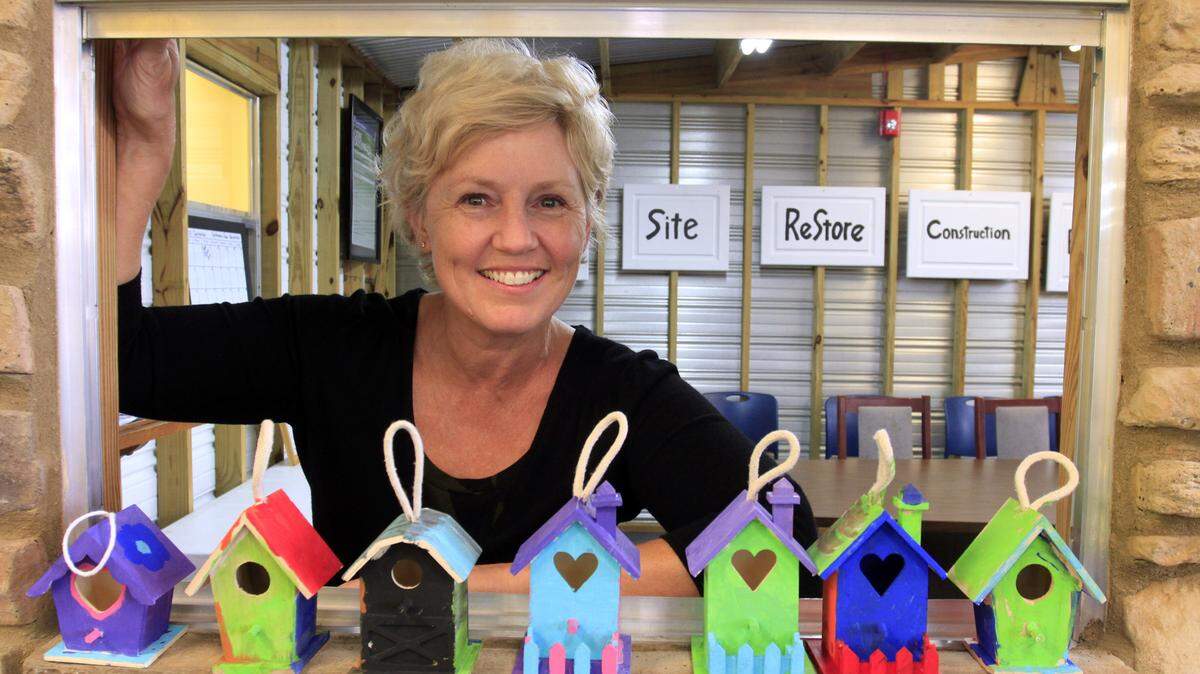
Louise Hurless admits to thriving on travel and adventure, having led groups of Habitat for Humanity volunteers on trips to build homes in Hungary, Portugal, Cameroon and Ghana.
Even personally, she has experienced some interesting moments. Those include spending two weeks in the Rocky Mountains helping to build a log cabin with four other families. Last January, the Michigan native also ventured to Canada for a weekend stay in a homemade igloo.
“Nothing is more peaceful than a calm, winter night with a full moon,” she says.
Now, Hurless, 55, finds herself settling into the job of executive director of Columbus Area Habitat for Humanity, an affiliate of Habitat for Humanity International, based in Americus, Ga., and Atlanta.
The Columbus organization was launched in 1984 and has built and put families in about 320 homes since then. Having started working here in February 2014, Hurless is striving to put the local affiliate in a position to increase that number at a faster pace.
She said the local Habitat hopefully will grow to constructing up to 15 homes a year. It also is now doing rehabilitation work on some dwellings and less-expensive exterior painting on others. In essence, the evolving focus helps even more residents of the city, she said.
“I think we’re headed in the right direction,” she said.
The Ledger-Enquirer visited recently with Hurless at her 3520 River Road office, which also is where the nonprofit organization’s ReStore retail store is located, having been moved there from its previous home on Martin Luther King Jr. Boulevard. The store sells donated home-oriented items to help fund Habitat’s work in the community.
Hurless discussed her job, the transition she has made since arriving here closing in on two years ago, and what she hopes to accomplish. This interview is edited a bit for length and clarity.
You still live in Leslie, Ga., near Americus, and drive back and forth each day?
I still commute. No one’s wanting to buy my house so much. It’s not too bad because there’s no traffic. It’s relaxing. I wake up and drink my coffee on the way here. On the way home, I unwind. It just keeps me from working too much. I have my house for sale.
What did you do in Americus?
I worked in the support center for two years, and that’s where affiliates can get all of the help they need, either by phone call or email, however we can support them.
What was your day-to-day role there?
I would answer emails and inquiries about what affiliates needed help with. I would help either with their policies and procedures or just questions about family applications, and board member information. I took that job after being at an affiliate for almost nine years.
That was the Barry County Habitat in Michigan?
Yep. I was the director there. I just wanted to help affiliates. I understood how much work it is to run an affiliate. It’s a lot. I wanted to work for international and it was time for somebody else to run the affiliate. Being there that long you do a lot, and it was just time to see what else was out there. I love Habitat work, so I heard they were opening a new support center (in Americus) and I thought, well, I’ll come down here.
How long were you in Americus?
About six or seven years.
Then this position came open?
I had a second (Habitat) job after the support center. I visited affiliates around the country to help with their government grants. I visited probably 80 different affiliates in a couple of years. I traveled a lot and I was probably gone 50 percent of the time. I really enjoyed it and I loved to see how affiliates operated.
And even though I loved the travel, it could only last so long. Four years of that was quite a lot. When you wake up not knowing where you’re at ... (laughs) ... Then affiliates started telling me they had job openings. It didn’t matter where it was. The last one was out west. They said come move out west, we have a job if you want a job.
I also missed all of the action at the affiliates. When you’re at corporate it’s a good feeling that you work at headquarters and everything, and you’re proud to represent Habitat, but there’s something about being in a community and being involved with homeowners and everything else. It’s a lot of fun.
Did you get some ideas from those visits elsewhere that you’re trying to implement here?
A little bit here and there. I’ll remember what I thought was a good idea as far as how we help our homeowners, what kind of classes we can offer them, different ways of governance of the board. Also I saw just how they interacted in neighborhoods when they would go build, how they would deal with people that lived there, how they treated them, how they approached people about building in their neighborhood. Just different things like that.
Because there are nuances to every affiliate and area in which they operate?
Some affiliates just build in the inner city, so they construct three-story townhomes and things like that. Some build out in the rural areas, in the country, and they may live on two or three acres. It’s all a little bit different, but we all practice the same core procedures.
The honeymoon’s over for you here. How has the first 18 months been for you?
It was a challenge at first just getting a grasp of how things were run around here and what role different staff members played, and just getting organized to see how and what we needed to do. Before I even was hired, I had a list in mind of what I wanted do, not knowing what the affiliate was all about. I’ve been checking things off my list. It’s been pretty good.
Was there anything major you wanted?
Well, I wanted more visibility, because anyone I knew who lived in Columbus or even at international, it’s so close to headquarters, but not too many people heard about Columbus Habitat. I was one of them. We would get a lot of information about affiliates and I never saw much about Columbus.
It’s a brand name, just about everyone has heard the name Habitat?
Yes.
Why is it necessary to have the visibility?
I just want to serve more families. I thought this was a pretty large community and I saw the numbers, and I did my homework before I got here and was able to research the affiliate. I thought, with this size community, we could do more. That was my main goal. I would like to see that increase.
The year before you came how many homes did the organization build?
It was kind of in a limbo time. There were a lot of projects going on, but the first year we only closed on two. So we finished up some existing projects the next year and we closed on 11. So we were happy.
One change you made was moving the ReStore location from Martin Luther King to here?
Yes. Even though our store was OK and was successful in the other location, nobody ever saw us. Not too many people drove down that street to go shopping. Unless you knew the store was there or had heard of it, you really didn’t go there. So it’s been helpful to be a lot more visible.
This site on River Road at Veterans Parkway is farther north. How has it been with the store here?
It’s been really good. We had our little adjustment time while we were moving and just basically redoing the place. Our sales were down. But we set some goals of when our moving costs would be done, and when we could see things start changing, and they’ve been almost right on. We had some slow time. We all agree with that.
Just like any business that relocates?
Thank you. And we planned that. We planned for the slow time and we knew that would happen. But what we’ve seen is a lot more customers than we’ve had before. The guys know the customers. They knew who came in the store before, and they said on our opening day it was probably 90 percent new people. That was really nice.
This location is great for your retail operation?
Yes, and for our homeowners, too. We’ve had people come in for applications that just saw our sign outside. Again, how many people just drove down our old street and saw our sign and knew that we were a housing place.
Another thing that’s been helpful is having that (storage shed-esque) meeting room here. We’ve been able to have meetings and other groups come here. So that’s been helpful to learn more about other organizations and have them come here and learn about us.
Another thing is at the other location, people thought it was only the store or thought it was only the office. They didn’t know it was both. We also have room here for activities and that’s kind of nice.
What’s your goal for building new homes each year?
I never want it to go below what we did the year before. So I would like to see a 10 to 25 percent increase every year. We can do that in different ways. It doesn’t have to be a new house. We now have the program where we rehab houses, and we can also do just minor repairs or we can do outside work, like painting. So I would like to see those things rolled into our program as well.
That’s somewhat of a change for Habitat?
It used to be with Habitat that they just counted new houses. As time has evolved with the housing problems and everything, and the mortgage failures, we count families served. So we count new construction, rehabs and repair. It’s more about serving families than counting numbers. This year, we’ll probably have a few more rehabs than we have in the past and those will make our numbers go up. But they’re not as time consuming or costly, so if they’re available we’ll do them.
How bad is the need in Columbus for your assistance?
There are some pretty rough neighborhoods, and we’re at the point where we have to start working with some other groups to make an impact because we have lots that are random here and there. But we won’t put one family in a real bad neighborhood all by themselves. So we also are assessing the property that we have and seeing where we can either purchase more lots, get them donated, or work with another group so we can do a concentrated effort.
In essence, put a little more thought into the entire process?
Yep. We have a group of houses in one neighborhood. There’s probably 18 houses in that neighborhood, but it’s still a rough neighborhood and we’re seeing problems with our homeowners. That’s a project down the road where we would like to look at the whole thing and see how we can help improve our existing homeowners there. There’s some boarded-up houses that need to be torn down and maybe we can revisit that.
What contact does your organization have with the city?
Most of my phone calls are to the (tax) assessor’s office to see who owns what property and things like that, and to see how we can acquire the lots around us. That’s mostly who I work with. Unfortunately, we’ve had to have the ‘weed enforcer’ call us saying ‘mow your properties.’ But that’s actually been helpful because when we’ve gone to the sites with them, they’ve said, well, the city owns that one and this one is privately owned. They know their neighborhoods.
I would like to take our board members on a field trip someday to the neighborhoods, to show them what we’re facing and why we may have 40 lots on our list but we can’t build on all of them. We’re getting a little fussier about what’s donated to us as well. I don’t know if, over time, we just ended up with oddball lots or what, but there’s some that we won’t ever build on. People like to make a donation. I’ve changed that. If someone wants to make a donation, we need to make sure that we can do something with it — and the title is clear. The title issue has been crazy.
None of this stuff you’re dealing with is new to you? Do you like it?
Part of the job I like is unsolved mysteries, such as with land. It’s a fun challenge to work things out and make something work. With projects I’ve had over the years either at international or at the other affiliate, sometimes we would get things that nobody wants, whether it’s property, whether it’s stuff in the ReStore, whether it’s homeowners that can’t get a mortgage at another place. So you figure out how you can make it work, and that’s kind of what I like.
You’re a problem solver?
Yeah, a problem solver, and (it’s) a scavenger hunt sometimes. You have to be creative. You can’t come in here with a closed mind. You can’t, because everything’s different. Everyone knows that with a nonprofit, their life is not like a regular business. I think that’s one of the challenges, because we have to be professional. We have to follow all of the laws with the mortgages and we have to follow all of the laws with family selection and homeownership. There’s a lot of professional things we have to do, but on a budget.
So when people say, ‘Oh, you’re just a nonprofit,’ well, that’s not a very nice thing to say, you’re just a nonprofit. We’re a professional nonprofit. We don’t make extra money, but we have to act professionally. That can be a challenge sometimes.
How do you fund operations, through donations and ReStore?
There’s donations of cash by individuals or businesses or churches. There’s grants that we can apply for at different places. There’s foundations that we can request money from. Our store is a fund-raiser. We get gifts in kind that account for things we don’t have to buy; we get that from our community and habitat international. That’s a big help. It’s a little bit of everything. And our mortgages are a big source of our income.
You underwrite the loans?
Yep. I would like to have our mortgages serviced someday, because servicing 200-something mortgages is a lot of work. That money comes in to our budget for our operations and more projects. Right now we’re kind of holding our own. One way an affiliate can grow is to not depend so much on their current mortgage money. That was how Habitat got started; the mortgage money was called ‘Fund for Humanity’ and that helped build new houses. So it does, but you also want to increase those numbers. So we really have to work on other ways (to increase) our income.
How many folks do you have on staff here?
There’s 11 of us ... We’re hoping to have more. As the ReStore grows, we most certainly need more staff out there. Fortunately, we have volunteers, but we all know volunteers aren’t regular. We try to schedule as much as we can, but there are some times when there’s not enough staff around. I would like to see a few more people in the ReStore, and we actually have an empty office in our hallway, so maybe someday that will be filled with somebody ... We’ll be hiring a manager at ReStore before long, I’m hoping.
What’s the toughest part of your job?
Realizing everything won’t be done all the time. It’s kind of ‘going’ all the time. You can check off things on your list everyday, but you’ll never ever be completely done, ever. It’s not like some jobs that at the end of the week, you’ve got everything you’ve set out to accomplish done and Monday morning you start fresh. This is ongoing.
Does that constant churning frustrate you?
I try not to let it do that. That’s why I like my ride home. I can unwind. But there’s also a lot of accomplishments that are pretty cool. You can have a homeowner come in and they want to make the last payment on their house. Those kinds of things are fun. Or you have a group of volunteers who have never set foot at a job site before, and they all learn something new. And that’s fun. So all of those kinds of things make it worthwhile.
Is a favorite thing for you simply getting out to a home work site?
Yes, yes, because I like being able to go and swing a hammer once in a while and work with the volunteers. And I find (you’re noticed) if you just wear your Habitat shirt out in public. I was with our construction manager one day and he has the logo on his van, so we were waiting for our lunch and somebody asked about the logo. So you just talk to people wherever you’re at and that’s kind of cool.
Bio
Name: Louise Hurless
Age: 55
Hometown: Wyandotte, Mich.
Current residence: The countryside of Leslie, Ga.
Education: Graduate of Theodore Roosevelt High School in Wyandotte, Mich.; earned a bachelor of science degree in human services from Lake Superior State University in Sault Sainte Marie, Mich., in 1981
Previous jobs: Worked with Habitat for Humanity International in Americus, Ga., and was executive director of Barry County Habitat for Humanity in Michigan
Family: Son Justin, and daughter and son-in-law, Hilary and Scott
Leisure time: Enjoys working in her yard and garden and likes to paint, draw and write stories
This story was originally published October 10, 2015 at 9:20 PM with the headline "Job Spotlight: Louise Hurless, executive director of Columbus Area Habitat for Humanity."