
Job Spotlight with Zipporah Horton, field recruiter, administrative assistant and job placement coordinator at Georgia Driving Academy
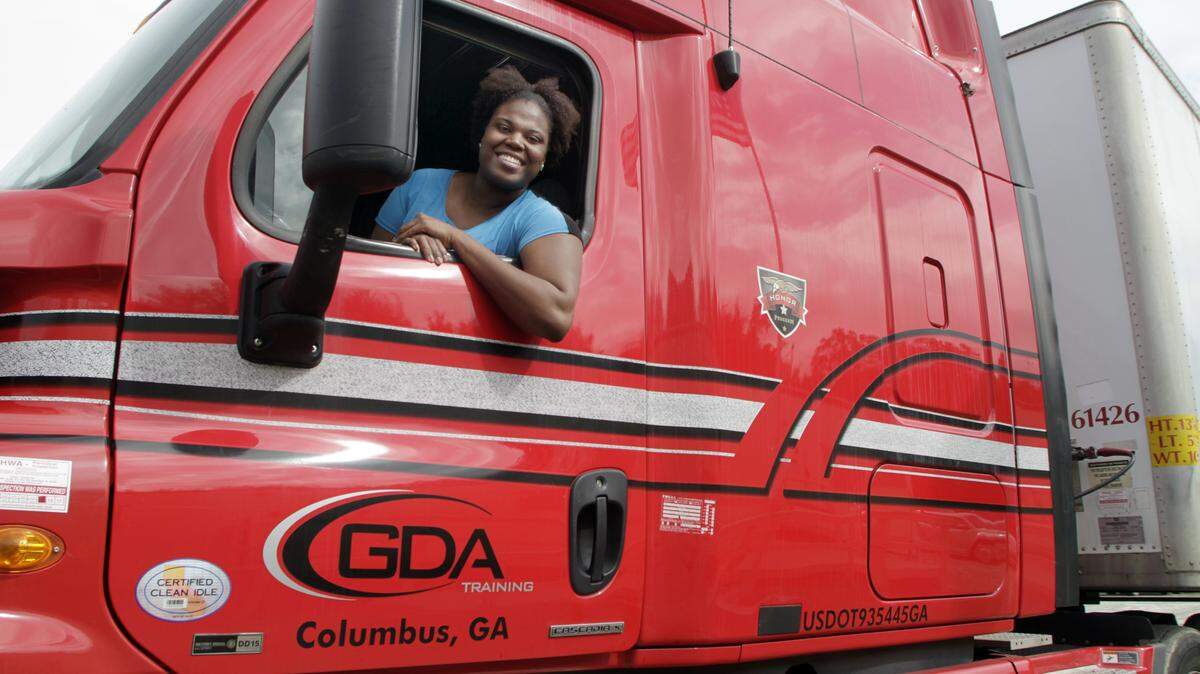
It’s not a stretch to say that Zipporah Horton is driven to help people develop a skill that will put them on the road to good, honest, steady employment in an industry that shows no signs of slowing down.
That’s because Horton, 34, is a field recruiter, administrative assistant and job placement coordinator with the Georgia Driving Academy on Morris Road in Columbus.
The daughter of a U.S. military retiree — she herself is in the Georgia Army National Guard — works with academy manager John Rinder and a fairly small staff to successfully train men and women to become truck drivers.
It’s an industry that is in constant need of new employees, with retirements of over-the-road drivers picking up pace and putting a strain on trucking companies working to keep their businesses running constantly with solid, safe personnel.
The U.S. Bureau of Labor Statistics estimates there are more than 1.7 million heavy and tractor-trailer truck drivers across the nation, with nearly 200,000 more needed by the year 2022 to avoid issues with hauling goods and materials to customers.
The bureau says the 2012 median pay for such drivers was $38,200 per year — some making higher, some lower — with Horton noting that students, after graduating and getting a license and putting in a year of long-haul trucking, can earn between $40,000 and $45,000 annually. Not bad for a job that requires training and testing, but no college degree.
The Ledger-Enquirer visited recently with Horton at the Georgia Driving Academy, where she discussed the job she has held nearly four years, the training offered there, and why she enjoys making a difference by helping people find security in both their jobs and their lives.
This interview is edited for length and clarity.
(Click here for Georgia Driving Academy on Facebook)
How did you land this job?
I’m actually in the National Guard and have been there for nine years, and one of my fellow guard members was working here (as manager) and he knew that I helped out with administrative tasks at our unit. So he let me know when an opening was available.
What do you do in the National Guard?
I’m a combat medic. I was deployed with an infantry unit, so we were out on (forward operating base) for about six months while we were over there.
Why not choose the medical field for a career?
Well, my passion is business. I love doing medical work, but I would rather be on the business end of it, than the hands-on medical stuff.
You’re from Columbus?
I’ve been in the area about 20 years.
What have you done before this?
I actually was unemployed; I was a full-time student and I had just came back from Afghanistan. I went to Afghanistan in 2009 and 2010 (about a nine-month stint). When I came back, I entered school, and then I found out about this position.
What are your duties here?
Day to day, I do administrative work, like paperwork. I contact companies on students’ behalf. I’m always looking for new companies to work with us and accept our students. So I’m kind of like a liaison for the students and the companies they’re going to work with. I track the students once they finish. Both myself and John (Rinder) have multiple stuff we do here. The financial stuff, I handle that. It’s basically anything that would need to be done, I have a hand in it.
Is there any down time at all?
A lot of times, I eat lunch while I’m working. But, no, as soon as I get in the door, I’m working.
Can you drive a truck?
I cannot. I actually was going to start the program up in Conyers (Ga.). This is a branch. We have another school in Conyers. I was going to do weekends there to get my license, but I play basketball as well and got picked up by a semi-pro team at that time. So I started playing basketball and it was interfering with the two. Since I was getting the license to just have the experience ... I kind of let it go. But I’ll probably go back and get it.
That would help you relate more to students?
Right, and especially with females. We’ve always had a woman here or a woman there, but here lately I would say about 25 percent of our students are women.
Does that surprise you that more women are getting into trucking?
Honestly, no, because women are getting into those industries that were traditionally male industries. Women in trucking right now is at an all-time high. Companies are realizing a lot of these women will come to work for their company. But some of them have a fear of ‘women have to be in a truck with a guy they don’t know,’ so (the thinking is) women truckers can be trained to be trainers who are top notch. Companies are looking for female trainers..
This is the oldest truck driving school in Georgia?
Since 1995. We’re privately owned and operated. This branch here was opened in 2011. But we’ve been in Conyers since ’95. We’re the only CDL (commercial driver’s license) school in the state of Georgia that has simulators as well ... The students actually go through the simulation of shifting the vehicle.
How many people approach you to train for trucking?
On average, in about a week’s time, we get anywhere from 30 to 40 phone calls. But they can go on the website and request information. From that, we get about 50 from Columbus alone. But Conyers has their own leads as well.
And you would be surprised how young they call. We have 18- and even 16-year-olds calling and they’re like, ‘I want to drive a truck.’ (laughs) We tell them we can help you once you get older. We can actually train at 18. But state regulations say you have to be 21 in order to take a commercial vehicle over state lines.
Is there a recurring reason why these folks want to be in trucking?
I wrote down some figures for you. The shortage for trucking right now is there’s a need for 20,000 to 200,000 people, depending on who you get the research from. Right now Georgia needs at least a 20 percent increase in truck drivers. That’s because of the Savannah ports. With the Savannah Port System, the truck-driving industry is looking for more employment.
Then there are the benefits. You get full medical benefits. Starting out you can look at anywhere from $40,000 to $45,000, depending on what division you go in to. There’s always been a truck driving industry, and it will always be here.
A lot of the truck drivers out here now are looking to retire. With that, companies are looking for people to take over for those drivers. They’re all competing with one another.
Getting an entry-level driver is kind of like having a piece of clay that you mold into what you want it to be. So they don’t have any types of bad habits, and they can learn the way that company works. That’s what the companies are looking for, not only getting the students in, but keeping them with their company. So they’ll compete pay wise. They’ll compete in benefits. They’ll compete with time home. You can basically tell the company, ‘I want to do this. Can you work with me?’ If not, you can find somebody that will.
It’s essentially an employee’s market?
Yes, it is, very much so.
The overarching factor in the training is safety, considering big rigs are so large?
Correct. We do review everyone that comes in. We can’t help everybody. But if for some reason we can’t help someone, we’ll let them know what their deficiency is and what they can do to get their driving record to a place where they may be able to drive trucks.
What would disqualify someone from getting a commercial driver’s license?
Certain things that do you, such as some traffic violations, will cause you to get a CDL disqualifier, meaning that for a specified period of time you cannot apply for a CDL — no permit, license, nothing until that comes off. That’s actually a good thing because it’s part of the safety aspect of it..
That can last how long?
I’ve seen it indefinite, like for repeated speeding tickets or multiple DUIs. The state will actually block you from getting your license, which is very good.
What percentage of people entering training make it through?
We just went up from four students to a maximum of eight students, because we want to make sure that environment stays very family oriented. ... We have our guidelines we stick by, but we don’t turn anyone away if they’re having difficulty picking up maneuvers or if they’re having difficulty getting their permit, because everybody learns differently. We understand that.
So rather than say, you can’t pass the permit test the first, second, third time and we’re going to throw you out, no, we’re going to assist you and figure out where you’re weak at and get you to where you can get that permit. ... We do give students as much one-on-one time as we can.
How long does it take to go through training and get a license?
We can’t put someone right out of school into a truck. So the truck driving industry actually does what’s called a finishing program. When we train them, it’s just the bare basics. Our program is 18 days. It is a quick program, but it is long hours. It’s basically like a workday, because our students come from 7 in the morning to 5:45 in the evening. They get a 45-minute lunch and they have scheduled breaks throughout the day.
What do they learn?
We break it into three phases. The first phase is based on permit, everything they need to know to get their permit. Also we go over the FMCSA, which is the Federal Motor Carrier Safety Administration. We go over Department of Transportation rules and regulations.
The second phase is when they go on to their yard and backing maneuvers. In the state of Georgia, they have to pass three maneuvers. We teach six ... we teach students how to use their truck and their mirrors to make backing maneuvers. We also stress that backing should be a last option, and that you should have a spotter, if at all possible, if you just have to back up.
After the yard, they move onto the road. We teach them everything they’ll need to know to pass the state skills test. We set that up for them and they use all of the same equipment that they’ve trained on here at the (test) site. And then they test here in Columbus, off Schatulga Road.
Are there some students who just can’t grasp things?
Since I have been here, we’ve had probably a 99.8 percent passing rate. We have had one student that I know of who just could not pick up the Class A (permit). You have to have those cognitive learning skills.
What type of license would, say, a FedEx driver need?
It really depends, because of the tractor trailers — I think all FedEx loads are doubles, which is a tractor and two trailers. That would be a Class A. But the vehicles that are dropping off packages would be a Class B, depending on the weight limit of the vehicle. The Class A covers both Class A and Class B vehicles. The only thing it doesn’t cover is a passenger bus. For passenger buses, they have to have a passenger endorsement, which we offer that training as well. That allows them to operate a bus with 15 passengers or more, including themselves.
Theoretically, in the industry, you’re guaranteed a job after getting your license?
Theoretically, if you are honest with the information that you provide us, your driving record, your criminal background, things of that nature, and you’re honest with your application for the company, our students will know their options for jobs by week two.
I do a job placement presentation with them on the first day of the program. They then fill out their applications and I send them out (to employers) on Monday of the second week. By Monday evening of the second week, they’ve got calls from the majority of applications. By the end of the second week, they should know at least their top three choices to go to work.
Multiple offers are not unheard of if you’ve done everything correctly?
Right. Our job placement percentage would be 100 if it weren’t for some people, you know, their mom or girlfriend pushing them into the industry. They finish but then they say, ‘I didn’t want to do this in the beginning, I’m not going to work. I’m going to find something local.’ ... But once students finish the program and they work over the road for a year or so, they’re considered an experienced driver and that opens up the local market for them.
Is it pretty much every trucking company out there hiring these days?
Yes, there’s Werner, Roehl, Steven, McElroy, TransAm, Schneider, U.S. Xpress, USA Trucking, Paschall Truck Lines, and others.
There obviously are a lot of details you must know for your job. Are there plenty of changes to stay on top of?
The learning curve is, I like to say, infinite. (laughs) I’ve been here four years, and everyday there’s something new with a company or a (change) in regulations. There’s always something changing. It is the (federal) government and it is the state.
What part of your job do you enjoy the most?
People. Meeting new people. I like someone who may have gone from worrying about, ‘What am I going to do for money. What am I going to do for bills?’ (to job security). I like it when people come in and they’re in that category. Then they give me a call a year later and say: Hey, thank you guys. I’m doing so much better. I’ve got this going on. I’ve got that going on. I’m actually going to buy my own truck and be an owner-operator.
That’s what keeps me in the industry and what keeps it going for me ... I would say in a year’s time, we get 20 or 30 students who come back here. They’ll bring their trucks with them. We’ll get pictures of them with their trucks and put it on our Facebook community.
What’s the most challenging part of your job?
I would have to say it would be people. It’s a double-edged sword. It is really disheartening to have someone that really wants (training and a job) and they have something going on in their criminal background or they have something going on with their driving record, but they have to wait for it. I’ve had people that have had to wait a year, a year and a half, or two years, and they’ve come back and say: I’m good to go now, let’s go. So to turn people away is something that’s hard for me.
Do trucking companies contact you seeking drivers?
I get calls three or four times a week, from moving companies, road construction companies, Coca-Cola, Pepsi, and others looking for Class A drivers.
What do you tell them?
I tell them if we have a student that’s interested in what they have to offer, then we’ll let the students know. We would like for students to go with a company over the road for at least a year, because that is what’s going to get them their experience, and that’s where they’re going to get the most out of their license.
Are military people among your students?
Yes, the military is downsizing. They actually have a program where if you’re 180 days out, close to your ETS (expiration of term of service), they will let you out even earlier if you have a job lined up that will pay you equivalent to what you’re making in the military. That program is really good. Another thing is most companies will honor your post-9/11 GI Bill.
So a fair number of trucking students are from the military?
Yeah. When we were doing four-person classes at a time, some classes would all be military. So now, out of classes of eight, we will see maybe two or three military. We offer a weekend class, which is big with the military because it’s not only two and a half months long, but it allows the soldiers to do something on the weekend to set up something once they get out of the military.
Financial assistance is available for students?
We do work with the Department of Labor. If someone is unemployed, the department will actually fund them to come to school, as long as they fit in with the requirements of their driving record being good and their criminal background being OK. Just because you have a criminal history does not mean you cannot get a license. It just means that some companies want that criminal history to mature a little bit. We don’t take HOPE or Pell because we are a privately owned and operated school, so we don’t take Title 10 benefits.
What’s the next career step for you?
I would like to say, hopefully, that GDA could open up another branch and I would be able to be a school director at a new branch. Even with what I’m doing now, I could transfer into another truck-driving company and do kind of the same thing I’m doing here. This really has opened up a lot of doors for me. But right now, this is home. (laughs) Everyone here, we’re like a small family, and that’s the way we like to treat the students who come through here as well, as a part of the family.
Will you be sticking with the National Guard?
Oh yeah, I’ll stick with them until they kick me out. (laughs)
Bio
Name: Zipporah Horton
Age: 34
Hometown: Born in Fort Myers, Fla., but is from a military family who retired here, so she considers Columbus home
Current residence: Columbus
Education: 2000 graduate of Russell County High School; earned associate degree in criminal justice and corrections from West Georgia Technical College in 2005; earned bachelor’s degree in business administration and management from the University of Phoenix in 2014; working on her master’s in business administration at the University of Phoenix.
Previous jobs: Work in retail sales and the fast-food industry, and serves in the Georgia Army National Guard as a medic, having deployed to Afghanistan at one point
Family: Single mother of one son, McKyle Horton, 12, and a Dalmation mix pooch named Perdita
Leisure time: Plays the position of center with Fort Benning’s women’s basketball team, competing against various colleges, junior colleges and military teams from other installations; she also gardens at her home, saying “I actually lost two girls in the last three years to premature labor. When I bought my house, I created a garden in their memory. It’s tough, but at the same time I think everything happens for a reason.”
This story was originally published November 7, 2015 at 8:55 PM.