
Longtime Columbus laundry business turns to making hospital gear during COVID-19 pandemic
The linen, laundry and tailoring business fades fast, when an epidemic hits in the spring.
Proms, graduations, weddings, restaurants, conference centers, hotels — all drove customers to Columbus’ Wade Companies for alterations and cleaning to employee uniforms, tuxedos, gowns, tablecloths and bed sheets.
When the novel coronavirus forced closures and cancellations, all that business vanished.
The 80-year-old family linen and dry-cleaning company’s commerce was cut by half, said George “Tripp” Wade III, whose grandfather George Wade Sr. started the business in 1939 on Linwood Boulevard.
Tripp Wade remembers how the steep decline hit.
“March the 13th, ironically being a Friday, I recall my first concerns, hearing about the virus in a new way…. I was actually out of town, and they canceled school that day and the following week, and I think that’s how it all began for us.”
Then restaurants closed.
“In the beginning, obviously our revenues started to decline when restaurants started to close,” he said. “About 35 percent of our revenue is the linen service, dedicated to the hospitality sector.”
Now the company, considered essential during the COVID-19 crisis because of government contracts to clean and maintain military uniforms and healthcare linens, has repurposed its operation to fill another need — the personal protective gear that has been in such short supply.
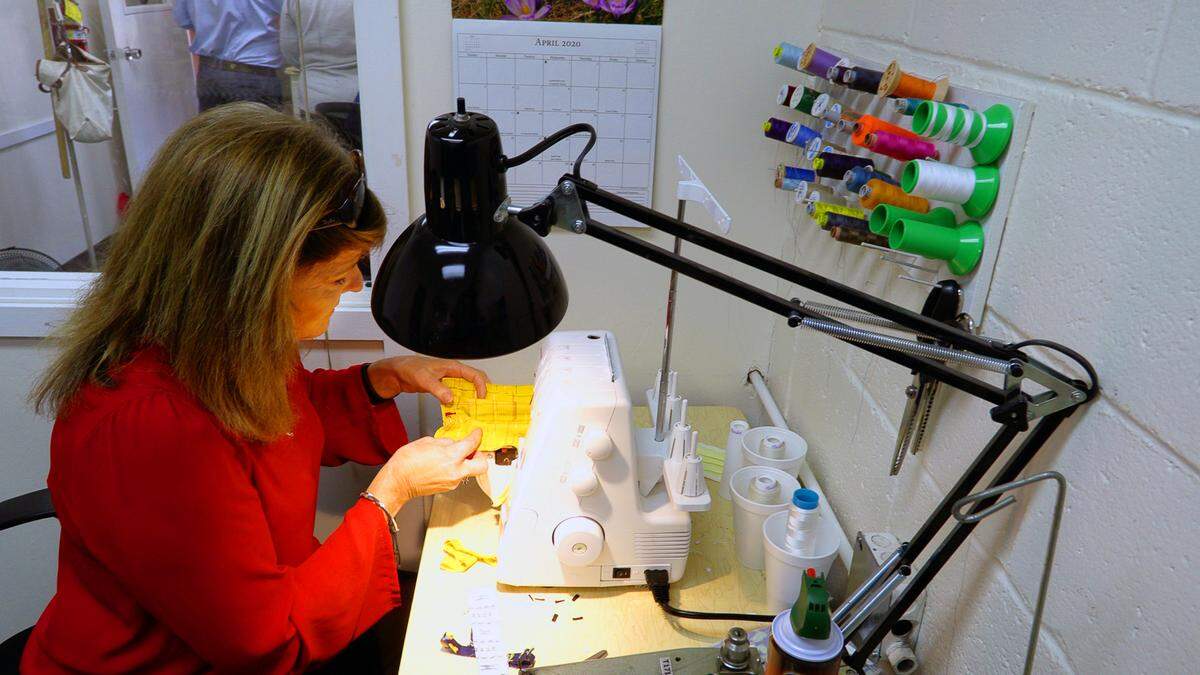
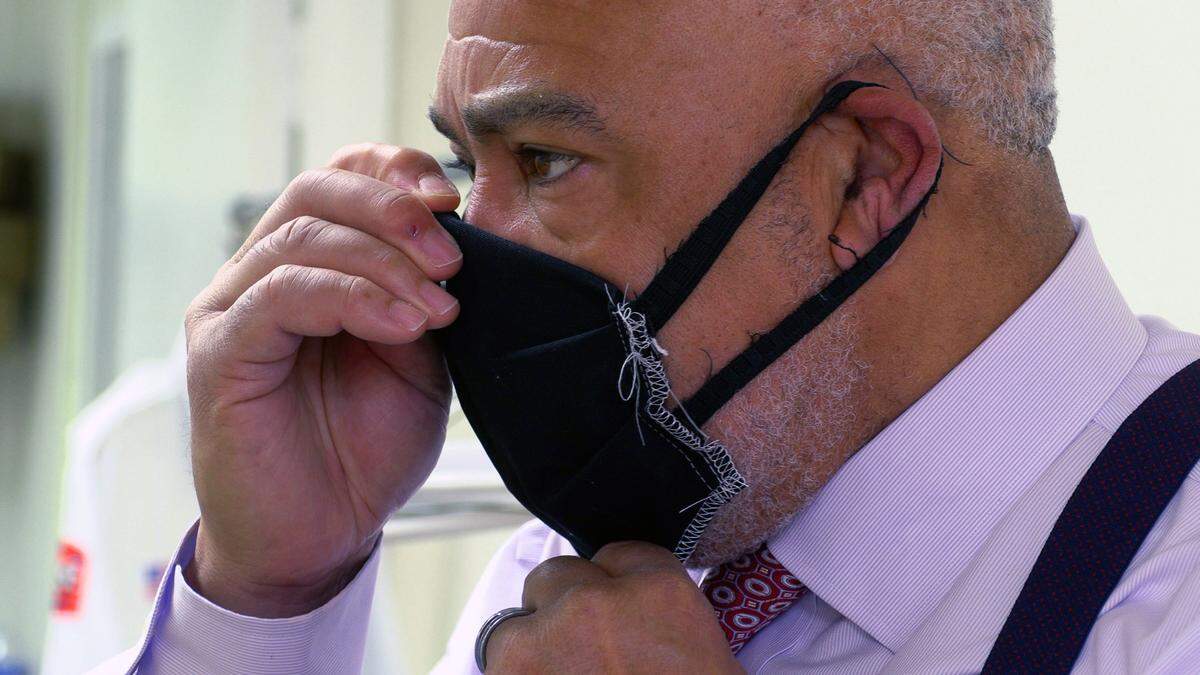
“The first thing we did was to start using our alteration personnel to make masks, which we’re continuing to make,” Wade said. “At this point, we have a waiting list, and they’re in there sewing away right now. … We’re doing some barrier gowns for our local hospitals and healthcare communities.”
Those gowns are reusable, so the company can launder them under the same sanitary standard already required in its cleaning contracts with Piedmont Columbus Regional and St. Francis-Emory Healthcare: A mix of heat, bleach and peroxide that kills viruses and other biological agents.
The dearth of PPE began before the virus emergency, because a recall on disposable gear cleaned out the available supply.
The recall
Wade’s chief operating officer Kevin Loncher said the recall pulled around 9 million PPE items off the market, prompting a run on what remained.
“All the regular buyers of disposables went and bought up all the resuable that was in stock,” he said. “And they bought everything — they didn’t just buy the barrier gowns. So when this hit really hard, there was no way to really supply their needs ... and that’s why people started coming to us and saying, ‘Hey, we need these, and we know you guys can launder them, because you’re a healthcare laundry.’”
But the company needed designs, material and more machinery.
Creating a functional mask took practice. Each has an embedded “high efficiency particulate air” (HEPA) filter that blocks anything larger than .3 microns. Wade lost count of the prototypes: “I can’t even begin to tell you how many we went through to make the best we can the quickest we can, and to fulfill the needs,” he said.
Finding material for the surgical gowns was another challenge: It’s a nylon fabric with a coating that can block infectious agents, yet remain breathable enough to feel comfortable.
“We’re getting it all over the country — Dallas, South Carolina,” said Loncher. “You’ve got to remember, this is not an industry we were in, that long ago. We were always laundering it, but we were never making it before, so we had to get all that information together.”
Despite such obstacles, the first shipment went out March 20.
“People were desperate. I mean, it went quick,” Wade said. Customers were hearing they’d get no more disposable PPE for six weeks to two months. “They were very concerned that they were going to run out.”
Now the company can’t keep up with the demand.
“I can tell you that we’re nowhere near our target,” said Loncher. “We need more seamstresses. We’ve got half a dozen of them working right now, and we could use a few more. We’ve got people that have never worked in any kind of seamstress or tailoring who are cutting and prepping material and stacking it.”
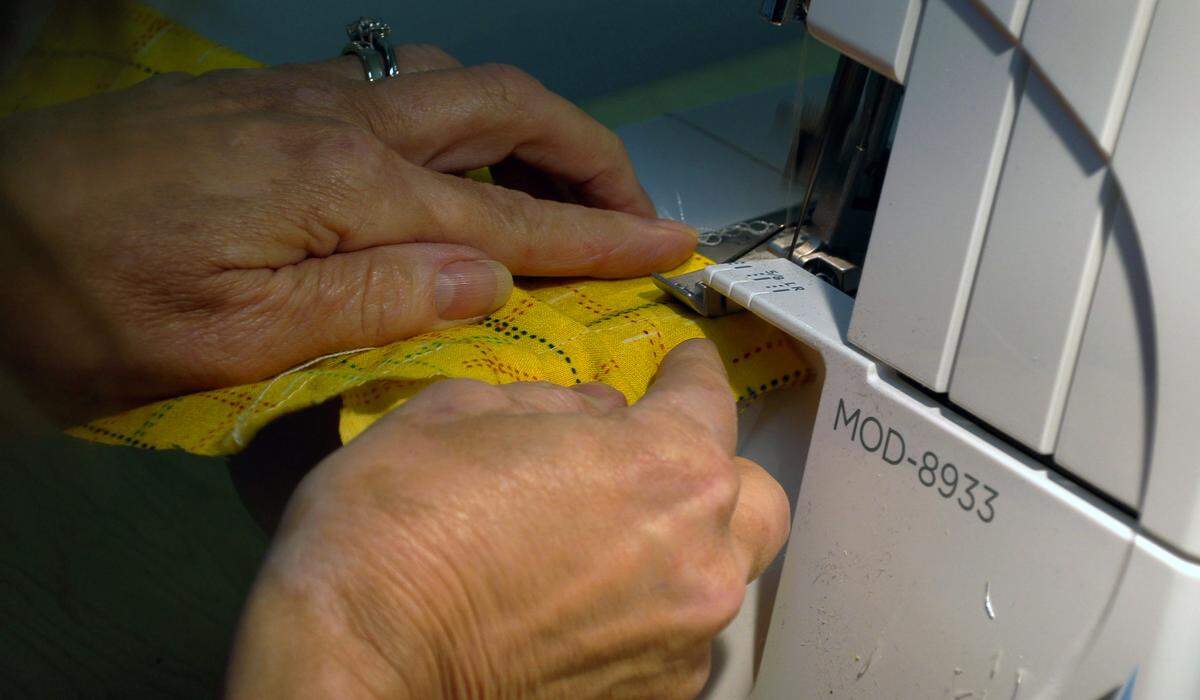
They also need sergers, a type of sewing machine that makes a “special stitch,” Loncher said. “It’s going to make the mask hold up longer.”
Said Wade: “We’ve actually purchased the last serger machine we could find in Columbus…. The problem’s not people. The problem’s the machinery to have the capacity to do it.”
‘A fraction’
This shift in direction, along with a federal Payroll Protection Program loan secured through Synovus Bank, has kept the family business going, long after it was founded amid a great depression and a world war.
But shifting to making masks and hospital gowns has replaced only “a fraction” of the business lost, Wade said.
Absent the government loan, the company would have faced hard choices.
“We would have been liquidating some assets, to try to keep the doors open,” he said. “Had we not gotten it, I venture to say we wouldn’t be standing here right now.”
Said Loncher: “It’s enough to cover payroll, and that’s important.”
The company has 120 workers, and has managed so far to keep everyone on the job. “In the beginning, I guess our first thoughts were, since revenues were declining, we’ve got to stay in proportion with our payroll,” Wade said. “So we did furlough people in the beginning; I think maybe 10 at the most out of 120.”
Besides its dry cleaning, laundry and linen service, Wade owns the local Sun Ray Cleaners and Henri’s Formal Wear, and provides wedding gown preservation. It has contracts with the Columbus Convention and Trade Center and with Callaway Gardens.
“Callaway Gardens is one of our largest clients, and they closed to the public almost 30, 45 days ago, so that left a big void,” Wade said. The resort had 700 rooms needing regular linen service, with a truck going back and forth every day.
What’s next?
Looking forward, Loncher believes Columbus hospitals will want reusable, locally sourced PPE after the crisis.
“We’re hearing from some of our healthcare partners that they like this better,” he said. “They don’t want to find themselves caught short again, and we’re local. If something went wrong, they can reach out and grab us.”
Said Wade: “I think that there’s going to be new opportunities that come out of this. I’m just not quite sure where they’re all going to be.”
He wondered how much business overall will bounce back, by the time the payroll protection money runs out: “If the revenue stream doesn’t return, where do we go?”
Still he’s optimistic the family-owned company will carry on, as his son George Wade IV graduates this year from Georgia Southern, and comes on board:
“We’ve been here since July 5, 1939, and I hope that we’ll be here another 80 years, and that we’ll learn ways to make safer practices, so that these type situations don’t occur again…. I feel like we’re going to learn a lot, and we’ll be a better society for it, at some point.”
This story was originally published May 8, 2020 at 5:00 AM.