
Columbus hospitals explain why they won’t release COVID-19 patient numbers to public
After repeatedly declining to provide data on how many COVID-19 patients are being treated in Columbus hospitals, representatives now explain why they aren’t releasing the information.
The Ledger-Enquirer reported last week that the total COVID-19 hospitalizations for Muscogee County residents was spiking, and that the increase in hospitalizations comes as newly-reported COVID-19 cases in Georgia rise to their highest levels since the beginning of the pandemic.
In an attempt to clarify the data reported by Georgia’s Department of Public Health, the Ledger-Enquirer asked Piedmont and St. Francis for their hospitalization data. They both declined.
The two hospitals have similar answers for the refusal: the number of COVID-19 patients is constantly changing.
“We understand the interest in the number of COVID-19 cases that our system is handling,” said Jessica Roberts, senior communications specialist with Piedmont Columbus Regional, in an email to the Ledger-Enquirer.
“The number of patients we are treating who are under investigation, confirmed and discharged is constantly changing,” she said. “For this reason, we believe it remains in the best interest to allow the Georgia Department of Public Health to continue to be the sole provider of this information.”
Melody Trimble, chief executive officer for St. Francis, said the hospital won’t report specific numbers to the public because the COVID-19 situation is “fluid.”
Trimble said it is a fact that the county has reported an increase in the number of COVID-related infections.
“And one would suspect that there is an increase in the amount of COVID patients in our community that some of those would transcend into being in the hospital as well,” she said. “And that again is a very, very fluid number so in a way, I feel a bit irresponsible to ever report that number, because we monitor it so closely and we just adapt to those changes.”
Local hospitals report their patient information to the Georgia Department of Public Health, which every day updates a cumulative number of patients in each county since the start of the pandemic. It does not break the information down by hospital.
The department acknowledges on their website that the data reported is “likely an underestimation of actual hospitalizations.”
“This number includes the confirmed COVID-19 cases that were hospitalized at the time the case was reported to DPH or when the case was interviewed,” the website says. “This number does not capture hospitalizations that occur after a confirmed case was reported.”
The hospitals are not required to release that information to the public, but nothing prohibits them either.
Phoebe Putney Health System in Albany, one of the state’s hardest hit areas, regularly reports the total number of patients in their hospitals , as well as the number of deaths and the number of patients that have recovered.
The system reported its most current numbers on Monday, stating that they now have “over 50 COVID-19 patients for the first time since late May.”
“Friday, we admitted seven new COVID-19 patients in Albany, our highest one-day total since May 22, and we know other communities in Georgia are currently seeing even greater increases,” said Scott Steiner, Phoebe Putney Health System Chief Executive Officer.
By providing real-time, accurate data on COVID-19 hospitalizations in the city, health officials have firmer ground to stand on when they implore the public to take steps to mitigate further spread.
“These numbers should serve as a warning to every Georgian. This virus has not gone away,” Steiner said. “The only way to reverse that trend is through...wearing masks, practicing proper social distancing, avoiding crowds and washing or sanitizing your hands often.”
Mayor’s office releases new chart
Perhaps the most accurate depiction of the daily number of COVID-19 hospitalizations in Muscogee County is now being released by the office of Columbus Mayor Skip Henderson.
His office recently began posting graphs on Facebook twice a week, showing the total number of patients in the hospital on a given day.
This is different from the data reported by the Georgia Department of Public Health, which reports only the cumulative amount of patients since the start of the pandemic.
After a slight dip in hospitalizations, the county’s hospitalization rate has been on the rise, the data shows.
The daily number of COVID-19 patients being treated in Muscogee hospitals climbed from a low of around 19 in mid-May to over 100 July 2-4, according to the data the mayor’s office received from local hospitals. The number was at 100 patients on July 6.
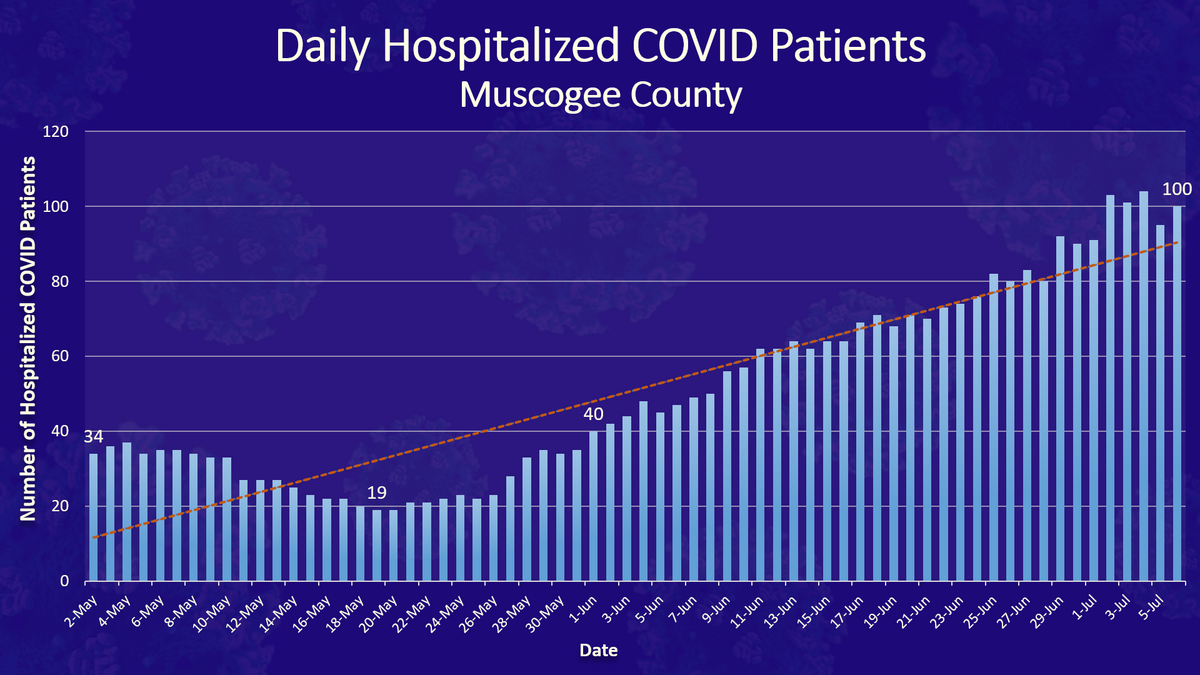
The data reflects only information since April 28, when the state started collected and releasing hospitalization data.
But it better reinforces the mayor’s message about the increasing number of cases, deaths and hospitalizations Muscogee is experiencing.
“To better explain why we are stressing masks and social-distancing, our office is sharing some of the information we evaluate every day for Muscogee County,” Henderson wrote on a July 2 post. “Remember, wearing a mask doesn’t protect the wearer; it protects everyone around the person wearing the mask. If we all wear masks and remember to social distance, we could very easily turn around the troubling trends depicted in these graphs.”