Fort Moore’s extreme heat threatens the mission. How Columbus’ basic training base adapts
Fort Moore — one of the largest and most vital military infantry training installations in the U.S. — is ground zero for heat strokes and, in the last five years, heat adaptation.
For a century, Fort Moore’s Maneuver Center of Excellence and its home city, Columbus, have mulled through hot, muggy summer days. An average of 64,000 soldiers are trained every year at the base, readying them for the U.S. infantry with an intense 22-week-long boot camp.
But in the last 10 years, heat has complicated training as much as ever. Those 10 years have been the warmest on record globally, and Georgia has experienced some of its hottest years in that period including 2016, 2017 and 2020, and 2023 was one the hottest July’s in Georgia. Unbearably hot conditions in the already hot summer and warming conditions into the spring and fall are creating recipes conducive to heat stroke and adding challenges safe training.
The Department of Defense recognized the problem of heat stroke illness at Fort Moore as early as 2008, according to Lt. Col. David DeGroot, heat center director of the Army Heat Center. But it wasn’t until 2016 when a soldier died from drinking too much water and losing electrolytes, an illness called Hyponatremia, that the base stepped up its caution for heat.
“The Army Heat Center started here in 2019, and we kept it here because DOD data shows Fort Moore leads the entire DOD in heat casualties,” DeGroot said, not referring to heat deaths but instead with cases of heat illness.
In the 1950s, the military created a gauge for minimizing time outdoors by using colored flag categories known as “flag days” — with black being the most severe at 92 degrees “wet-bulb globe temperature.” Wet-bulb globe temperature is different from the heat index in that it takes into account ambient temperature, humidity, sunlight exposure and wind speed.

DeGroot, a physiologist who partners with the Army Research Institute of Environmental Medicine (co-located at the Soldier Systems Center in Natick, Mass.) said flag days matter but more needs to be done. He leads several programs at the Army Heat Center headquartered at Fort Moore located in the Martin Army Community Hospital on base.
He said prevention and education are key, not just at Fort Moore but at other bases too. Over 6,000 people have received training from Army Heat Center staff since its inception in 2019, according to the 2023 DOD Heat Illness Report.
Another component of his work is minimizing severity and recognizing that, “we are never going to get heat casualties to zero,” he said.
Since DeGroot’s time as heat center director, the heat stroke casualties at Fort Moore have dropped. DeGroot said there has just been one heat-related death in the past five years, which occurred in 2020.

Aside from 2023, the frequency of exertional heat stroke at Fort Moore has been reduced by 47% since 2019. DeGroot said 2023 was an unusually warm year, which is likely why there were higher levels compared to 2022 or 2024.
Tools and techniques for adapting
Over 90% of all exertional heat stroke casualties at Fort Moore occur during foot march or running events, according to the 2023 DOD heat illness report. DeGroot said changing times for outdoor training makes it safer, because they go out during cooler parts of the day.
“July and August from two to five p.m. is not when people go out for runs and do foot marches,” DeGroot said.
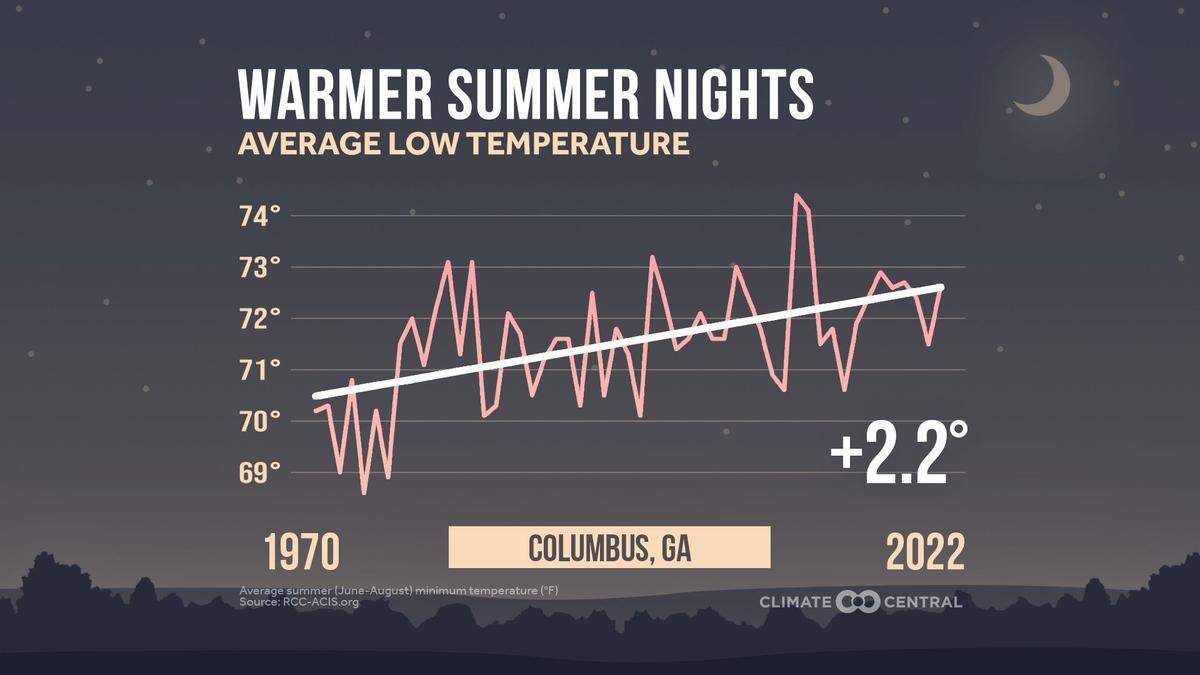
Sometimes in the hot summer months, the coolest part is just a small window in the morning when it’s still very humid or warm. And because of climate change, Columbus has warming low temperatures. Lows have gotten 2.2 degrees warmer since 1970.
“It’s not just how hot it gets each day that matters, it’s also how warm the coolest time of day is,” Degroot said in an email. “Leaders schedule events with higher risk of heat illness for the coolest time of day, but when that time of day is warmer than usual, it’s increasingly difficult to mitigate heat stress.”
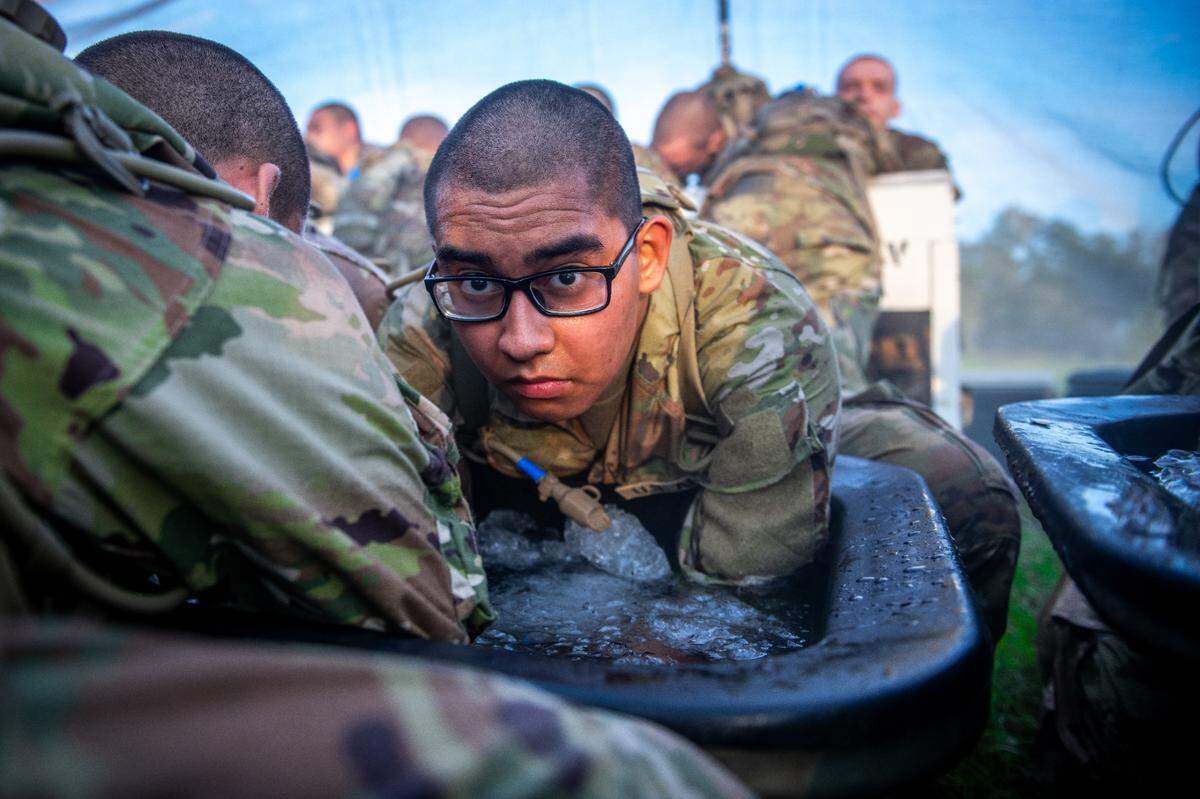
DeGroot said people on-base will dunk their arms in a bucket of ice. That can cool body temperatures by half a degree, which is significant to avoiding heat illnesses.
“When it’s hot enough and humid enough just resting or passively resting in the shade is not going to be enough,” he said.
Another component of the heat center DeGroot stresses is that leaders need to know it takes time for the body to acclimate and soldiers need to be educated on slowing down, which DeGroot said is the most important part for soldiers preventing heat issues.
“Drill sergeants are holding the line and saying, ‘don’t run in front of me’ when they go for a run,” he said.
But that goes against a culture of motivation and competitiveness that the military has built up for years. DeGroot said that culture can be the Army’s own enemy when it comes to fighting heat stress.
“Yes, this could absolutely, potentially impact the quality of the training,” DeGroot said to the Ledger-Enquirer.
Future challenges
There were an average of 80 days per year above 90 degrees in Muscogee County from 1970 to 2000, and 14 days per year over 100 degrees, according to the Union of Concerned Scientists, a nonprofit organization of climate scientists aimed at developing solutions for a safe future.
That number is expected to rise drastically. In the group’s 2020 project, “Killer Heat in the United States: The Future of Dangerously Hot Days” they say Muscogee County is at risk of experiencing 118 to 127 days per year above 90 degrees and 51 to 68 days above 100 degrees as early as 2036 if slow or no action is taken on climate change.
The annual average global temperature increased by 1.8 degrees from 1901-2016, with most of this increase taking place in the last 30 years, according to NOAA.
Sherri Goodman, the current secretary general of the International Military Council on Climate & Security, told the Ledger-Enquirer about military bases at home adapting to climate change last month. Goodman also was the first deputy undersecretary of defense (environmental security).
“In the ‘90s we talked about ‘owning the night,’ as night vision goggle technology was the advanced technology ... ,” Goodman said. “Now we have to ‘own the heat.’ Deputy Secretary of Defense Kathleen Hicks talks about how we have to ‘own the heat’ in the climate era.”
Earlier this month, climate scientists determined that 2024 is set to break 2023’s global average temperature record.
“Global warming is real and the risk is not going away,” DeGroot said.
DeGroot said the challenge now is complacency because the risk of heat is here, but leaders at Fort Moore rotate.
“This is the longest we’ve gone without a death. The danger now is complacency because leaders rotate in and out of positions.”
This story was originally published November 29, 2024 at 7:40 AM.