School project to replace plastic water bottles landed Columbus 6th graders in front of CEO
Three months ago, five gifted students from St. Anne-Pacelli Catholic School started sacrificing after-school time and Saturdays to come up with a winning project idea that would combat a problem in the world’s oceans: plastic water bottles.
The students embarked on the project as part of the 2025 FIRST Lego League Challenge competition, seeking to create an alternative to water bottles using cardboard or glass, and develop a floating plastic trash collector. Last week, their project landed them in front of a CEO who wanted to hear what they had to say.
This school year, 10 gifted students tested into Scott Chandler’s class. Five of them decided to participate in the Lego League competition that required the students to use coding language and incorporate robotics to solve ocean issues.
Unlike the previous five years of Chandler’s Lego League gifted teams, this group went beyond the requirements and seized the opportunity to present their two-part project to a local prominent business, Callaway Blue Springs Water Company.
A previous employee at Callaway Blue, the water bottle company that has premiere mountain spring water based in Hamilton, told Chandler that they should pitch their ideas to CEO Edward Callaway. Not only was it a good idea for real-world impact, but it was practice for the team to present at regionals, the next competition stage at Columbus State University scheduled for Jan. 25. They qualified for this after winning the “robot performance award” and tournament championship in December.
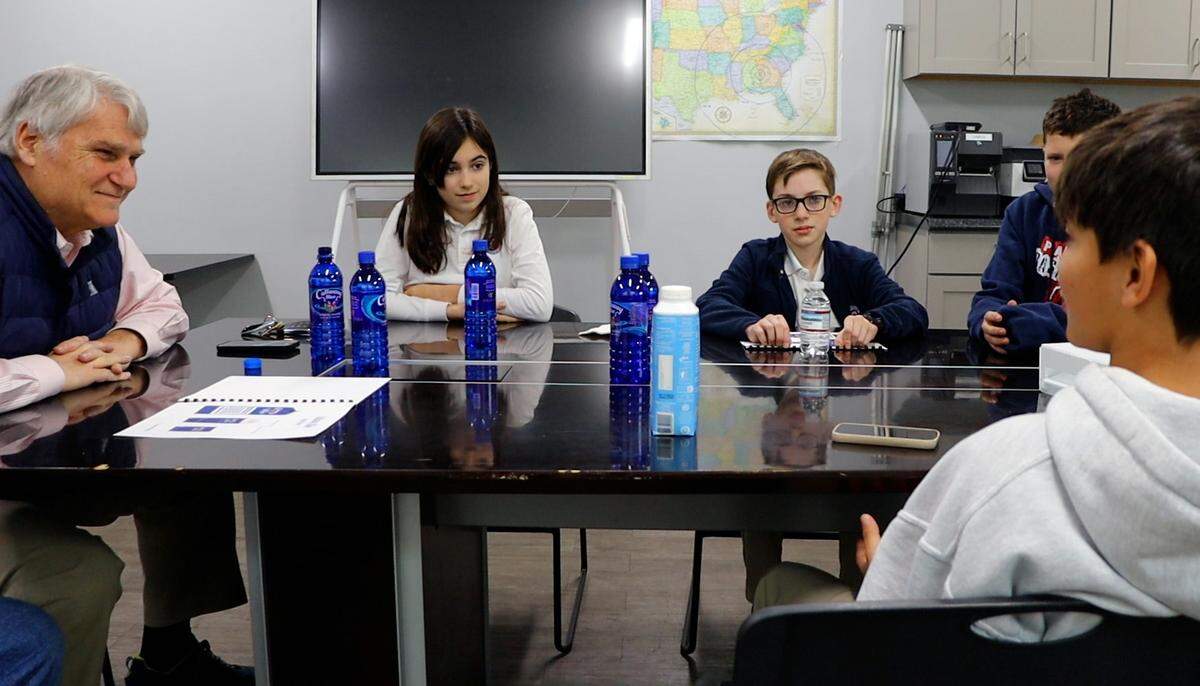
Callaway enthusiastically welcomed the eager group of five to his bottling plant, just 30 minutes north of Columbus off Interstate 185.
On a chilly Friday morning, Nor McLellan, 11, Liam Watson, 11, Landon Conner, 12, Stephen McGinn, 11, and Harper Singleton, 12, pitched their ideas to Callaway and Chief Financial Officer Frank Bonner.
McLellan came up with the idea to remove plastic after learning the theme for the 2025 Lego League Challenge and hearing from a University of Georgia profess who has studied ocean plastic problems for 10 years.
Scientists say the ocean has become a collection ground for trash. Due to ocean currents gyrating swirls of garbage like fishing nets, plastic water bottles, and other items that wash out of landfills, a floating garbage patch exists throughout the world’s gyres. The most well known of these is the Great Pacific Garbage Patch in the northern Pacific Ocean. The patch consists mainly of plastic in its full original size and some decomposed nano-plastics the size of plankton, which has scientists worried about how it might affect ocean marine life.
“I’m really interested in this,” Callaway said to the group. “We’re all over. We’re very curious. We’re very engaged in this. We care a lot about this, recycling plastic.”
Watson handed Callaway and Bonner a presentation packet for them to skim as they presented. The professionalism of the sixth graders mirrored an atmosphere of a 30-story building in Manhattan, only the presenters were wearing St. Ann- Pacelli uniforms instead of suits and ties.
“So what’s funny about their whole group is that when you say it’s Lego robotics, you think, okay, it’s all coding and all, but they all have different skills, and that’s why they’ve been successful so far as well as skills on this project,” Chandler said to Callaway.
“So like Nor, is the artist in the group, Liam, is our resident nerd – using block coding language – Stephen did the renderings.”
Two of the other boys are more interested in athletics. Two of them focused on research. Their different skills helped then succeed, and Callaway was impressed.
How would these ideas work?
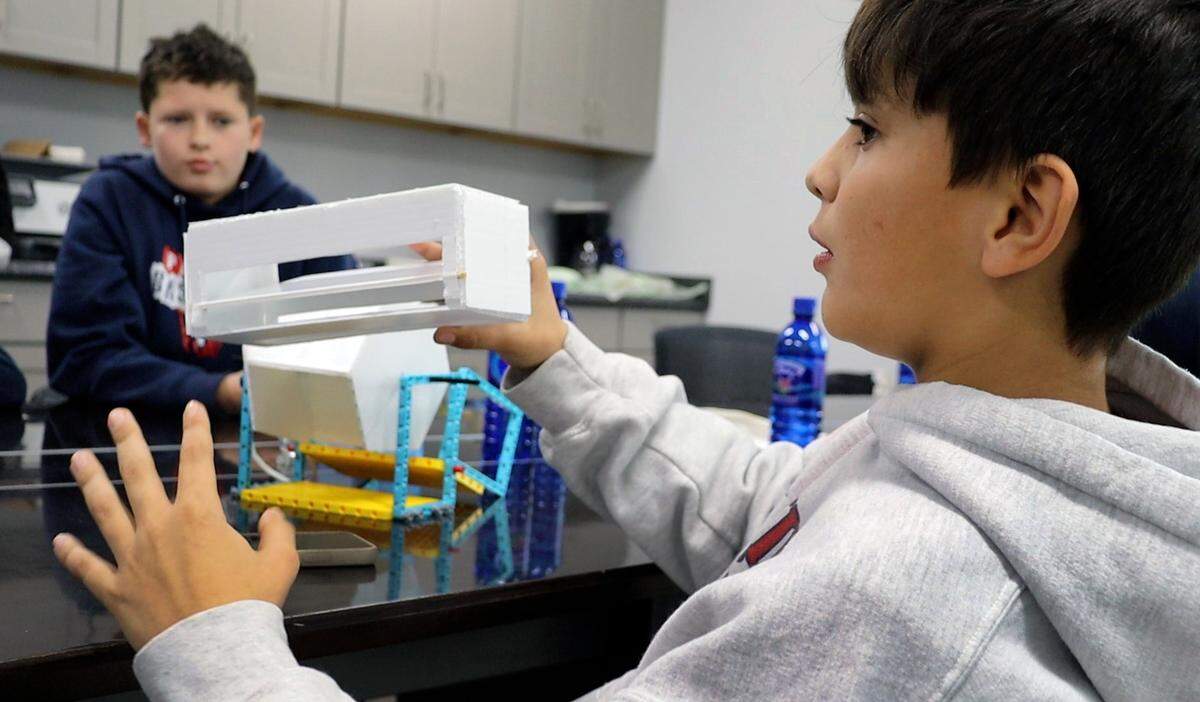
Watson, McGinn and Singleton explained to the CFO and CEO how one part of the collector would passively bob from waves and collect trash from the large ocean gyre of floating garbage. Another part of the collector would be battery powered and actively collect it, send it up a conveyor and burning it to be melted down and reused.
“We created these two models,” McGinn said. “A battery powered motor would spin and collect trash. It would be attached to the boat while floating in the ocean.”
McGinn continued, “A conveyer belt would send it up, shred it and put it in, like into shipping containers. And then the passive one. When the boat is moving, it would tilt, scoop it up, it would tilt it down so the plastic would be forced up. So when we would get the shreds of it, we would melt it down.. We melted plastic down until this little melted plastic.”
McGinn explained how plastic would move along a conveyer belt, get shredded, and eventually melted. He moved Lego pieces in formations, showing the process as he described it.
The students said “72% of Americans drink plastic water.”
“We thought, why do we even have plastic in the ocean? And then we thought of plastic water bottles,” McLellan said. “We have 1,200 plastic water bottles per week that just go through our lower school.”
McGinn added,. “so we tried to think of a substitute that could replace plastic water bottles. But while we were researching it, we realized water bottles are not only bad for the environment, they’re bad for humans.”
Callaway immediately acknowledged plastic water bottles as a problem and said his plastic bottles do not contain BisPhenal A, a known toxic plastic ingredient.
“Oh yeah, plastic is not good inside of your body,” Callaway said.
What could water bottles be made with instead?
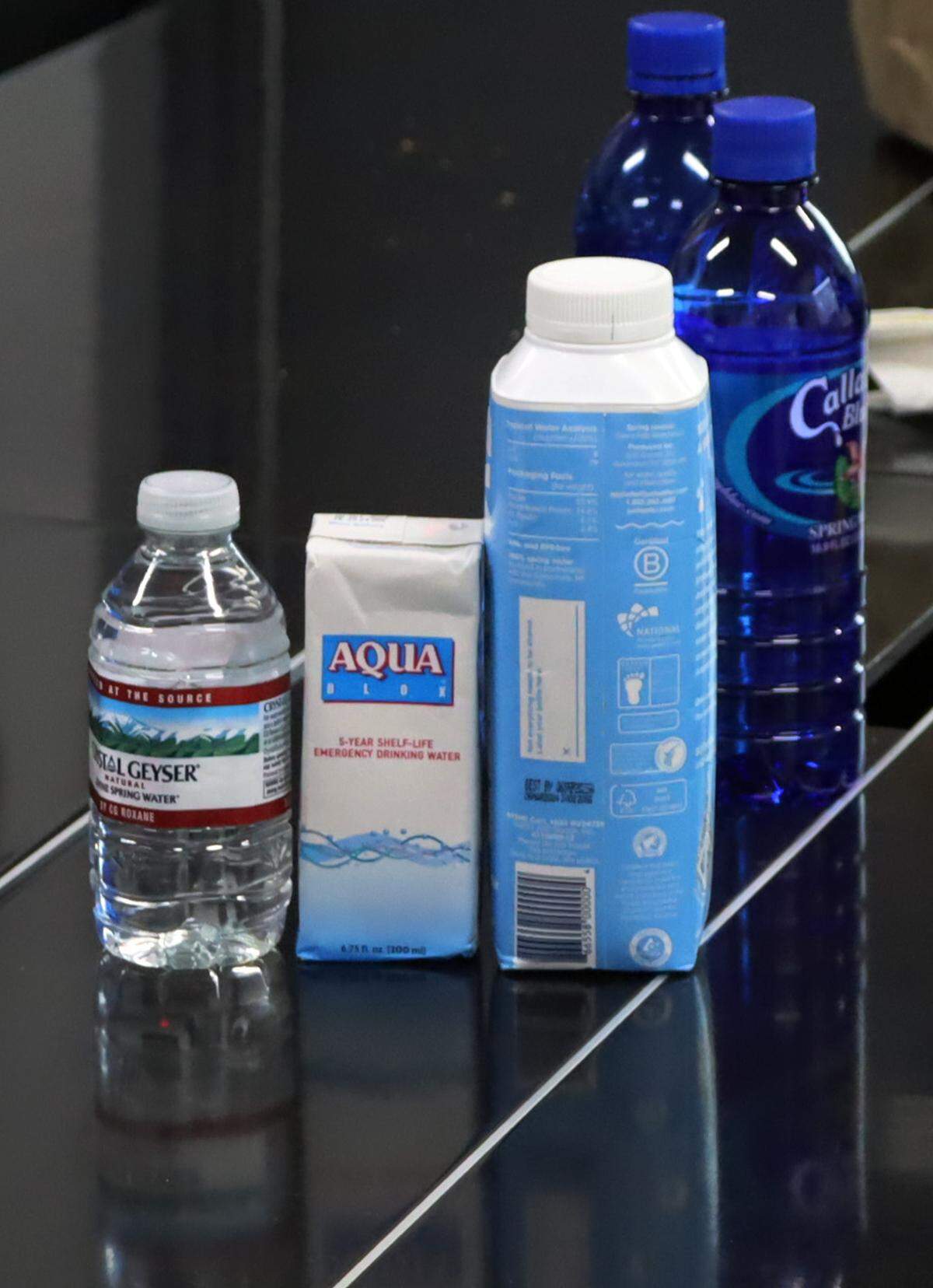
The group of 11 and 12 year olds presented a few alternatives that used cardboard without plastic lining. They said this option was completely biodegradable. They cited plastic as bad for human health due microplastics and BPA that are in some bottles, as well as environmental health.
They appealed to Callaway when they talked about a new market opportunity.
“I you decide to do this, this will be a whole new market, because schools and parents that care about what their what their children drink,” McGinn and Watson said. “You could just get, like, a six pack of those and keep it in the car and the temperature does not affect it if it freezes.”
These bottles only take two to five years to decompose, while plastic bottles take over 450 years, the students told Callaway.
“We’ve been looking at that, we’ve tried it,” Callaway said about the cardboard.
But his concern was about the taste. He was worried the cardboard would leech into the water.
“We just really want to help the environment, because nature is something that will be here forever unless humans (prevent) other generations enjoying it,” McGinn said.
After the pitch, the students got to tour the inside of the plant, watching as bottles flew by on conveyors onto pallets as plastic bottles were packaged.
Callaway told the Ledger-Enquirer that right now they are selling over 1 million bottles per month and they’ve had major growth in the last six years.
“We’re eight times bigger than we were six years ago,” he said.
Callaway Blue currently does not use any post consumer recycled content in packaging but has ambitions to use recycled Polyethylene terephthalate, which is a polyester plastic derived from petroleum.
Callaway is adamant about keeping plastics out of landfills. He said he wants plastics out of our oceans but said his mission is to bring healthy good water available to those who want it.
Glass bottles are another alternative that Callaway says wouldn’t leech chemicals or ruin taste, but it’s expensive to transport.
“Glass is heavy and takes a lot of petroleum to deliver it,” he said. “You wind up being worse off environmentally.”
Petroleum, or crude oil, is what makes up polyester plastic. In 2019, 9 million barrels of crude oil went toward making plastic every day, according to Statista.
Callaway was blown away by the students and said they did a better job than most adults.
Like the skills that they bring to the table, the students had a variety of reactions after the tour of the plant and pitching to Callaway.
“I was nervous,” Watson said.
McLellan said it was fun.
“I’ve never really done anything big like this. It’s unusual but really fun. Some people get scared of presenting, but not me. I enjoy it.”