Saharan dust will collide with Canada wildfire smoke this week in Georgia
The ominous haze that made its way to Columbus last weekend isn’t going away yet, and dust from the Sahara Desert is about to add to it.
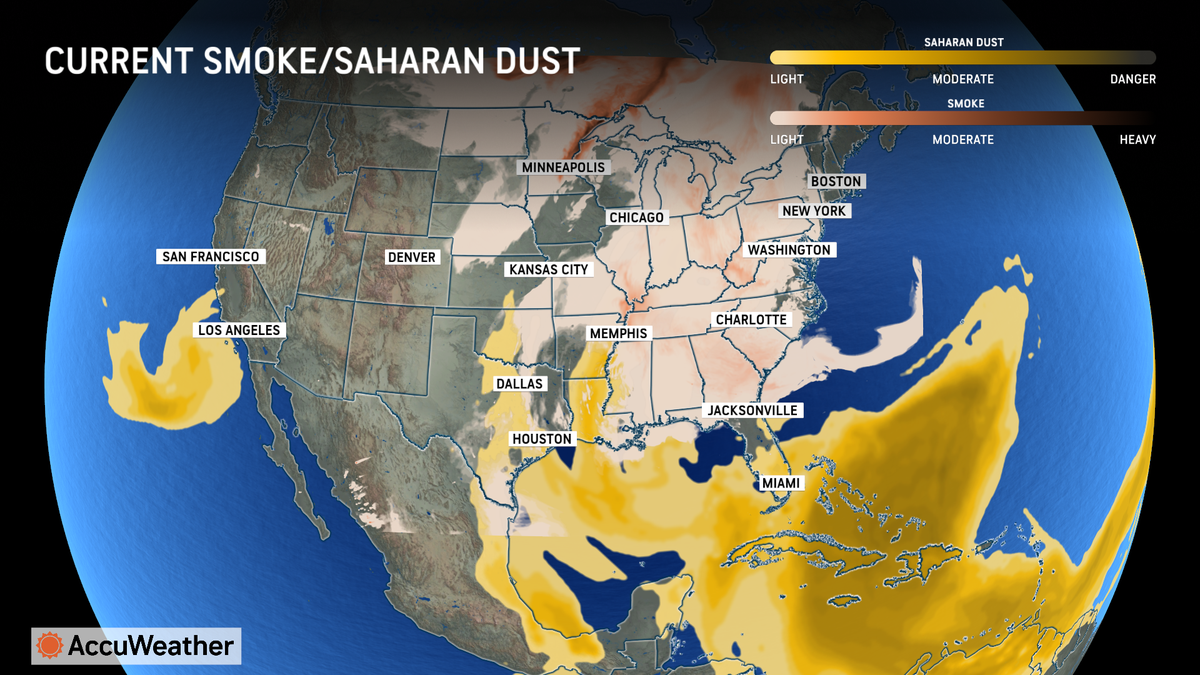
The tinted orange lighting and hazy conditions are a trace of the 212 wildfires currently burning in Canada.
The Canadian Interagency Forest Fire Centre reported on Wednesday over 2 million acres of forest have burned so far this year, and 105 of the fires are “out of control.”
“The largest fire in Saskatchewan is bigger than the state of Rhode Island,” Brett Anderson, senior meteorologist with AccuWeather, said. “The fire season has gotten off to an early start, and it’s much bigger than usual.”
Steering winds have driven the smoke all the way to Florida, and it has blanketed the Peach State in “moderate” air quality status, causing what Anderson called an “inversion” of pollution from automobiles and factories trapped by the smoke high up in the atmosphere.
Anderson said the smoke will make for red sunsets and sunrises.
Incoming dust from the Sahara will hit Georgia
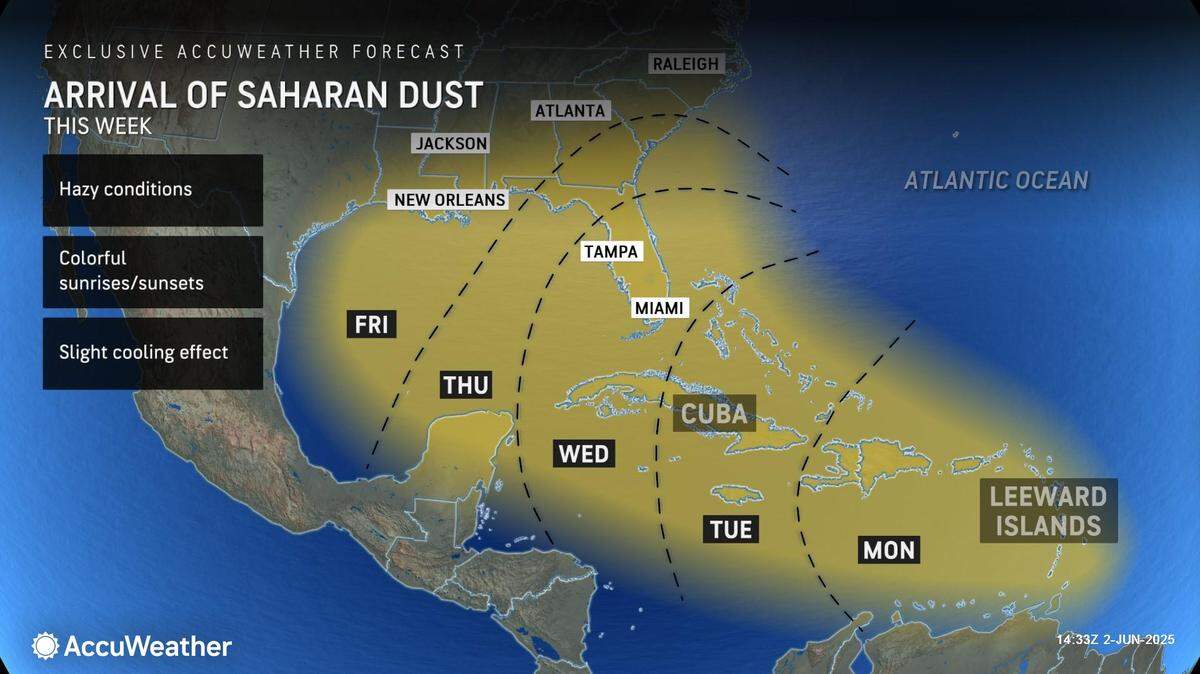
While northern U.S. states bear the brunt of the burning trees in Canada, Florida and Georgia will soon be victim to the incoming dust storm from across the Atlantic in Africa’s Sahara Desert.
Anderson said while it’s normal to have a dust storm come across the Atlantic, it’s “earlier than usual, because of strong trade winds.”
It’s a plume as big as the eastern quarter of the U.S., Anderson said.
The cold waters in the North Atlantic and the warm waters in the tropics converge to make the intense trade winds, Anderson explained. The intense difference is what causes a temperature gradient and a stronger trade wind.
The dust and smoke could converge starting Thursday, if the smoke from Canada doesn’t subside.
“It will have a haze effect similar to the dust, but not as pronounced as what we’re seeing from the smoke,” Anderson said.
The dust is already in the Caribbean and southern Florida, and won’t be as thick in Georgia.
“It will dissipate with time,” Anderson said.
It should only linger until the weekend and like the smoke, it’s most noticeable during early morning hours or late evening hours.
Extreme events colliding in a warmer world
Wildfires and Sahara dust storms are common. But both are happening more frequently and earlier in the year.
“I’ve been a forecaster here for over 30 … 35 years, in my first 20 years here, yeah, there was dust, but it wasn’t as significant,” Anderson said. “In the last 10 years or so, we’ve definitely seen an uptick in the amount of Sahara dust coming west across the Atlantic.”
When these fires first ignited, Climate Central’s Climate Shift Index found unusually high temperatures in Saskatchewan, where it was 11 to 20 degrees above normal, reaching up to the 90s. At that time in Manitoba, temperatures were 12 to 13 degrees above normal and also in the 90s. These higher temperatures were three to five times more likely because of climate change.
“Climate change-driven heat dries out vegetation and sets the stage for wildfires. Combine that with persistent drought and a locked-in high-pressure system, and you have a perfect storm — one that’s becoming more common as we continue to burn fossil fuels and heat the planet,” said Kaitlyn Trudeau, senior research associate for climate science and wildfire expert at Climate Central.
Parts of Canada currently ravaged by the flames have been in a moderate drought since April 30, according to the North American Drought Monitor.
“While excessive heat primarily affected Canada, the resulting smoke and poor air quality highlight how climate-driven events don’t stop at borders,” said Shel Winkley, a meteorologist.
This story was originally published June 3, 2025 at 4:55 PM.