1,700 people urge regulators to prevent powering Georgia data centers with coal

AI-generated summary reviewed by our newsroom.
- Georgia Power plans to extend coal plant operations for 9 years in 2025 IRP.
- Nearly 1,700 Georgians urged PSC to exclude coal from data center power plans.
- Commissioners to vote July 15 on IRP while coal and gas concerns remain unresolved.
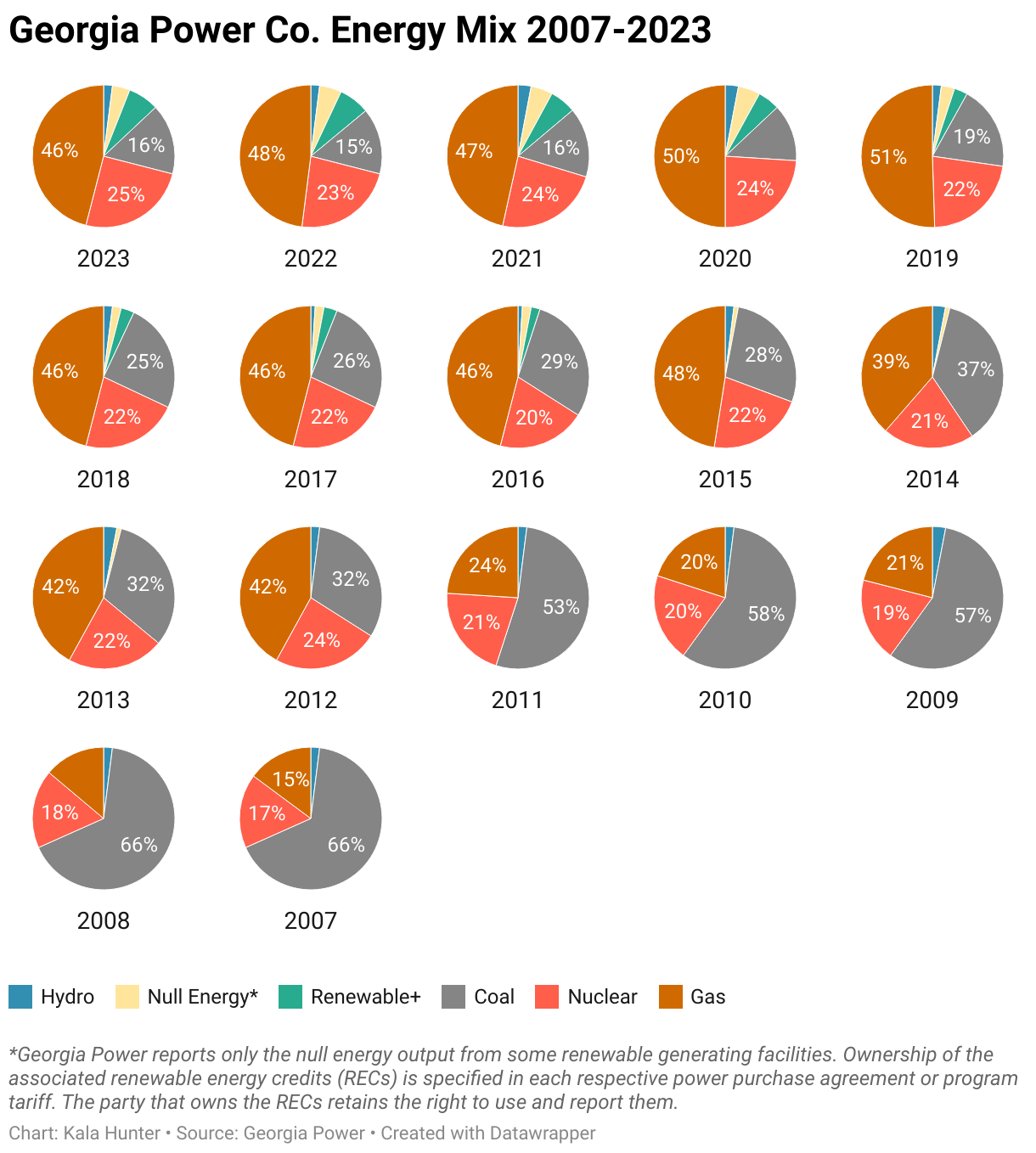
Over the past 18 years, coal power in Georgia has seen a precipitous decline.
Between 2007 and 2013, coal power generation was cut in half, dropping from 66% of the Georgia Power energy mix to 32%. It has further dropped from 28% in 2015 to 16% in 2023.
Meanwhile, clean power such as solar and batteries have grown from 2% to 7% in the last 9 years, though climate-warming natural gas makes up the majority of the company’s power generation at 46% of the portfolio.
That coal decline, which helps in combating climate warming and air pollution, could lose momentum as Georgia Power’s long-term energy plans include extending a lifeline to three coal power plants for another 9 years. The plants are Sherer in Juliet, Bowen in Euharlee, and Gaston in Wilsonville, Alabama, which is also part of Southern Company, the parent company for Georgia Power.
Georgia Power’s 2025 energy plan, known as the Integrated Resource Plan, is currently under review by the five Georgia Public Service commissioners and the Public Service Commission staff, following weeks of hearings and expert intervention. The commissioners cast a final vote to approve the plan on July 15.
But Georgians are trying to get a word in to ensure the PSC knows what they want the elected body to do. Last week, 1,694 Georgians from across 225 cities throughout the Peach State told commissioners through a public advocacy campaign that they do not want coal power in the plan, especially to power data centers.
Jennifer Whitfield, lawyer with the Southern Environmental Law Center, shared the nearly 1,700 signatures and 203 personalized letters with three commissioners on June 2 in private meetings.
“These are hard decisions (the commissioners) are making, and we want to make sure they have regular Georgians in mind as part of their calculus,” she said. “There are a lot of very powerful interests who meet with commissioners, and regular folks don’t get their voices heard to the same degree, so this is an effort to make sure they are hearing from everybody.”
The SELC conducted public advocacy campaigns like this during previous Integrated Resource Plan campaigns, but the group has never sat down to share these printed copies before this year. In the past, they’ve sent this via email.
“We’re trying a different approach in the hopes that (commissioners) would take a moment to digest and consider more perspectives,” Whitfield said. “In the past, we’ve sent zillions of emails directly to the commissioners…that can be difficult for them to handle and manage, so we wanted to try this, particularly with such a compressed timeline.”
This advocacy campaign yielded about 50% more comments than the last IRP campaign.
Starting the week of June 23, after the last rebuttal hearing ends, ex parte rules begin, meaning the commissioners can no longer meet with any parties to discuss the 2025 IRP.
Will data centers be powered with natural gas or coal?
The subject line of the message to the commissioners of the campaign read, “Don’t power data centers with coal.”
There are 150 of these humongous warehouses that store data for everything from cloud services to powering up Instagram or Netflix across Georgia, mainly near Atlanta, according to the Data Center Map. The data centers have sprouted across Georgia faster than anywhere else in the U.S., doubling construction plans from just a year ago, the Atlanta Journal-Constitution reported in March.
Whitfield said it isn’t clear whether coal or gas will be used to power the data centers because of an all-source request for proposals seeking to produce an additional 9 gigawatts of energy – which would be half of Georgia Power’s full energy production currently. That 9 gigawatts isn’t listed in the current 2025 plan.
“We won’t find out until July about how much fossil fuels will be used, and that is part of the urgency of this moment,” she said.
What the SELC team knows at present, Whitfield explained, is “they are planning to run those coal plants more often than had been run in the past and the three plants will be online for about a decade.”
That doesn’t sit well with Michael Grammer, a Columbus resident and one of 203 people who attached a personal letter to the SELC advocacy signature campaign.
“Please don’t put Georgia families’ health and pocketbooks on the line so Georgia Power can cash in on data centers,” Grammer said. “Coal is too expensive and gas is unpredictably priced. Georgia Power is making a lot of profit by powering data centers with these fossil fuels, but regular Georgians like me don’t want to be on the hook for paying the bill for even more coal and gas.
“Please don’t let Georgia families be stuck with even more dirty and expensive fossil fuels to power new data centers. We want energy policies that will reduce our energy bills and drive investments towards a cleaner energy future.”
There were 25 other signatures from Columbus.
Mary Mathius from Macon wrote a personalized letter saying, “PEOPLE WILL LEAVE GA” if you allow this.
“Don’t put Georgians at risk,” she said. “Don’t put Georgia families’ health and pocketbooks on the line so Georgia Power can cash in on data centers. PEOPLE WILL LEAVE GA if you let this happen. How will you find your project then? Coal is too expensive and gas is unpredictably priced.”
Another Macon resident, Nathan Lott, said commercial users should pay 100% of the energy they use at the same rate as residential users and talked about how they don’t help with jobs.
“With the nation’s newest fossil-free baseload generation, Georgia needs to stay the course away from price-volatile coal and gas electricity generation for long-term competitiveness,” Lott said. “Data centers don’t create significant long-term local jobs, but higher residential bills will cost families education and other opportunities.”
In addition to Lott and Mathius, there were 25 other signatures from Macon.
“These comments are saying, ‘remember us,’ the regular folks paying the bills who care about the air we breathe and everything else,” Whitfield said. “We want (commissioners) to have a constant reminder that there’s another kind of public interest at play here that matters tremendously.”
How did commissioners respond?
Whitfield said Chairman Jason Shaw has always been receptive, always had an open door, and she’s grateful for his willingness to listen.
But commissioners did not respond to the Ledger-Enquirer about how these in-person visits and signatures may affect their opinion about Georgia Power’s 2025 IRP.
Tom Krause, public information officer for the Georgia Public Service Commission, said in an email that commissioners cannot express opinions until they’ve heard all of the evidence of the docket, citing government rules, they can only speak to procedure.
“I reviewed the signatures and the letter, that information is now part of the record (we) will use to make our decision,” Shaw said in an email to the Ledger-Enquirer. “We must, by law, consider the evidence presented to us.”
Shaw listed a dozen parties involved in 50 hours of expert testimony, lawyers, public interest advocacy staff and the oral evidence that is paired with tens of thousands of pages of written testimony.
Commissioner Fitz Johnson said he is reviewing the book of letters and names of Georgians in support of the letter. Commissioner Bubba McDonald said he receives many emails and letters but declined to comment further.

The SELC has not yet had a chance to meet with commissioners Tim Echols or Tricia Pridemore.
Whitfield also argues that at this point, Georgia Power has not yet provided enough information to the commission to make major resource decisions.
“(Commissioners) could ask (Georgia Power) to refile their docket as part of your all-source RFP; they could defer the coal decision until after they have more information about what Georgia Power wants to buy and replace,” she said.
Whitfield acknowledged that the commissioners have a lot on their plate and so many variables at play, and there are a lot of conversations about how to handle the massive amount of growth in front of them. But her message to the commission is to include these voices as another variable when making a decision.
“At the end of the day, what (commissioners) have to decide is: are they going to hold Georgia Power to the standards required in the statute–that the Commission has historically held them to–which is prove what (Georgia Power) needs and demonstrate that we’re going to implement change in a responsible gradual manner, or are they going to write a blank check for Georgia Power to buy whatever it wants without the without the information? Hopefully they’re not going to do the latter.”
This story was originally published June 9, 2025 at 11:54 AM.