A data center pushed her from ‘forever home.’ Now she’s fighting another one in LaGrange
AI-generated summary reviewed by our newsroom.
- Hutchings sold her Fayette County home due to nearby data center development.
- She now advocates for LaGrange ordinances limiting data center expansion.
- Troup County enacted a moratorium to review data center community impact.
In 2018, Cyndie Hutchings and her husband, in their mid-40s, transplanted from Cincinnati to Georgia in an effort to escape cold winters and find their forever home.
Cyndie Hutchings needed nature and land, and her husband’s only requirement was to be within an hour of the Atlanta Hartsfield-Jackson International Airport for work travel. They settled on a 6-acre property in Fayette County that evoked a mini farmhouse feel surrounded by pasture. Hutchings can recall taking breaks from her graphic design work in front of her computer to pet neighboring horses and walk one of her four dogs through the fields and county roads.
“It was our dream place,” she told the Ledger-Enquirer. “We never planned on selling. It was going to be our forever home.”
Hutchings enjoys fixing up homes and yards. Four years after settling in, she took out a $32,000 home equity loan to enhance the home’s deck that had gone into disrepair. The resulting 1,200-square-foot deck covered the back part of the house, allowing for all the space they wanted to enjoy spectacular sunrises.
Meanwhile, a billion-dollar data center dubbed “Project Excalibur,” about 5 miles south of the Hutchings’ property, started construction in 2023. The Hutchings didn’t notice any immediate impact until New Year’s Day 2024. It was then that Cyndie Hutchings said she heard about her neighbors receiving a letter from Georgia Power saying the power company wanted to buy some of their land to add transmission lines through to power the QTS data center
It gave her pause, she said. But she knew the neighbor had been on that land since the Civil War and possibly considered selling some land for a subdivision, not a transmission line. Months later, another neighbor was approached by Georgia Power to purchase their land for a substation
This time, she said she thought, “It’s going to affect the whole feel of the area.”
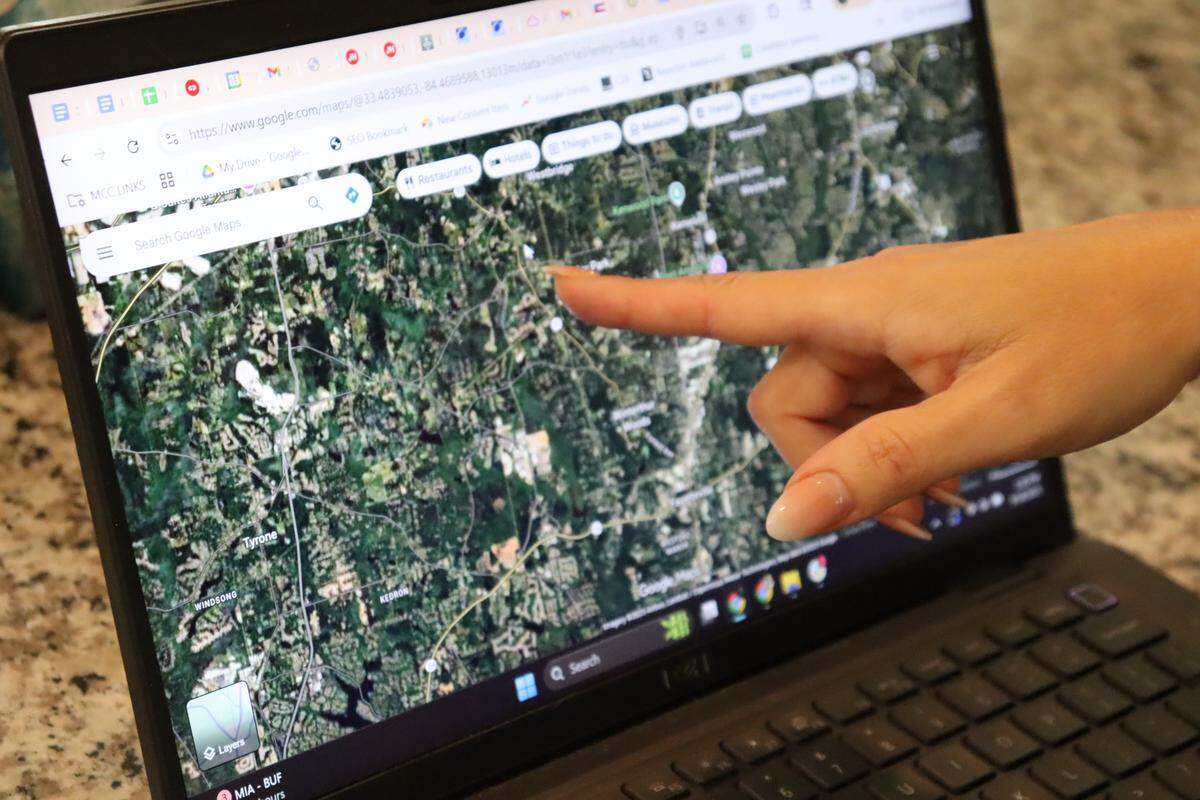
Within hours of hearing this, the Hutchings took to Google Maps to investigate how close they were to the Project Excalibur data center and where the substation might go, realizing they were being surrounded by transmission lines.
“We were like, ‘oh my god, our view might be impacted by this,’ and then we started realizing our property value might be impacted by this,” she said. “We thought, oh my god, we can’t take a chance on this. We need to sell. We need to get out of here.”
The couple got to work, and by April 15, their home was on the market.
“I mean, it was absolutely heart-wrenching,” she said. “We were just sick. We were very depressed for a long time.”
She looked at a few properties she always admired just a few streets over on Gingercake road. She is thankful they decided to go further away, because today, properties near that road have transmission poles in the front yard.
Diana Dietz, another resident of Fayette County, shared photos of such transmission poles in front of local homes.
Within a month, the Hutchings found a property in LaGrange on West Point Lake that checked all of their boxes for an ideal home. The most important part of the checklist was staying away from data center development.
The Hutchings family bought their new home on the same day they closed on their old one, Hutchings said. The couple made more than $200,000 on the sale of their old home and purchased the new one for $581,300. The new home has a three-quarter-acre front yard, which sits on a branch of West Point Lake.
Hutchings noticed that most data center projects were closer to Atlanta and felt safe going to LaGrange, farther south.
“We decided finally that our best option was to buy within an established neighborhood where we didn’t have to worry about, you know, something bad being built right up against our property or right within view of our property.”
Data center development comes to Troup County
When the couple was making one of their last trips to transition from Fayette to Troup County, they looked out their old backyard window and saw orange and pink stakes in the ground on their property near the fence.
“We freaked out,” she said. “We didn’t own the property anymore but there wasn’t any notice. Never in a million years did I think they would take our backyard.”
They went over to inspect, and as they guessed, Georgia Power had their name on the stakes.
Rerouted mail from their old home had been delayed, and the couple discovered that they were mailed a notice from Georgia Power right before the move.
“They wanted a portion of our backyard for a measly $13,000,” she said.
Hutchings said the land Georgia Power wanted was a sliver of about 50 to 75 feet near their fence, but it stretched across the whole yard, meaning it likely added up to about an acre.
If they stayed, she said, they would have fought against it. There was a row of 30-year-old cedar trees that would have been cut, she said, and she was adamantly against it.
But Hutchings has a different fight now. Just a few months after moving, she saw reports about a data center potentially coming to LaGrange.
Those reports have materialized, as Project Pegasus, an eventual 130 megawatt data center, is being built in LaGrange. That power usage is about the same amount of energy the entire city of LaGrange uses on average. The new data center is expecting to use an existing substation that was already there for prior tenants.
Project Pegasus could use a wide range of water every day for its operations, anywhere from hundreds of thousands to millions of gallons of water per day, according to the LaGrange Development Authority president, Scott Malone.
Project Excalibur’s final megawatt usage is unknown. In 2022, when the land annexation from Fayette County to the city of Fayetville was confirmed, it was projected to be up to 250 megawatts and 1.5 million square feet. Today, the square footage has increased to 6.6 million square feet and the Fayette County Development Authority bought an additional 415 acres of the original 122.
Megawatt usage has not yet been reported. Project Excalibur is set to take up to 10 years to complete.
“My heart just sank, because we moved here, thinking we had gotten away from them, only to find out that we didn’t,” she said. “We talked about moving again because we don’t want to be anywhere near these things.”
After some research, the Hutchings family felt far enough away from the proposed development that they weren’t as worried about their own home
Still, she’s pushing to block any other proposed data center development in LaGrange.
Hutchings now attends county commission meetings and city council meetings regularly, trying to stop data centers from coming by pushing leaders to issue moratoriums or create ordinances that would restrict these types of facilities. Her own experience with data centers has caused Hutchings to be more involved in politics than ever before.
This past summer when Project Pegasus started construction in LaGrange and Gage Bailey’s “Say NO to Data Centers” Facebook group began sharing rumors about more data centers coming to the city, Hutchings got involved, even though she doesn’t believe there is any immediate threat to her home.
“I really want to make sure that the citizens here are educated about what these data centers do to a community, and I want to make sure that they have all the information that they need to decide, (whether) they want this for their community,” she said. “If they don’t, I want to make sure they have all of the information and tools that they need to fight it, because I don’t want to see the same thing happen to people here that happen to people in Fayette County.”
‘We love LaGrange’
Hutchings attended a Sept. 4 town hall about data center issues, asking questions of scientists and policy experts who have raised concern about the surge of these facilities.
“Who do we apply pressure to?” she said to the panel. “My husband and I were directly impacted by one that was built by Fayette County, we had to sell our home because of it, that’s why we’re here now. We were disgusted to get here and find out that its happening here.”
“We love LaGrange,” she said. The Hutchings made friends shortly after moving.

She’s concerned about rumors popping up regarding another data center, labeled “Project Crow.” No one knows where it might end up.
Scott Malone, the president of the LaGrange Development Authority, told the Ledger-Enquirer in mid-August that Project Crow is in very early stages of development.
“Crow holdings is a long term project,” he said. “They’re planning out right now. They’ve shared with us is they are looking out eight, nine years. They are (currently) doing a feasibility study.”
Hutchings says she isn’t totally against data centers.
“I know that the AI train has left the station, it’s here,” she said. “But the ROI for the surrounding community just isn’t there, in my opinion.
Fayette County Development Authority President Nicki Vanderslice didn’t didn’t immediately respond to requests for comment about whether she’s concerned this project has caused residents to leave. Five months ago she told More Perfect Union, an advocacy journalism outlet, that she was “apologetic” to residents’ frustrations, but the benefits of property and school taxes far exceed the cost of a couple hundred seeing issues.
“In 2021, that property (where QTS is being built) paid $36,000 in property taxes, total,” she said. “In 2024, on raw land it paid $1.13 million in proprety taxes. That contributed $760,000 to our local board of education. I’m apologetic that they are being impacted but I also see the benefits of what the companies are doing and how they’re improving our economy. And so there’s the balance that when you have 200 out of 120,000 people, you have to balance what’s the highest and best use for the whole of the community.”
Hutchings was happy that just last week, Troup County created a moratorium pausing data center development until Dec. 15.
“(The moratorium) pauses everything so that then there’s time for the county and the city to discuss what kind of ordinances they would like to put into effect, so that we can either completely keep data centers out, or that we can make sure that any data centers that we do allow to come in have conditions in place that will require them to be a benefit to the community, rather than just a drain,” she said.
Hutchings hopes the city of LaGrange and Troup County require data center operating companies to invest money in the local technical college to train people to be able to take on some of these “supposedly high-paying roles in the data centers.”
She also said she’s concerned about the environmental consequences of these facilities, including the use of energy and water, and the noise and light pollution that come with them. She hopes to see these addressed during the moratorium study period.
This story was originally published September 23, 2025 at 5:00 AM.