GOP ‘scared to death’ by Dem turnout as Kemp rallies for ‘important’ PSC election
AI-generated summary reviewed by our newsroom.
- Republican incumbents held a rally as early voting opens for two PSC seats.
- Contested issues include data center rates, fuel pass-throughs and rate hikes.
- Democratic & Republican candidates missed or skipped debates while emphasizing clean energy policy.
Next week, early voting begins for two of the five seats on the Georgia Public Service Commission, which regulates rates, services and operations of utility companies in the state.
Utility expert Charles Hua refers to the Public Service Commissioners as the “Supreme Court justices of energy.” Hua is executive director of Powerlines, a nonpartisan organization aimed at modernizing utility regulation for consumers to lower utility bills and grow the economy.
The commission oversees how Georgia Power sources energy in their triennial resource plan, followed by approving rate proposals that translate to how power is billed to customers.
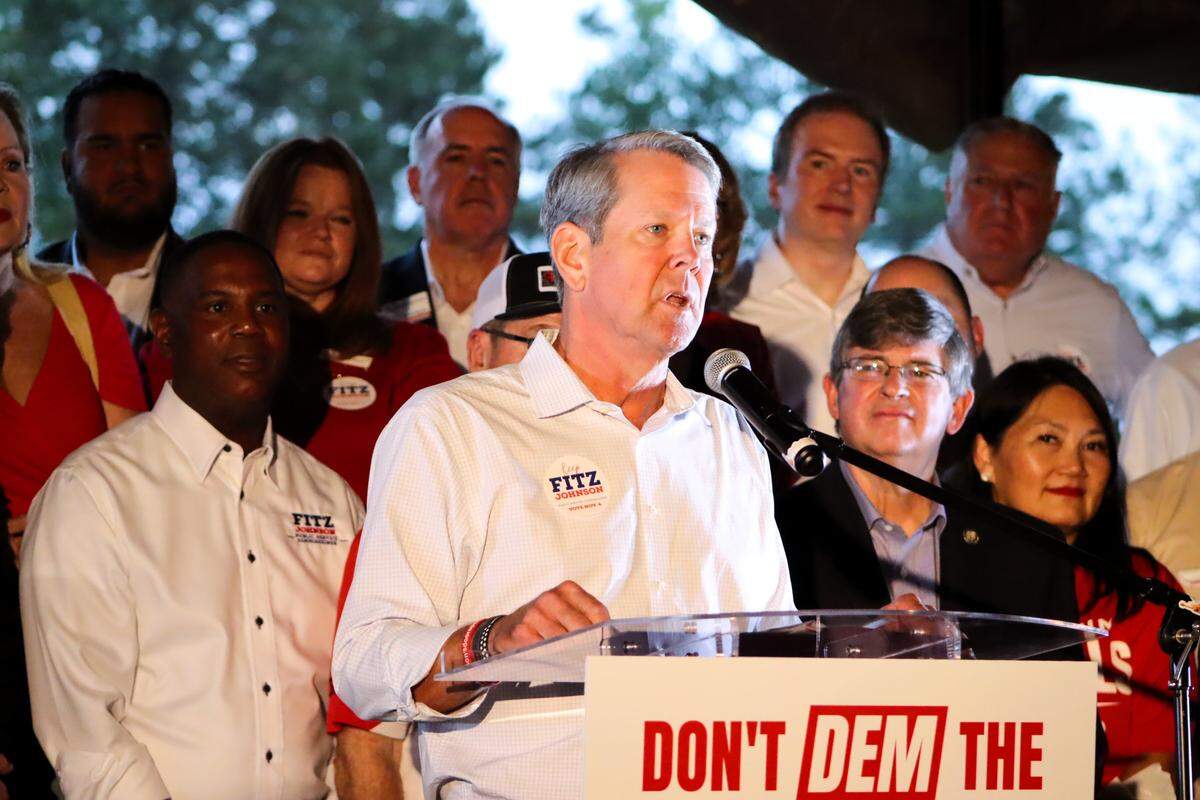
The two incumbent Republican Commissioners, Fitz Johnson and Tim Echols, held a rally Tuesday evening at a barn in Cumming, with strong backing from Republican leaders like Gov. Brian Kemp and Attorney General Chris Carr supporting their reelection bid.
Carr called the two Democratic opponents, Alicia Johnson and Peter Hubbard, “socialists who will make energy costs go up and reliability go down.”
Echols, who has been on the commission for 15 years, said the Democrats are “at war with our fossil fuel plants” and “we can’t allow (them) to take the helm of the Public Service Commission to shut these things down.”
Echols, of District 2, admitted the Democratic primary turnout June 17 scared him to death, but he is “fired up now.”
The Democratic primary turnout in June doubled the Republican vote total.
Johnson, of District 3, told the crowd of 100 people Tuesday that he loves his job and he is thankful to Kemp for appointing him several years ago. This is Johnson’s first election as he was appointed because a previous commissioner left the position in midterm to fulfill another role. The commission terms last six years.
“My opponent is a big Green New Deal guy,” Johnson said. “The Green New Deal is crushing families in this country, and we are not going to let (him) California our Georgia. … We need you to tell your friends and families because it’s about turnout.”
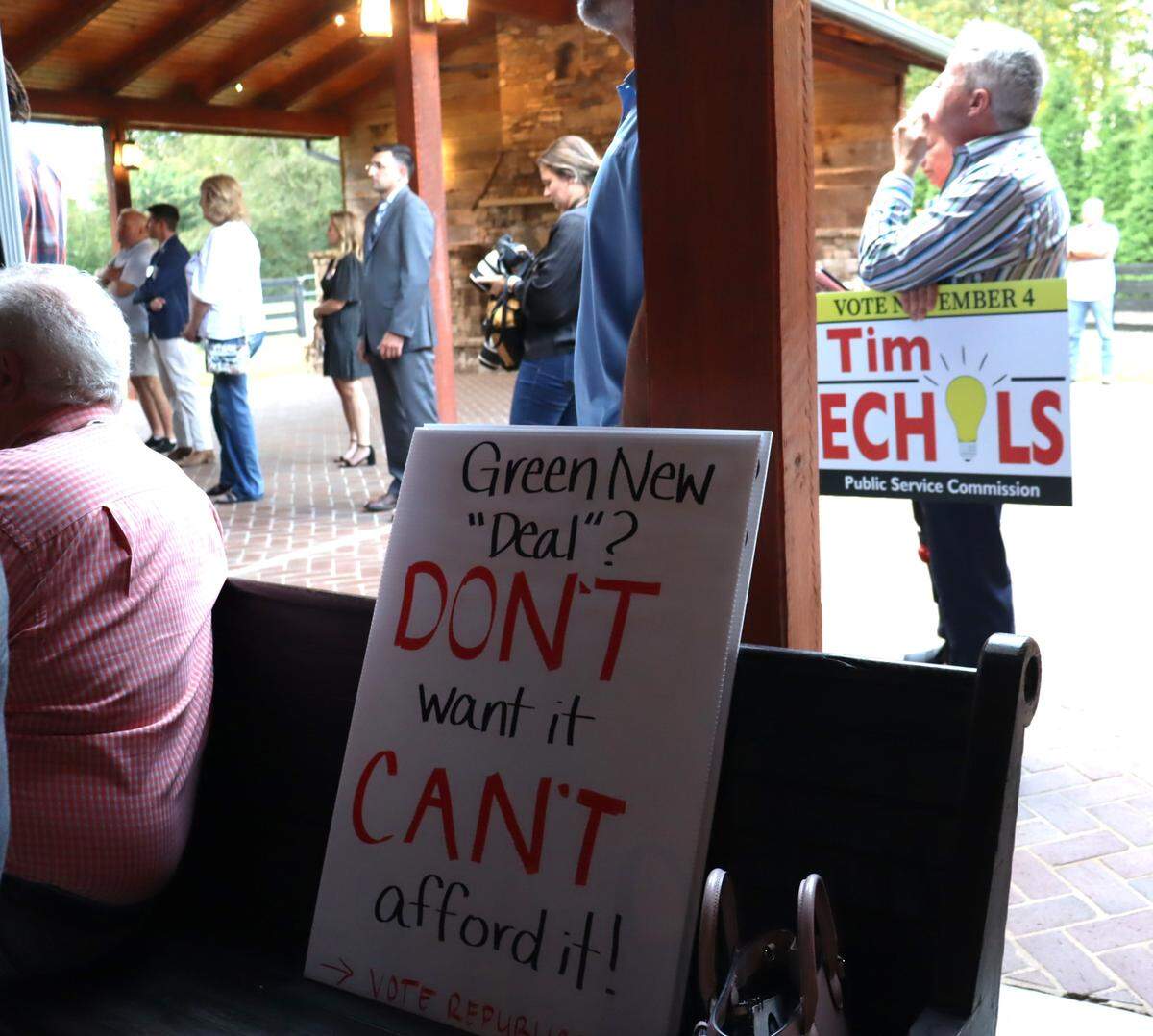
Johnson claimed rates have gone up in New York and Chicago, and a $24 “climate tax” was added to California bills. That tax is an income-graduated tax and is not associated with climate change.
“It’s an honor to support Fitz and Tim”, Kemp said. “We know how important this race is, not only for this year but for next year and for the next decade when you think about our quality of life, business environment and how much we’re paying for utilities.”
Just over 12 hours later, Echols and his opponent, Alicia Johnson, vying for the District 2 seat, were scheduled to debate for the Atlanta Press Club at the WABE station in Atlanta. Neither attended the 9 a.m. debate.
Echols told the Ledger-Enquirer he is not going because his opponent is not going. Johnson said she could not go because she works full-time and couldn’t leave a work commitment. Johnson is a managing principal at Health Management Associates, a health care research consulting firm.
Echols called Alicia Johnson a “DEI candidate” who will bring “DEI and wokeness to the PSC,” at the rally on Tuesday.
Alicia Johnson emailed the Ledger-Enquirer her response to that claim, saying it is a reflection of him, not her, and it’s “a lie and racist MAGA dog whistle.”
“He is a rubber stamp for Georgia Power and not a regulator,” she wrote. “After a decade of service, he should have a record to run on and not be using terrorist fear-mongering as a tactic. But he does not. I won’t be intimidated or distracted.”
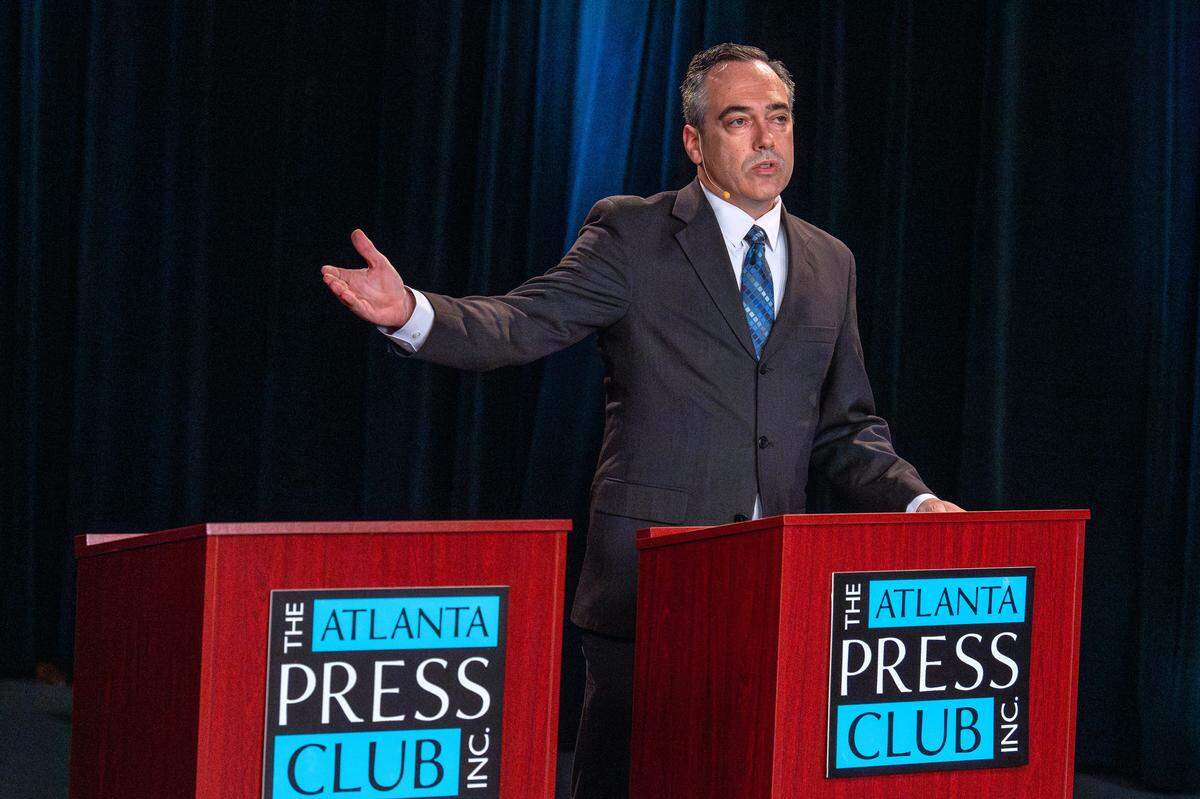
The one-person debate
At 10 a.m., the District 3 debate wasn’t a debate because clean energy expert Peter Hubbard faced an empty podium as Fitz Johnson declined to attend.
“Why didn’t you have the courage to show up today and defend your six rate hikes in two years, and what will you do to lower bills?” Hubbard asked the absent Fitz Johnson.
“The answer to that question,” Hubbard said, “is I had the courage to show up today, and I will unlock the value of solar that is held captive by the monopoly electric utility company that has their thumb on the scale of the fossil fuels. I will bring down the profit metric, which would unlock $700 million that we can use to lower power bills.”
Fitz Johnson told the Ledger-Enquirer via email that his record of delivering lower prices and reliable energy speaks for itself, and he isn’t interested in “a format that rewards soundbites and snark rather than serious discussion of these complex kitchen table issues.”
Hubbard mentioned more commission policies he believes should change.
“We’re in a hole, and we have to stop digging,” he said in his opening statement. “We’re burning coal and gas and sending billions of dollars to other states for those resources.”
Hubbard was referring to fuel costs, of which 100% are passed through to customers. Georgia Power has no “skin in the game” or “incentive because Georgia Power has three or four affiliate companies that profit on the sale and transportation of natural gas, and there is money to be made,” he said.
Hubbard has been an expert witness during four Georgia Power Integrated Resource Plans at the PSC in the past six years. He has written his own Integrated Resource Plan. Fitz Johnson is a U.S. Army veteran and small-business owner.
Protecting Georgians from data center burdens
The contentious and ubiquitous growth and development of data centers in Georgia also was a topic at the debate and the rally.
Kemp told the crowd Echols and Fitz Johnson and have been supplying the data centers with what they need, and, if voters want renewables or businesses want renewables to power it, the PSC can give you what you need.
In January, the Public Service Commission created a new rule requiring all data centers that use more than 100 MW of energy to be billed an equivalent of charging 50,000 homes, and the large-load customer must sign a 15-year contract.
Georgia Power currently serves 60 data centers in Georgia, according to Alicia Brown, spokesperson for Georgia Power. As far as new data centers that would fall under the January PSC rule, Brown shared Georgia Power Company filed a request for 2 gigawatts of large load contracts with the PSC, and noted 80% of their large load requsts are data centers. But did not share how many data centers, specifically, are in the 2GW filing.
Hubbard called this rule “inferior to legislation that can be changed in 30 days.” He also said, “It implies they weren’t paying their fair share before.”
Hubbard said data centers are paying five times less than what the average customer pays on their summer bills: 4.2 cents per kilowatt/hour while the average summer residential customer pays 21 cents per kilowatt/hour.
But the July residential average is 15 cents per kilowatt/hour, according to the Energy Information Administration. The agency does not break data centers out of the industry category, which is 10 cents per kilowatt/hour.
“There is a reason why 90% of what we built in the U.S. and around the world (last year) was solar, wind and batteries,” Hubbard said. “It’s the lowest-cost resource, and it can provide capacity for data centers. We can accommodate load growth from data centers with renewables, batteries and a low amount of fossil fuels. It’s very possible.”
Hubbard said there is enthusiasm to combat climate exchange and skyrocketing power bills and that enthusiasm will carry to Election Day.
“It’s true not many people know (about the PSC),” he said, “but I’m doing everything I can to get this out.”
This story was originally published October 10, 2025 at 5:00 AM.