Nearly all of Georgia is under a drought going into new year. Will it stop soon?
For the last three months, the majority of Georgia has been under abnormally dry conditions, and that was set to carry on through New Year’s Eve.
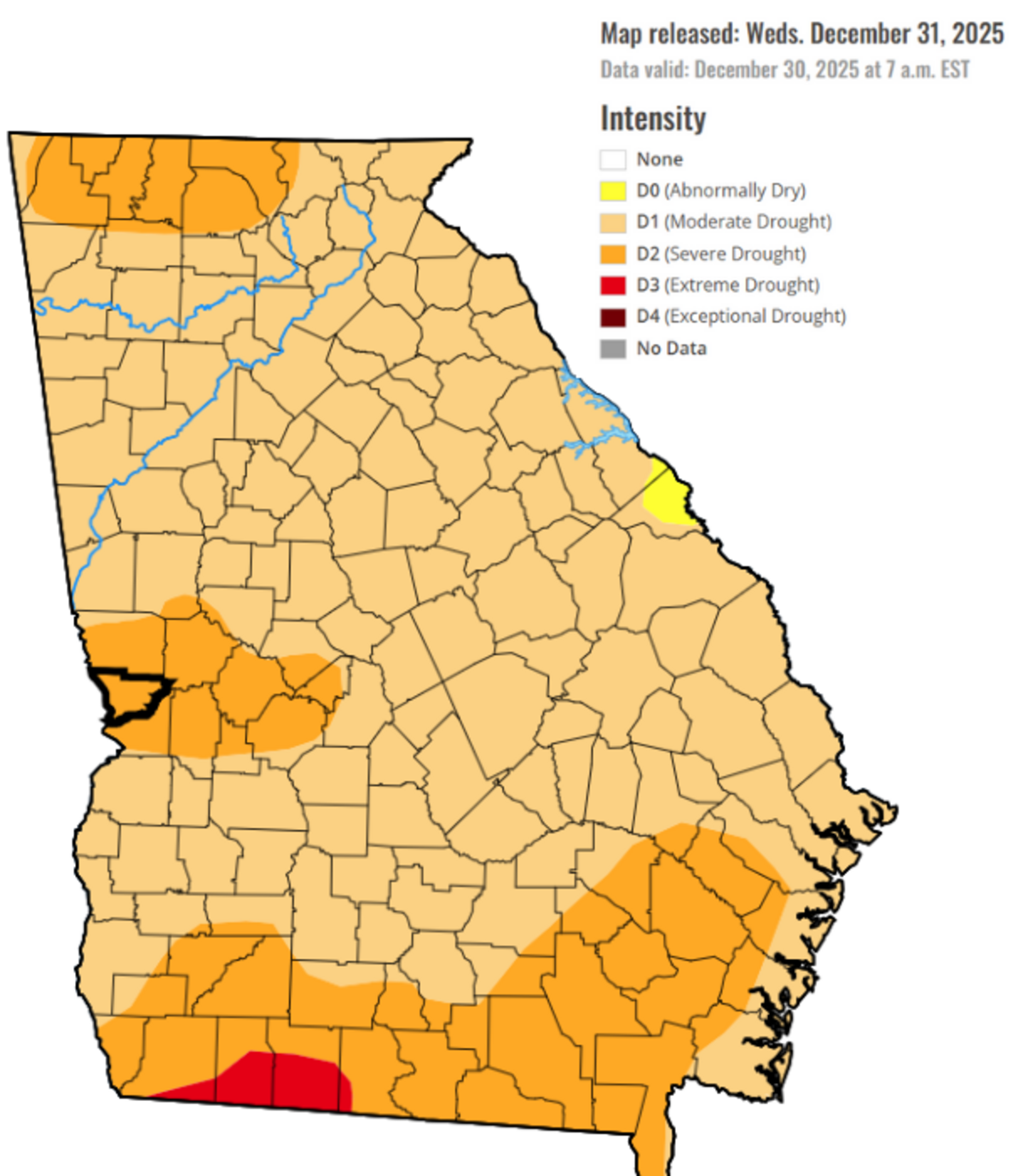
Wednesday morning, 99.6% of Georgia was in a drought. Muscogee County has seen severe drought conditions since early October, the U.S Drought Monitor reported.
“Over a 16-week period, Sept. 9 to December 30, drought expanded to cover nearly the entire state of Georgia,” Rocky Bilotta, a scientist with the National Center for Environmental Information, said in an email.
While dry conditions in the fall and winter are an expected weather pattern in the South during a La Niña period, according to meteorologist Katie Martin with the National Weather Service in Peachtree City, the below-average rainfall and high temperatures last week have created cause for concern.
Fire danger, cattle feed and spring planting are the biggest concerns among experts. The NWS issued a fire warning in 77 counties, including Muscogee, due to low relative humidity and windy conditions.
A quick reprieve, then more dry days ahead
While Columbus residents might not feel the impact of the drought now, planting in the spring will be difficult if drought conditions remain. The forecast indicates they will.
“We have to watch for what happens in the spring because if it continues, then it’s hard to put plants and seeds in the ground and have them germinate and thrive,” said Pam Knox, University of Georgia agricultural climatologist. “If the soil doesn’t have moisture, people can’t plant anything.”
Conditions are expected to persist, according to Martin, aside from some rain forecasted this weekend. It won’t be enough to get Muscogee County out of the drought.
Muscogee County would need 11 inches of rain over the next month to get out of the drought, or 19 inches over three months, according to NWS hydrologists who Martin relayed information from.
“Without 1 inch of rainfall per week, drought persistence can be expected,” she said in an email.
Muscogee County was 2.26 inches below normal rain amounts during November and 7.5 inches below normal over the past six months, Bilota said.
The high temperatures last week throughout Georgia showed an 18-degree departure from normal, according to the U.S. Drought Monitor. The Columbus Airport recorded temperatures reaching 79 degrees on Christmas Eve.
Is the drought because of climate change?
The drought itself isn’t attributable to climate change, because it’s a short term week-by-week forecast, and climate change is attributable to weather patterns over long periods of time, Knox said. The big alternating dips of highs and lows have had some climate change attribution, but the jury is still out, she said.
Temperatures are just one piece of the puzzle for what creates a drought, Knox said.
“We’ve certainly been setting records,” she said. “The records in the middle country have been attributed to climate change.”
Climate Central, which uses decades of weather and climate data to discover whether temperatures would have been likely without human-caused climate change, found that the temperatures in Georgia between Dec. 24 and 28 were due to climate change.
.png "climate-shift-index-tavg (1).png")
This story was originally published December 31, 2025 at 12:25 PM.