River watchdog weighs in on proposed Columbus data center. Water Works answers to council
The Chattahoochee Riverkeeper gave 10-pages of recommendations and information about data centers to the Columbus Council ahead of Tuesday’s first reading of the proposed technology overlay district ordinance for data centers.
CRK has had its eyes and ears on the rapid influx of hyperscale data centers in Georgia for the past several years, as the scale and speed of development have drawn criticism for their unprecedented water demand required to cool equipment inside the facilities. The water policy director for CRK, Chris Manganiello, has examined the different ordinances made throughout the Chattahoochee basin, from Troup County and Coweta County and in between.
CRK director Henry Jacobs and Manganiello wrote in their letter to the council that they agree with the latest technology overlay draft, prohibiting open-loop cooling. However, they critique the lack of text about water and other environmental concerns, and they contend the ordinance should go further in protections.
Up to 100,00 gallons of water is permitted to be drilled into groundwater wells by large industrial users, according to the Riverkeeper, unless the Columbus Consolidated Government, which governs the city and county, has specific local legislation, the Riverkeepers warn in their letter.
The letter recommends data centers “must pay” for any water-related infrastructure on their property.
Columbus Water Works president Jeremy Cummings has said in public presentations the water infrastructure needed for the proposed hyperscale data center Project Ruby on 865 acres in northeast Muscogee County would cost $30 million and the developer would have to pay for it.
Cummings told the Ledger-Enquirer they would have to pay the same rates as any large business.
Cummings has also emphasized that Columbus has a permit to draw up to 90 million gallons of water per day but uses only about 30 million gallons per day. He said Project Ruby’s potential 330,000 gallons per day was “kind of comical” because it “wouldn’t have an impact on our water.”
In the letter, Manganiello verified the permit capacity — but with the caveat “only if there is water in the river.”
Georgia is in a Level 1 drought., according to the state’s Environmental Protection Division.
During the council meeting Tuesday, Councilor Toyia Tucker of District 4 asked Cummings about potential water shutoff or water controls due to the drought.
“There is no way the river would get that low that we would need to (shut off),” Cummings replied.
Cummings presented a slide showing how Project Ruby would rank by 2033 as a water user: fourth after Fort Benning, Harris County and the Columbus Consolidated Government.
Riverkeeper comments also emphasized wastewater questions remain unanswered with evolving cooling technologies.
“Direct-to-chip and immersion liquid cooling technologies are developing, evolving, and may offer different challenges,” the letter says. “Some direct-to-chip options may use a water and propylene glycol mix that is considered non-toxic, while others may use an ethylene glycol mix that is considered toxic and cannot typically be flushed into municipal treatment systems. At least one immersion liquid cooling option may include PFAS.”
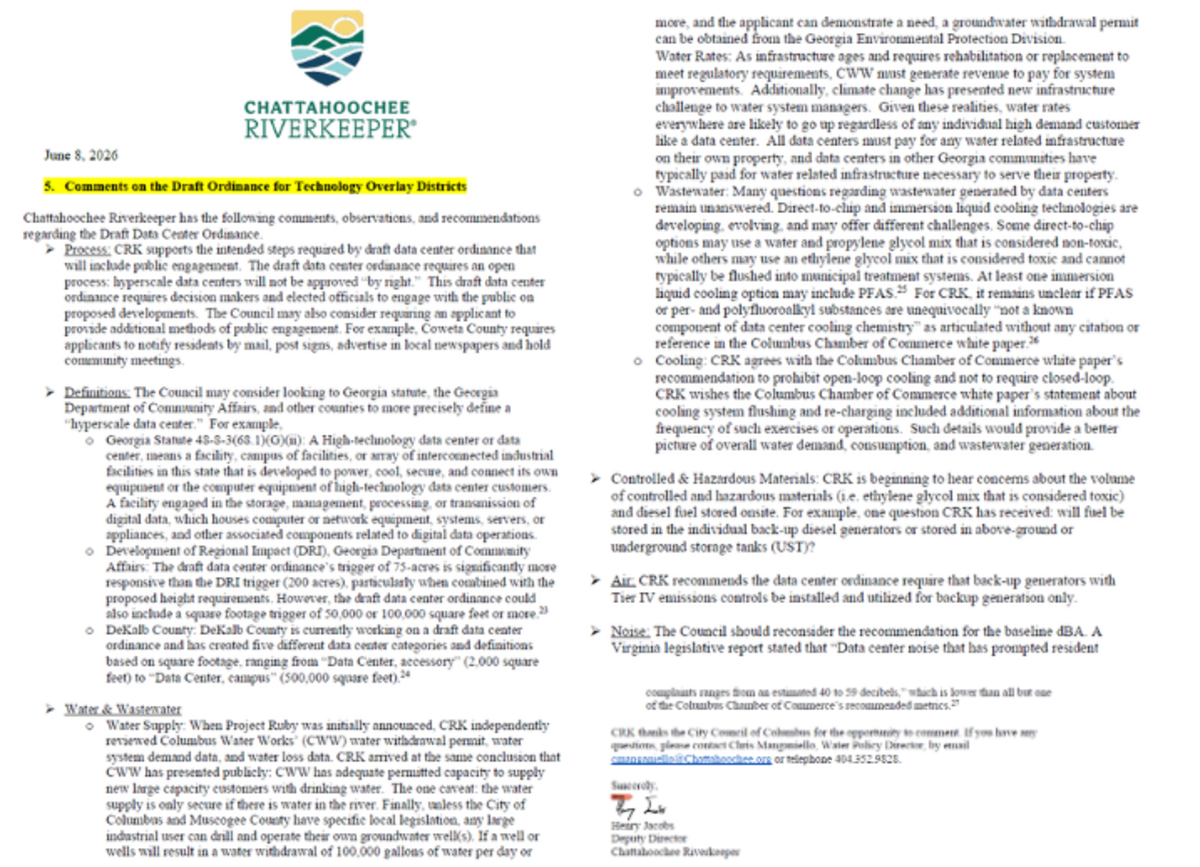
Jacobs and Manganiello also call out the lack of clarity if PFAS (forever chemicals) are a known component of the data center chemistry.
CRK noted the proposed ordinance doesn’t explain how chemicals and fuel should be stored.
“How are chemicals used within these cooling systems and how are they stored on site?” Manganiello posed to the Ledger-Enquirer. “How much glycol do you have stored on site? Moving beyond the cooling system. If there are backup generators you have on site, how much fuel are you storing on site, is it in a single tank?”
CRK asked the council whether fuels including back-up diesel generator or other chemicals will be stored in above-ground storage tanks.
Like Clean Energy Columbus, the group recommended adding Tier IV emission control for backup generators and installed and utilized for backup generation only. Tier IV is not required in Georgia; only Tier II is required, a less stringent diesel generator.
The river watchdog nonprofit recommends the technology overlay add that residents be notified about data center development, a better definition of what hyperscale data center is by acreage or square footage. It also requests noise decibels not go above 40 decibels, lower than the ordinance draft’s limit of 55 decibels.
The council’s vote on the technology overlay district is scheduled for June 16.