Columbus got 20 inches of rain in 60 days. Is the drought over in Georgia?
The dry-to-wet pendulum has swung, and Columbus is no longer in a drought.
Just 60 days ago, Columbus, like most of Georgia was under an extreme drought (a 4 out of 5 in drought monitor category severity, D4). Now, the U.S. Drought Monitor declared Muscogee County to be drought-free, along with much of middle and central Georgia.
This is a drastic change from what was the dryest eight-month period in Georgia since record keeping began in the late 1880s.
“Sept. 1, 2025, to April 30, 2026, was the dryest period on record,” Bill Murphey, state climatologist for Georgia told the Ledger-Enquirer.
But that was followed by Georgia’s fourth-wettest May on record, according to Murphey, and it was “Columbus’ number one, wettest May on record.”
In May alone Columbus received a deluge of 9.8 inches of rain — the most in any May over the past 30 years.
“Columbus is sitting at almost 300% of normal rainfall for the past 60 days — 13.58 inches surplus, the normal value would be 7.09 inches,” Murphey said. “The total rainfall that’s fallen over that period of time is last 60 days is 20.67 inches.”
Murphey said this “hammering of rain” was brought on by “stalled thunderstorms that stayed across the same area” and Tropical Storm Arthur, which hit Texas and Louisiana last week, brought more rainfall to Georgia.
Not out of the woods yet
Even though most of Georgia is now just abnormally dry, (D1 out of D5), there is still a ways to go as the summer’s intense heat begins to arrive.
“Hydrology still needs to catch up; stream flows, ponds need to fill up, reservoirs are still low (especially across north Georgia), some reservoirs are lower than others, like Lake Lanier, still about 4.3 feet below full pool,” Murphey said. “Stream flows are looking better in the south and central part, but the north needs to catch up. We’re not completely out of the woods yet.”
The Georgia Environmental Protection Division declared a Level 1 drought response in April due to the severity of the drought. Communications director Sara Lips said the EPD is not considering lifting the response, even with Thursday’s latest report showing improved conditions. Like Murphey, she noted Lake Lanier levels and other hydrological factors and said “prudent management is still needed.”
“Despite all the improvements, we still see longer-term precipitation deficits and the consequences of such.,” Lips said in an email to the L-E. “ Many USGS (U.S. Geological Survey) gages and monitoring wells still provide readings that are in the low percentile range. Lake Lanier is still more than 4 feet below the normal pool level. The Savannah River Basin Army Corps of Engineers Hartwell and Thurmond reservoirs are still under Drought Response Level 2. As we move into the warmest and driest part of a year, prudent management of water resources is still needed.”
A heat dome has arrived in the U.S. and is expected to bring Georgia temperatures to the upper 90s and feels-like temperatures in the triple digits this weekend and next week, according to the National Oceanic Atmospheric Administration’s forecast.
Because of the heat dome, Murphey said, more rain is required in southern Georgia.
“There’s a pretty big heat dome building across the eastern U.S., and Georgia is going to be part of that,” he said. “You get more evapotranspiration crops losing more moisture. The intense heat is going to put more stress (on crops). We’re still gonna need some additional rainfall in some areas. You might need 10, 12 more inches in parts of even in parts of far-south Georgia over the next couple of months.”
Warmer oceans creating a ‘wild card’ of predictions
The temperatures in Georgia over the next three days are 100%-200% more likely because of climate change, according to Climate Central. Scientists compare two versions of Earth — using weather data with and without human pollution — to create the likelihood of climate change causing the temperatures.
Additionally, Georgia has warmed 2.5 degrees on average since 1970, with the trend continuing, according Zach Lee, climate scientists at Climate Central.
Georgia gets a lot of its moisture this time of year from tropical storms, which are predicted to be lower than normal, according to NOAA. Murphey said this is because of the El Niño weather phenomenon, which he said to keep an eye on because of very high sea surface temperatures.
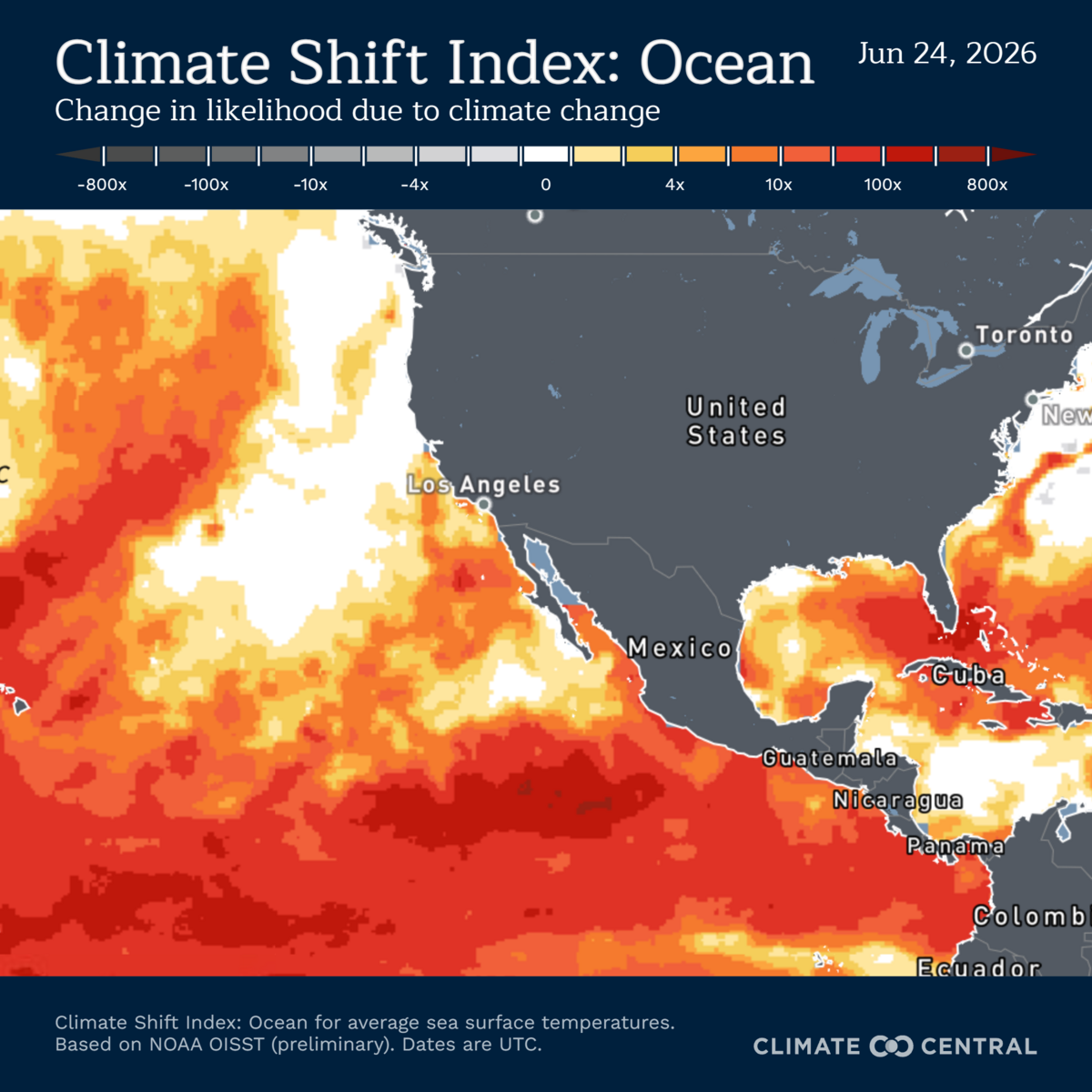
Sea surface temperatures in the Pacific Ocean are at a record-breaking temperature for this time of year, according to NOAA. Waters in the Gulf of Mexico, where hurricanes rapidly intensify, are also well above average. Climate Central shows both of these locations are 2 to 50 times more likely the temperature they are because of climate change.
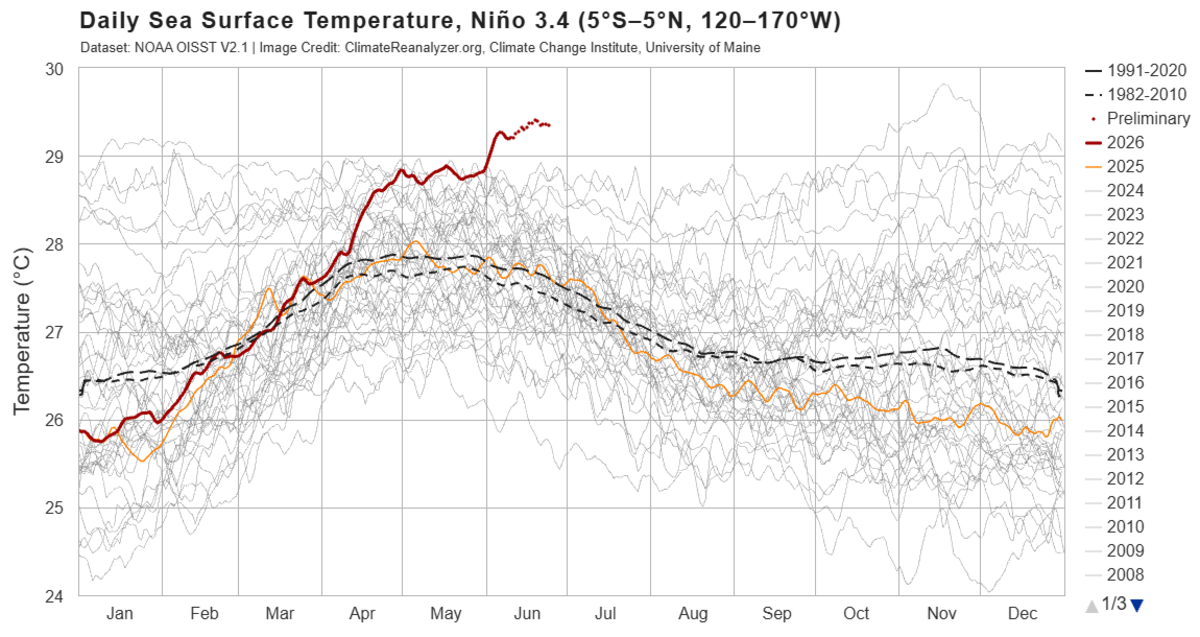
“Typically, El Niño reduces and helps suppress tropical activity in the Atlantic Basin, and so that’s why NOAA and Hurricane Center made that forecast,” Murphey said. “Still, sea surface temperatures are real high. So if something forms, it could ramp up quick, so you still have to watch the Gulf in the Caribbean. The tropics are kind of the wild card in all this.”
This story was originally published June 25, 2026 at 3:37 PM.