Parts of Georgia will feel like 112 degrees today. When will the heatwave end?
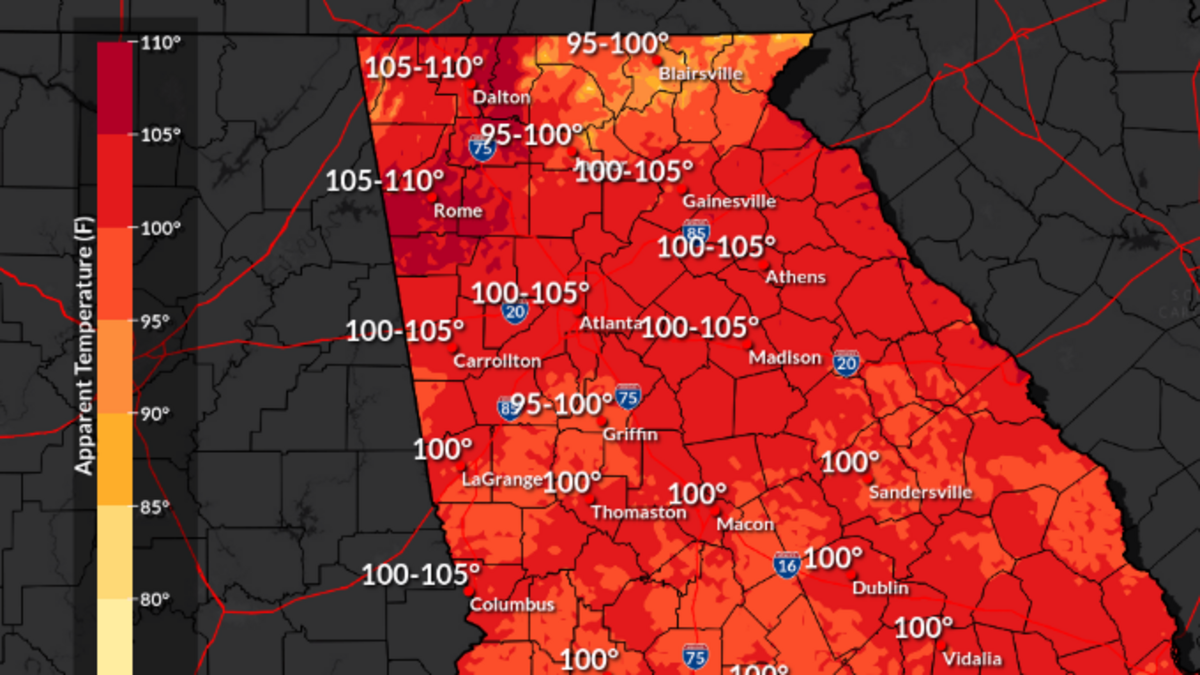
A heat wave moving across the central United States arrived in Georgia this week. Temperatures are peaking today, with places in northern Georgia 15 degrees above normal. From the Fall Line to the Appalachians, Georgia is getting scorched by extreme heat — and climate change is a factor, experts say.
Heat indexes (the feels-like temperature when combined with humidity and air temperature) are forecasted to reach 112 degrees in Rome, according to the National Weather Service.
The northern half of Georgia is under a heat advisory. Most of that area is under an extreme heat warning. That is expected to continue tomorrow and into the Fourth of July holiday weekend.
“We are expecting heat index values in the triple digits for pretty much everywhere (in Georgia) through Saturday except for the northeast Georgia,” Lindsay Marlow, lead meteorologist at the NWS Peachtree City office, told the Ledger-Enquirer. “It’s possible to see 105 (heat index) or above for north Georgia for July 4th. Sunday, we are expecting warmer further south to Columbus and Macon.”
Central Georgia has been faced with heat advisories since June 28, she said.
Hot and humid summer days are part of the social contract of living in the South for the mild winters and pleasant spring and fall. But these temperatures are exceeding what’s normal.
.png "Temps in GA 4th of July (18).png")
Marlow said the NWS keeps records for only high air temperatures, not heat index. While no records have been broken as of Thursday afternoon, temperatures are between eight and 15 degrees above average.
“In Central Georgia, the mid to upper 90s forecast is about 4 to 8 degrees above normal,” she said. “We’re normally closer to upper 80s or lower 90s. In northern Georgia, the mid-upper 90s is 8 to 15 degrees above average. These widespread highs in northern Georgia are less common.”
The scientific research working group Climate Central, headquartered in New Jersey, found the average forecasted temperatures from today through July 4 in central and northern Georgia were three to five times more likely because of human-caused climate change. These numbers mean the conditions would be “extremely rare” without climate change.
.png "2026-07-02-to-2026-07-04-climate-shift-index-tavg (1).png")
Climate Central creates real-time climate change attribution through its Climate Shift Index tool, where the historical weather observations with advanced climate model simulations are combined and compared to current temperatures against what they would be in a hypothetical world without human-induced warming.
Next week forecasts a slight rain reprieve
The above-average temperatures are expected to continue through mid-July.
The six-to-10-day outlook and eight-to-14-day outlook, going through July 15, are above average, Marlow said.
“It’s going to remain quite warm,” she said.
Marlow said the temperatures will cool down, relatively speaking, starting Monday, thanks to the potential for scattered showers, then some slight relief coming around Wednesday.
“Still expecting highs in low to mid 90s Monday, Tuesday and Wednesday,” she said.
The Fourth of July could be a record-breaking temperature day for Atlanta. The record high temperature is 99 degrees, and the forecast for Friday is 98, Marlow said.
“We could potentially tie it,” she said.