
She’s the new person in charge of how Muscogee cares for families, children in crisis
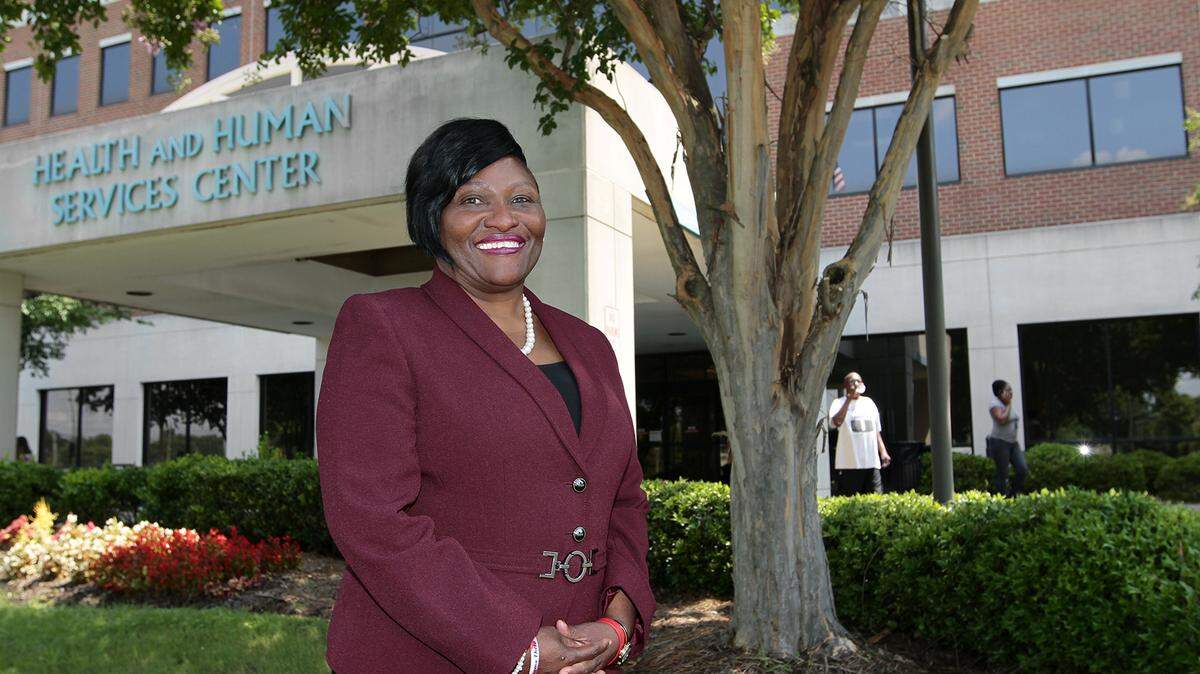
Jena Jones wanted to help more families and children, and she knew where she wanted to do it.
While directing the Crisp and Dooly county offices for the Georgia Division of Family and Children Services the past four years, she served as interim director in the Muscogee County DFCS office from October 2015 through October 2016.
The combined population of Crisp and Dooly counties was 36,743, compared to 194,058 in Muscogee, according to the U.S. Census Bureau.
So when the Muscogee director’s position opened again this year, Jones not only saw the chance to help more people, she recalled how engaged the community partners are in Muscogee.
“The judges, law enforcement, hospital personnel, the school system, the military — they showed me how important this community is to them,” she said.
In fact, her first day as interim director, a judge called her with ideas about how to help. Her reaction: “Wow.”
No wonder she ranks Muscogee as the No. 1 office in terms of community engagement out of the 28 Georgia counties she has served during her 16-year DFCS career.
“I chose Muscogee not only for the community, but for the team that was still here and the ability to hire new team members,” she said.
Jones became the Muscogee DFCS director July 1. She replaced Delbert Montgomery, who was in the position since November 2016.
Asked why Montgomery left the Columbus DFCS office, Walter Jones, the legislative and communications director for Georgia DFCS, said in an email to the Ledger-Enquirer, “It is not our policy to comment on personnel matters.”
The leadership change is one of several at the Muscogee DFCS office since 2012, when Deborah Cobb, a former acting director, and Phyllis Mitchell, an intake supervisor, were arrested for allegedly falsifying information.
“With all the challenges that Muscogee had, we did a great job,” Jones said of her interim period as director here. “But I really felt strategic wise — not only that but career-wise — I wanted to be the best county director I could be. It’s always been my goal.”
She explained why.
“The county directors I worked with were always so giving, so humble, so supportive of the staff,” she said. “My county directors were on the floor with us, through the hard times, through the good times.”
Jones grew up in Rutherford County, N.C., outside Charlotte. She earned a bachelor’s degree in child development/human and behavioral science from North Carolina Central University in 1998. She moved to Georgia to become a history and science special-education teacher at MLK High School in DeKalb County.
“I was a social worker in the classroom because the kids would come to school high after being out all night,” she said. “They had all these things going on in the community. So they would come in the classroom and go to sleep. I had to create these ways and incentives to read and learn. All of them passed the Georgia high school test except three, and they were very low functioning, so we had to create some alternative tests for them.”
After a year of teaching there, Jones figured she should become a professional social worker instead of just serving like one.
Jones enjoys social work, she said, because “most of all, it’s just serving families in the community, not only with food, clothes and shelter, but also to help change lives and help stabilize the community.”
She and her four brothers are products of kinship care, having relatives — two pairs of aunts and uncles and their children — help their factory-worker mother raise them. So although her family lived in circumstances that could have necessitated government assistance, they never needed it while she was a child.
“I’ve seen what family can do,” she said. “I didn’t know anything about DFCS or welfare. … I didn’t know until I got older that my aunts weren’t my grandmothers.”
That’s why, when her staff discusses with her a case involving children who might need foster care, her first questions is, “Where’s the dad?” or “Where are the relatives?”
“Foster care can meet their needs,” she said, “but it’s not their family.”
Jones emphasized she wants her staff to make taking care of families the priority.
“With that holistic relationship, I believe in keeping children safe,” she said. “That means, whether having to go to the home to make sure that the parental caregiver is taking care of the child, making sure that they’re safe from harm, making sure that they’re going to school and getting an education, even making sure that they’re eating every day, that they’re getting their basic needs met.”
Her interim period as Muscogee’s DFCS director helped her hit the ground running.
Under her leadership, the staff started a clothes closet and a food pantry. Jones moved a staff member downstairs to greet walk-ins seeking help with necessities such as utilities, food, housing or transportation. And she has empowered more staff to make more decisions by themselves instead of waiting for approval from a supervisor.
“We’re going to have some really good customer service and get to the needs of these folks right away,” she said.
That’s the way she tries to treat her staff, like customers. And when they become distressed by a case, she acts like a social worker for them.
“The team as a whole is a family,” she said. “Social work, they don’t make a lot of money for all the time they work on cases.”
The average salary for a case worker is around $35,000, after the state gave them a 19 percent raise last year, she said.
“Even though the case loads are high and the work is emotional and tough at times, and late nights and weekends sometimes, people that do this work really enjoy the work,” Jones said. “They really love connecting. They have these friendships with their peers and coworkers while they’re serving the community.”
Jones wondered how the high turnover of directors has affected the staff. One of them told her, she said, “We’re out there so much day to day seeing the children, we hadn’t noticed.”
Many of them are seeing more than 30 children per month.
“I know there’s going to be some transition,” she said. “I’m accustomed to it. So what I’m open to is trying to find out what my staff needs from me.”
That’s why, Jones said, any interaction she has with a staff member doesn’t end until she asks how she can help. She knows each job because she has done each job.
“I’ve gone through every position in DFCS to get here,” she said. “. . . I know it from intake all the way to adoption.”
Wherever they are in the DFCS hierarchy, the staff can have a profound impact on vulnerable human beings.
“When we knock on someone’s door, we’re invading,” she said. “… I tell my team, ‘Be respectful. Introduce yourself. Tell them why you’re there.’ You’re there to talk and see how you can help.
“Do we remove children? Yes, we have to if they’re unsafe in a domestic violence situation or if they’ve been hurt. But the majority of the time, we’re helping and supporting families.”
MUSCOGEE COUNTY DFCS BY THE NUMBERS
The Muscogee County office for the Georgia Division of Family and Children Services provides Medicaid, SNAP benefits (food stamps for seniors and families), TANF (Temporary Aid to Needy Families), ChildCare, preventive services, employment services, PeachCare, emergency services/community general intake, foster home and foster parent recruitment and retention efforts, wrap-around services, homestead services, ABD Medicaid (Aged, Blind and Disabled) and Drug Court.
Here’s a statistical look at Muscogee County’s DFCS office, 2100 Comer Ave., 706-321-2673:
$127,134,241 — Office’s current fiscal year budget.
194,058 — County’s 2017 population.
20,467 — Number of people in the Supplemental Nutrition Assistance Program, also known as food stamps.
7,058 — Number of contacts with foster families in fiscal year 2018.
456 — Number of foster children in DFCS custody as of June.
277 — Monthly average number of child protection intake reports.
215 — Monthly average number of foster children placed with relatives.
214 — Monthly average number of cases of neglect.
196 — Monthly average number of family support services cases.
172 — Monthly average number of Child Protective Services cases.
157 — Number of Social Services and Office of Financial Independence staff members.
133 — Monthly average number of family preservation and Drug Court cases.
60 — Number of family foster care homes.
59 — Monthly average number of referrals from general intake.
46 — Number of administrative, technical and resource staff members (included in the SS and OFI staff members).
34 — Monthly average number of cases of maltreatment.
19 — Monthly average number of children taken out of state under the Interstate Compact on the Placement of Children.
14 — Number of resource parent homes.
10 — Number of adoptive homes.
Source: Muscogee County DFCS office.