
Officials looking at containers on right of way to reduce litter from evictions
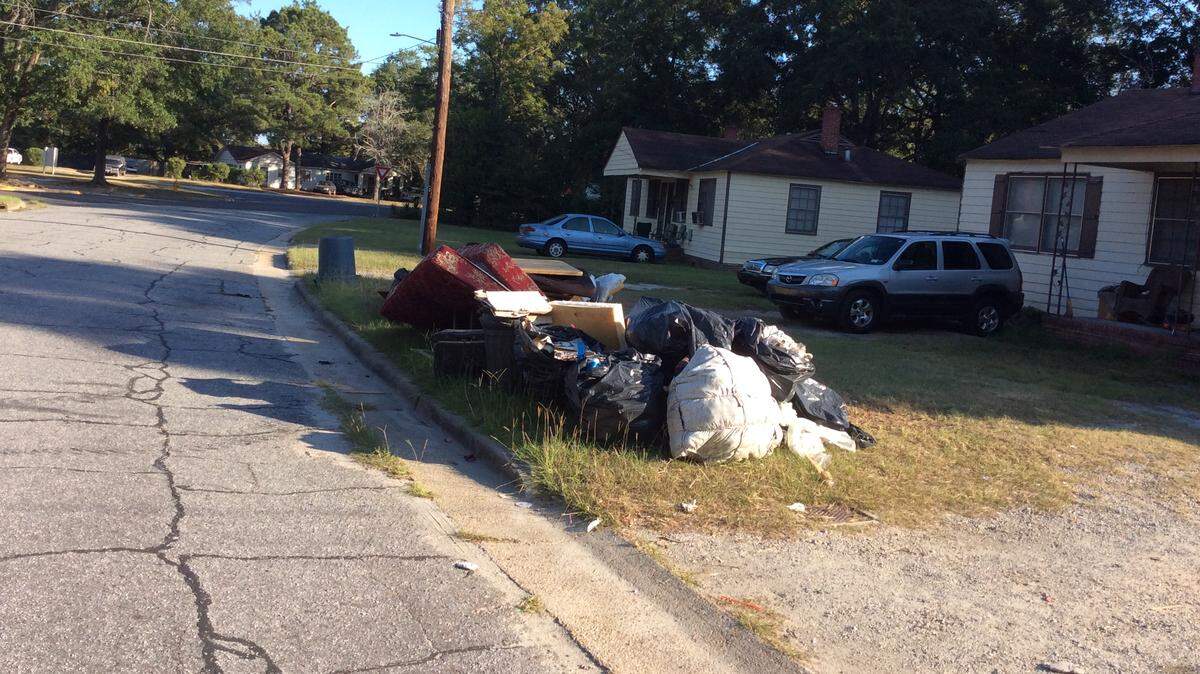
The city of Columbus is taking a closer look at ways to reduce debris and litter after families are forced out of their homes during evictions.
Neighborhood litter was one of the last questions at the Sept. 20 “Let’s Talk With the Mayor” forum at the City Services Center. The idea of requiring a container to be placed on the right of way may reduce debris during evictions, said Drale Short, deputy director of Public Works.
“You have people who go through your belongings and scatter them from one end of the street to the other,” Short said. “It is just one way we’re looking at that could possibly help to keep that under control. We want to keep our community as clean as possible. Evictions are unfortunately a part of life.”
Muscogee County Marshal Greg Countryman said deputies conduct 5,800 to about 6,000 evictions or dispossessory proceedings every year. Some people rent a place, live there three months and leave. “You have some people that just play the system,” he said.
Under the law, Countryman said household items are placed on the right of way but deputies make sure clothes and other loose items aren’t dropped on the right of way but neatly placed in bags. When the deputies leave, everything is piled up but items don’t remain that way.
“It’s considered abandoned property. People go through it and that’s what causing that,” he said of the littering. “We make sure they put it down neatly and secure. It has to be in a bag.”
In some neighborhoods, deputies are trailed by drivers in U-Haul trucks to scavenge items from the curb. Deputies who watch workers clearing the property have seen fur coats, new Nike sneakers, big screen TVs and other valuable items on the curb.
“We’ve had an array of nice things,” the marshal said. “Some people never know they are going to be evicted.”
Gloria Weston-Smart, executive director of the Keep Columbus Beautiful Commission, said the city of Albany, Ga., requires a roll off container to store items during evictions. To get a program in Columbus, she doesn’t know whether the city can get donated containers or would have to purchase them but the property owner would be responsible for the item.
Weston-Smart said she and Short are still looking at the idea. The city of Albany had to put an ordinance on the books to get the program started. “We’ve been looking at the issue a good while,” she said.
Countryman said he’s concerned about the business owners served by deputies. If a property owner has only one or two rental homes and there has been a cycle of bad tenants, the person is hit with added costs to go along with the eviction. He already has to clean up the property and prepare it again for the market. The costs may be different for property owners with 400 or 500 pieces of property.
“The job market is not what it used to be,” he said for some businesses. “Columbus is just coming out of the recession.”
Countryman said he’ll support efforts to make it better.
“The only side I’m on is the side of the law,” he said. “Whatever Georgia law says, that is what I’m going to do.”
If there is a change in the local ordinance, he will have to do his job differently.
“I do know they are our customers and that’s who we deal with,” he said of property owners. “We hear what their gripes are.”
In conversations with some landlords, Countryman said several don’t favor the idea.
“We need to get their input,” he said. “If that is going to cost them money, they need to know. I have spoken with several landlords and they did not favor that at all.”
There is nothing to present to the public yet but the conversations have started, officials said. “The entire goal of having a program of that nature is to stop the littering of debris,” Short said.
If you’ve seen something that needs attention, give me a call at 706-571-8576.
This story was originally published September 30, 2018 at 11:13 AM.