
My Lai Massacre ‘still staggers me,’ prosecutor says, recalling Calley trial at Benning
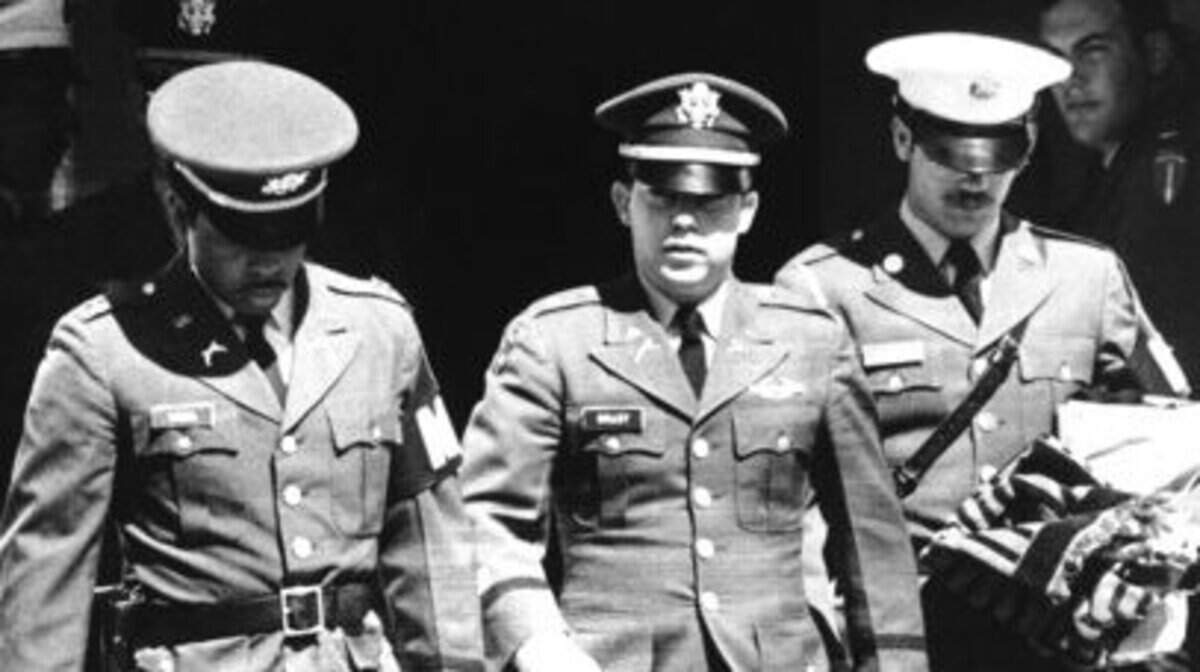
In the 100-year history of Fort Benning, perhaps no event put the U.S. Army post in the international spotlight more intensely than this controversial court-martial.
From Nov. 17, 1970, through March 29, 1971, news reports about the trial of Lt. William Calley flowed from Fort Benning. He was convicted for the March 16, 1968, premeditated murder of 22 unarmed civilians in the South Vietnamese hamlet of My Lai.
The incident became known as the My Lai Massacre. Calley was a platoon leader in Charlie Company, First Battalion, 20th Infantry Regiment, commanded by Capt. Ernest Medina. Reports vary, but the unit’s soldiers killed more than 300 Vietnamese children, women and old men in approximately three hours that morning.
Although five officers were charged and tried in other military courts, Calley was the only soldier convicted. He was sentenced to life in prison, but his sentence was reduced. Calley spent three years under house arrest and was released in 1974.
John Partin, then a captain in the Judge Advocate General’s Corps, was the assistant on the two-man prosecution team that won the conviction. Now retired from practicing family law in Columbus, he recalls the trial with pride about the verdict but discouragement about the punishment.
Getting the case
Partin first heard of the massacre when he arrived at Fort Benning during Labor Day Weekend in 1969.
“The case was already in the office,” Partin told the Ledger-Enquirer during an interview in his Columbus home. “. . . We just heard a rumor of a big case coming up. That’s all we knew. We didn’t know any details of where it was or when it was.”
A preliminary investigation, called an Article 32, was being conducted. After charges were recommended, chief prosecutor Aubrey Daniel and Partin were assigned the case in December 1969.
Partin was only six months out of law school, and Daniel had less than three years of experience.
“Two rather green guys dressed in green, representing the Army,” Partin said.
He doesn’t know why he was chosen, but he was pleased to have the opportunity.
“It was a big job,” he said.
And it became practically his only job for the next 20 months.
Learning the horror
When he learned the extent of the massacre, Partin said, “it makes you sick to think about it. It still staggers me, when you think about what happened. It’s just not supposed to happen, not by an American.”
Thankfully, Partin said, his investigation didn’t require him to “see bodies. We just saw pictures, which were bad enough. And we were dealing with people who were stressed by it. You could have sympathy for that. (Pvt. Paul) Meadlo lost a leg the next day and thought he was being punished by God.”
A half century later, the significance of the My Lai Massacre and Calley’s trial remains the same, Partin said.
“Historically, we did the right thing — ultimately, we being the Army,” Partin said.
Asked how he could say that understanding there were attempts to cover it up, Partin said, “Once the public disclosure through (Ronald) Ridenhour’s letters — he wrote over 20 different people — the Army’s Criminal Investigation Division took up the investigation, and from there it followed as it should have to start with.”
The oft-expressed reasoning for the massacre combines several factors: the unit’s mounting casualties, the intelligence that indicated the residents of My Lai were members or sympathizers of the communist guerrilla force called Vietcong, and various soldiers saying they were ordered to kill everyone in the hamlet.
“I think they got there with the assumption, just like Capt. Medina has said, finding an enemy they wanted to face and actually have combat, but they were so fired up that it didn’t matter,” Partin said. “It was not because they were afraid.
“When they landed and started into the village, they came upon families having breakfast. There were no combat-age people there.
“In the briefing, the people who committed those type of things remembered Medina saying that’s what we were supposed to do. When Medina was tried, he was tried for ordering the murder in the village, and about half the people who testified said he didn’t say it, and the other half said he did.”
Asked what he believes, Partin said, “He may have said it, but that doesn’t justify what happened. … You can’t follow an illegal order, the order to kill people who are noncombatants and under control.”
To those who say American soldiers couldn’t tell the difference between Vietcong and civilians, which Calley asserted, Partin argues, “All I know is, that particular day, March 16, 1968, there were troops alongside Calley who did not shoot people and who disobeyed the orders of Calley to do that. They were unpunished.”
Partin doesn’t know any of the victims in My Lai were Vietcong. But it doesn’t matter, he said.
“They were innocent then,” he said. “The fact that six weeks earlier they met with the Vietcong, would that make a difference? If they had a cup of tea with them 16 days before? (Calley) didn’t know what these people had done. They did nothing to him. They did nothing to any of his troops. They did not threaten his troops. They didn’t run from his troops. They were there, rounded up and killed.”
As an officer in the U.S. Army, Partin said, Calley was “supposed to know better than that.”
Despite having more knowledge of this moment in history than nearly anybody, Partin still struggles with the prevailing question about what happened then and there:
“I don’t understand why the whole thing just went bad for three hours,” he said.
The trial
On the first day of the four-month trial, Partin said, “Nerves are going, butterflies, then you get started and settled into a routine. We worked 9 to 5 in the courtroom, with an hour for lunch, and that became the pattern. Aubrey and I worked at night to be ready for the next day.”
Partin disclosed some of the strategy.
“The biggest error we thought would be if we denied the defense things they were arguably entitled to,” he said, “like the trip to Vietnam. It would be easier to go and do it than to argue it and have that as an issue for appeal, that you denied him possible witnesses.”
There also was the matter of Calley’s mental fitness.
“The judge ordered that Calley raised his mental ability, which came as kind of a surprise,” Partin said, “and so we had to stop, and he was seen by three psychiatrists and ultimately determined to be competent, both March 16, 1968, and at the time of the trial.”
Partin’s assessment? “There wasn’t any question about it,” he said.
After the two sides rested their cases, they waited 13 days for the verdict. The longer the deliberations took, Partin said, the less confident he was in getting the verdict he sought.
“But you never know,” he said. “We knew it was going to take some time, because this was a difficult decision, even if they were convinced that it had gone on.”
He was most concerned about the jury feeling pressure from people who thought Calley was a scapegoat.
“They were secured and said they were not listening to news reports,” Partin said, “and hopefully they were not, but there was an awful lot of sympathy being projected for him, for Lt. Calley.”
Partin’s proudest moment during the trial was the day he heard the verdict from the six-officer jury, comprising five Vietnam veterans and one who served in Korea.
“It was finally settled that we had been able to convince a group of people that we knew wanted to find a way to acquit or, if not acquit, at least have lesser included charges,” Partin said.
After the verdict was announced, Partin said, “You can’t jump up and down or laugh or shake hands. You just listen. You do that whether you win or lose.”
But it reaffirmed his belief in justice.
“I hadn’t lost it,” he said. “The faith in the system got us to the point.”
In a statement to the court after the verdict and before the sentencing, Calley said, “My troops were getting massacred and mauled by an enemy I couldn’t see, I couldn’t feel and I couldn’t touch — that nobody in the military system ever described them as anything other than communism.
“They didn’t give it a race, they didn’t give it a sex, they didn’t give it an age. They never let me believe it was just a philosophy in a man’s mind. That was my enemy out there.
“And when it became between me and that enemy, I had to value the lives of my troops — and I feel that was the only crime I have committed.”
The sentence
With a conviction for premeditated murder, the choice for a sentence was death or life in prison. Partin and his co-counsel didn’t request either option.
“We did not think he would get the death penalty,” he said.
Asked whether Calley deserved the death penalty, Partin said, “If they had given the death penalty, I’d have been surprised but not mortified, because it was pretty heinous.”
Several times during his interview with the L-E, Partin mentioned a scene, reported by witnesses, involving Calley along a ditch in My Lai.
“It’s not like a mistake, four or five people or even one or two people,” Partin said. “He shot at a child along the ditch. Picked him up and threw him in the ditch. … It’s not like he ever got confused about it.”
Partin added, “It was a conscious effort on that trail, on that ditch, and then they picked up that baby and threw it back. He made a conscious choice.”
One day after the jury sentenced Calley to life in prison, President Richard Nixon ordered him to instead be put under house arrest. Calley stayed there for three years as the Fort Benning commanding general Orwin Talbott reduced the sentence to 20 years, and Secretary of the Army Howard “Bo” Callaway (born in LaGrange and raised in Harris County) reduced it to 10 years then granted him parole in 1974.
President Nixon “degraded” Partin’s faith in the system. And he gave the president that message in a letter, dated April 4, 1971.
“I was just really distraught,” Partin said, explaining why he wrote the letter.
Partin told Nixon in the letter that “1 April 1971 was the most discouraging night of my life.”
In his letter to Nixon, Partin noted that the president gave Calley leniency while “some 200 other prisoners, none of whom are even charged with capital offenses, remained in the stockade. … It now appears that the only reason Lt. Calley was afforded such peculiar treatment was the public outcry.”
That outcry included “many who hold responsible positions,” Partin wrote, and “merely fanned the flames ignited by ignorance and unreasoning emotion.”
Partin also told Nixon, “This case could have served as a true vehicle for the respect in the military justice system which is so badly needed. Instead the extraordinary action shows how unrespected it is even within the system. This action has decreased my respect for the system immeasurably.”
He criticized the president for “no condemnation from your office of all the persons within this grand society who reacted with threats of violence against the court members, the judge, and other participants. . . . The failure to condemn such acts is an implicit condonation of their acts, at least to them.”
Partin concluded his letter to Nixon with this declaration: “Expediency and politics are not going to provide the backbone for a rejuvenation of the spirit of America which you have said you wanted for this country. These actions can only delay that much needed rejuvenation.”
He never received a response.
Despite the outcry, Partin said, he never felt in danger.
“The death threats were sent to the judge,” he said, “and he quit opening the mail.”
The aftermath
Around the time of the trial, during a drive to see relatives in southern Tennessee, Partin and his wife, Vicky, stopped in Rome, Ga., to shop for carpeting. A man who saw the Fort Benning sticker on his car started talking about the Calley case, how unjust it was and how wrong it was to prosecute “good American boys.” Then he paused and acknowledged to Partin, “But you might know a little more about the case.”
Partin told him that he was the assistant prosecutor.
“He never said another word,” Partin recalled. “… He didn’t ask anything. He didn’t want the facts to mess up his opinion.”
But that was as close to a confrontation Partin had due to his involvement in the trial.
If the case were tried now, with social media being so prevalent, Partin said, “it would be incredible.”
Partin said he never doubted he was on the right side of justice — and he balks at the notion that Calley was a scapegoat.
“If you read the statements from the people,” he said, “it was very clear (Calley) was in charge, and he abdicated his responsibility.”
Calley married and stayed in Columbus for decades. He worked in his father-in-law’s jewelry store. In the 2000s, he got divorced, moved to Atlanta and then Florida.
Around town in Columbus, Partin’s interaction with Calley was brief.
“We didn’t talk much, except to say hello to each other,” he said. “… It’s always been courteous and professional.”
They were on the same plane for the trip back to Vietnam as part of the investigation before for the trial.
“He was always respectful of me, called me Capt. Partin all the time,” he said. “I think he just thought we were doing our job.”
Asked whether Calley was just doing his job, Partin said, “Apparently, he thought.”
Partin was on the other side of another legal issue with Calley: His law firm represented Calley’s wife in their divorce.
“She was a client of my partner (Milton Hirsch),” Partin said. “In the end, I tried the case.”
Partin said the court-martial wasn’t the reason Calley’s wife chose his law firm.
“It was happenstance,” he said.
The legacy
Evidence of the Army using the massacre as a lesson, Partin said, came from a report about Operation Desert Storm in 1991, when a U.S. commander in Kuwait told his troops, “There will be no My Lais in my unit.”
“That’s a clear example that somebody got the message,” Partin said, “through OCS (Officer Candidate School), West Point, somewhere along the line. … I know that it changed the way that land warfare was taught at all military installations.”
Partin added, “I can’t tell you that if Calley heard a different lecture he would not have done this.”
Cautioning that he isn’t a psychologist, Partin speculated that a factor in the massacre was the dehumanizing of the enemy.
“Part of what we saw in Vietnam was we were not fighting people; we were fighting slopes or slants or other nicknames there were for people,” he said, “instead of human beings.”
Partin praised the heroes of My Lai, such as Warrant Officer Hugh Thompson, who landed his helicopter amid the massacre to end it.
“What he did was outstanding,” Partin said. “It’s proof that there are heroes in every kind of situation, where he rescued people from the ditch and was willing to stare down Calley.”
Calley issued a public apology during a 2009 speech to the Kiwanis Club of Greater Columbus:
“There is not a day that goes by that I do not feel remorse for what happened that day in My Lai,” Calley said then.
According to Dick McMichael’s report in the Ledger-Enquirer, Calley’s voice started to break when he added, “I feel remorse for the Vietnamese who were killed, for their families, for the American soldiers involved and their families. I am very sorry.”
When asked at that Kiwanis meeting whether obeying an unlawful order is an unlawful act, Calley said, “I believe that is true. If you are asking why I did not stand up to them when I was given the orders, I will have to say that I was a second lieutenant getting orders from my commander, and I followed them — foolishly, I guess.”
Asked in the L-E’s interview how the case changed him, Partin said, “Somebody else might have to answer that. I know when I relive this, I can get very emotional, to the point of tears.”
Mark Rice, 706-576-6272, @MarkRiceLE.
This story was originally published October 25, 2018 at 12:00 AM.