
‘We’re not going away.’ Hundreds expected in Columbus for School of the Americas protest
Roy Bourgeois may never see another protest at the Fort Benning gate akin to SOA Watch at its peak.
Now 80 years old, the former Catholic priest who long led the annual mid-November demonstration against a Benning training center for Latin American soldiers remembers when busloads of protesters swelled the ranks, and each Saturday of the weekend event became a festival.
Along with Columbus police and Muscogee sheriff’s deputies working security, thousands swarmed the Fort Benning Road gate, where residents set up tables and sold homemade food, and out of town vendors trucked in souvenirs befitting the cause, selling them under canopies at the curb.
At the stone gate, where a high chain-link fence blocked entrance to the post, protesters danced and sang as musicians played on a stage, among them folk singer Pete Seeger and Amy Ray of the Georgia rock duo Indigo Girls.
“People talked about it being a joyful celebration of hope,” Bourgeois said Monday, speaking by phone from the apartment he still rents near the Benning gate.
Those peak years were 2003 to 2010, when wars in Iraq and Afghanistan drew a flood of pacifists to Columbus, with 15,000 expected in 2004 and 2005, though police estimates of the turnout never matched the organizers’. In 2007, for example, police said about 12,000 turned out; SOA Watch said twice that many were there.
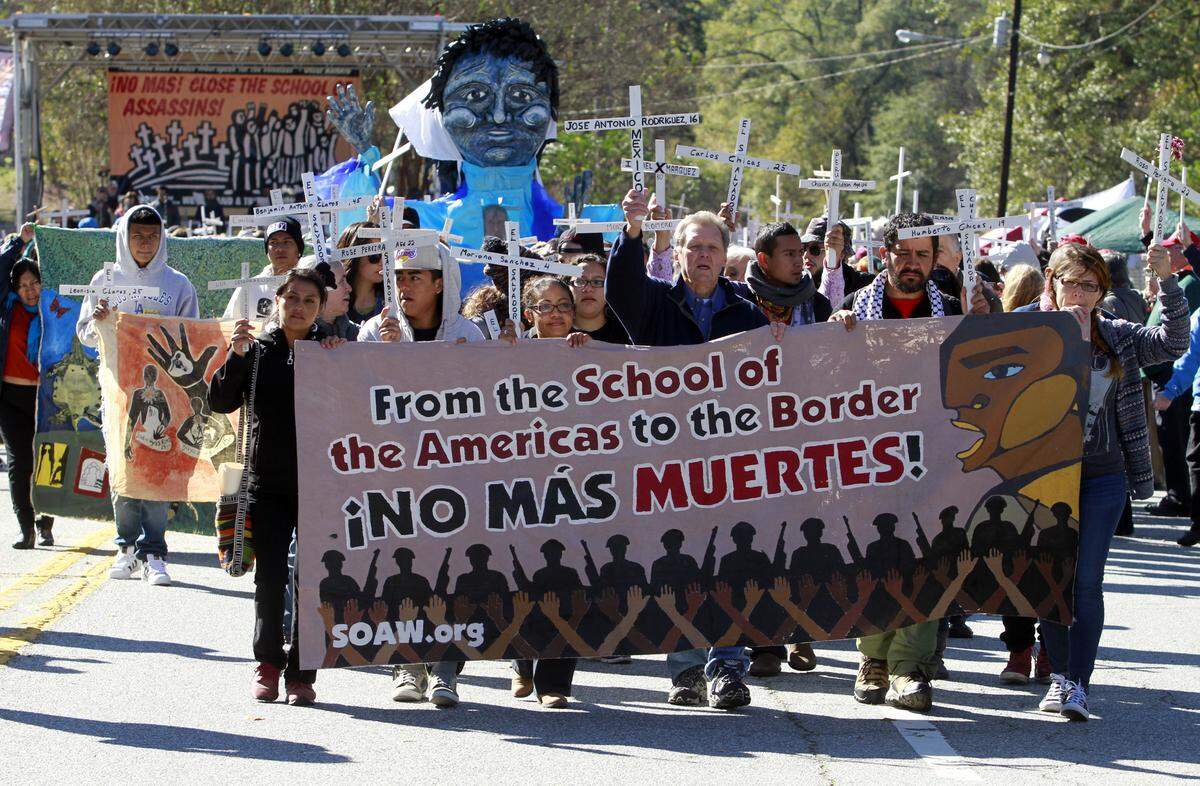
The protest’s signature act of civil disobedience was climbing the fence onto the post, to be arrested for trespassing. One year so many crossed the line that authorities loaded them onto busses, booked them and then hauled them back to the gate.
The protest against the training center once called the School of the Americas lately has moved to the Mexico border south of Tucson, Ariz., as the treatment of migrants became a central issue.
But this weekend it returns, to mark the 30th anniversary of the murders that provoked it — the 1989 El Salvadoran massacre of six Jesuit priests, their housekeeper and her teen daughter.
Though hundreds are to attend, from Friday night through Sunday afternoon, no one expects the mass of Catholic college students, nuns and other activists who once made the annual pilgrimage.
This year dozens of demonstrators will not climb the chain-link barrier to get arrested, Bourgeois said: “That won’t happen.”
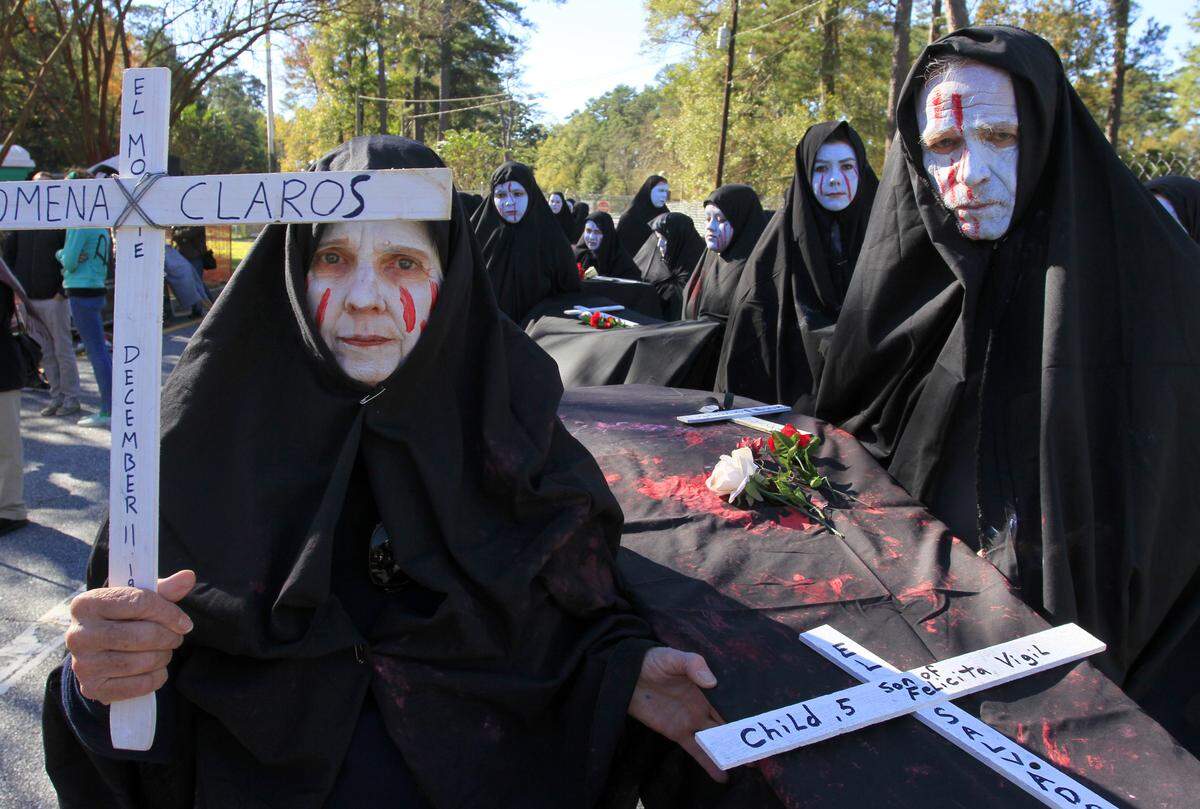
Also no Saturday gathering at the gate is scheduled, but the Sunday ritual of mourning those killed in conflicts in Latin America — reading their names aloud during a funeral march to the gate — will continue.
Among those names will be Jesuit priests Ignacio Ellacuría, Ignacio Martín-Baró, Segundo Montes, Amando López, Juan Ramón Moreno and Joaquín López, their housekeeper Elba Ramos and her daughter Celina.
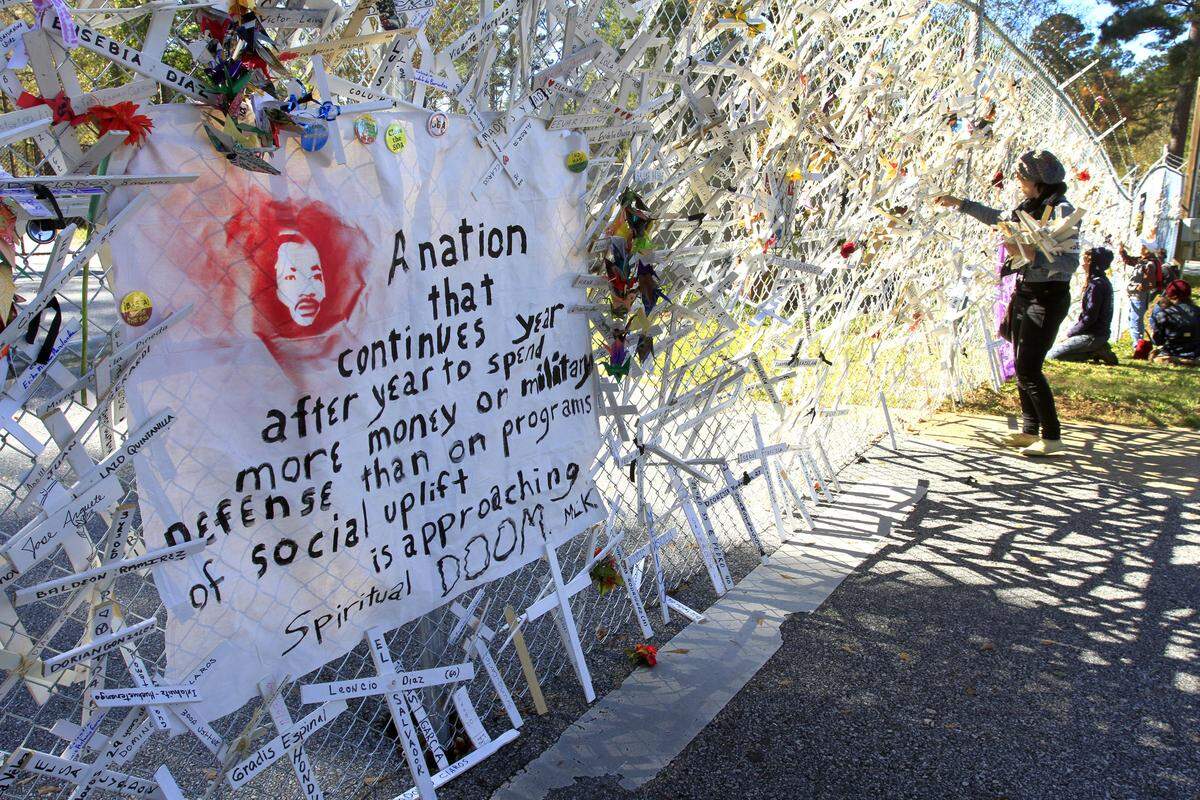
They were murdered Nov. 16, 1989, by 26 Salvadoran Army soldiers at the Central American University in San Salvador. Later investigation revealed 19 of the soldiers had trained at the School of the Americas.
That turned a spotlight on the training school that had not attracted widespread attention here in the United States, where it relocated from Panama in 1984.
The military training school was established in 1946 in what was then the U.S.-controlled Panama Canal Zone. It was named the The School of the Americas in 1963.
After the 1977 Panama Canal Treaty, the school suspended its Panama operation and, in December 1984, it reopened at Fort Benning.
Sparked by the Jesuit massacre of 1989, the protest began in September 1990, with Bourgeois and nine others holding a water-only fast at the Benning Road gate.
It was not a popular cause, with locals who saw it as a protest against Fort Benning.
Bourgeois remembered passersby yelling “Go home!” or “Get a job!” On one occasion someone threw a teargas canister into the protest camp, he said.
That attitude shifted, over time, as the demonstration grew, drawing thousands who rented motel rooms, shopped at area stores and ate at local restaurants.
“Some of the signs that used to say ‘Go home’ started saying ‘Welcome peacemakers,’” Bourgeois recalled.
Still city leaders complained bitterly about the expense of securing the protest site, though the SOA Watch group organizing the demonstration said the swarm of law enforcement officers wasn’t necessary, for a nonviolent event.
The cost estimates varied, year to year. In 2001, the city said it spent $137,000. In 2004, the price tag was $93,000.
The institute
The School of the Americas closed on Dec. 15, 2000, and the Department of Defense on Jan. 17, 2001, opened a new training center named the Western Hemisphere Institute for Security Cooperation.
The institute currently has students from Belize, Brazil, Chile, Colombia, Costa Rica, the Dominican Republic, Ecuador, El Salvador, Guatemala, Honduras, Jamaica, Mexico, Panama, Paraguay, Peru, and Uruguay. It hosts 1,200 to 1,900 students a year, with a staff of 207, a budget of $8.8 million, and 16 courses, including instruction in democratic principles and civil rights.
“Since 2001, WHINSEC has been dedicated to teaching ethical leadership, human rights, democracy and the First Amendment,” the institute said in a statement regarding the protest, adding it always has welcomed visitors to see how it operates: “The institute remains open for tours to this day, and will continue to be transparent with its professional education and training.”
Bourgeois and his compatriots are not impressed with the changes. He called them “minor adjustments in the window dressing” of a training institute whose primary focus remains a military approach to civic governance.
“This is not a Peace Corps operation here,” he said, and SOA Watch is not going to retreat: “We’re going to keep our hands on the plow, you know? We’re not going away.”
New schedule
So they’re coming back, starting Friday with a schedule that’s different from the past.
Though they’ve planned nothing at the gate for Saturday, Fort Benning Road will be closed there from 6 p.m. Saturday through 5 p.m. Sunday. Other post entrances will be open, and visitors will be closely screened. They will be asked to show identification, and their vehicles will be subject to search.
The Fort Benning Road gate will be secured by Columbus police, with the same contingent as in the past, said Assistant Chief Gil Slouchick. He would not say how many officers will be deployed, only that the department has canceled vacations and other off-days to ensure adequate staffing.
“The thing is, we never know what to expect,” he said Wednesday. “You prepare for the worst and hope for the best.”
Calling this a “Commemorative Gathering” marking the anniversary of the Jesuit massacre, SOA Watch plans a candlelight vigil at the gate at 5:30 p.m. Friday, when Bourgeois and other leaders will welcome participants.
Saturday’s programs will be at the Bibb Mill Event Center, 3715 First Ave., with registration at 8 a.m. and meetings throughout the day, the last set for 7 p.m.
At 9:15 a.m. Sunday, Buddhists and Veterans for Peace will lead a “Walk of Peace” procession to the gate from the Candlewood Suites, 3389 Victory Drive. Programs at the gate will start at 9:30 a.m. and end at 2:30 p.m.
Local authorities are asking people to avoid the area if they are not participating, to reduce traffic congestion.
When it’s all over, and those who came from out of town head back home, Bourgeois will remain, in the apartment he rents within view of the gate.
Though some still call him “Father Roy,” he’s no longer the Maryknoll priest who joined the order in the 1960s, after serving four years in the Navy, in Vietnam.
The church expelled him in 2012, when his lectures on the turmoil in Latin American shifted to another issue: ordaining female priests.
Believing God calls women to the priesthood as well as men, he said it’s an injustice that must be addressed, and he’s not giving up on that crusade, either.
This story was originally published November 14, 2019 at 3:40 PM.