
Columbus preps for legal battle over Confederate flags removed from Linwood Cemetery
Columbus city leaders are readying their defenses for a legal assault from the Sons of Confederate Veterans.
They’re girding for a courtroom fight over rebel battle flags, and whether the SCV can fly them at the city’s historic Linwood Cemetery, where the group put two flag poles at sections where Confederate soldiers’ graves are concentrated.
The battle flag’s links to white supremacy spurred city leaders no longer to allow it to be flown at Linwood, where passersby might assume it bears the city’s endorsement.
So when the SCV flew battle flags there for four days in October, after being warned not to, the city pulled the poles up.
The SCV vowed to sue, under a Georgia law protecting Confederate monuments, but so far, it has not.
Backdrop
Columbus Council voted 6-to-4 to allow the flags in 1994, approving an SCV proposal dependent on the group’s donating the poles and flags, maintaining the gear and bearing all the expenses.
That pact allowed the SCV to fly the battle flag continuously, “with other flags of the Confederacy possibly being flown on Confederate holidays.”
Not anymore.
Now the red, star-crossed battle flag no longer has the city’s approval, and council will not allow it in the 1828 cemetery.
“The current Columbus Council deems the flying of the Confederate battle flag offensive to a large segment of our community, and as a result it will no longer be flown in Linwood,” Mayor Skip Henderson said at council’s Oct. 22 meeting, as councilors voted unanimously to rescind the 1994 resolution.
That followed the SCV’s sending city leaders an Oct. 11 letter warning it would fly battle flags at Linwood the weekend of Oct. 18, and if the city interfered, it would sue.
The SCV stopped flying the battle flag at Linwood during former Mayor Teresa Tomlinson’s administration, which negotiated with the group to instead use other, less controversial flags. Henderson made a similar offer, during a Sept. 19 meeting with SCV representatives, who were told then that if they flew the battle flag, the poles would be removed.
In its Oct. 11 letter, the SCV wrote:
“Naturally, we are not oblivious to the reality that a number of Georgians object to the Confederate battle flag.”
But consider the context, it said: “Linwood Cemetery is the burial ground for more than 500 Confederate veterans, ranging from high-ranking officers to common soldiers and sailors … consequently, there is no reasonable basis for forbidding the flag under which they fought from flying above the cemetery in which they are interred.”
Among the notable Confederate leaders buried at Linwood is Gen. Henry Lewis Benning, for whom Fort Benning is named.
Flag negotiations
Henderson told the SCV it was welcome to fly other flags, such as the Confederate States of America first national flag, commonly called the “Stars and Bars” because of its broad, horizontal red and white bars and circle of stars in a blue square in the upper left corner.
The Georgia flag has that same pattern, and Henderson said the SCV could fly the state flag, too.
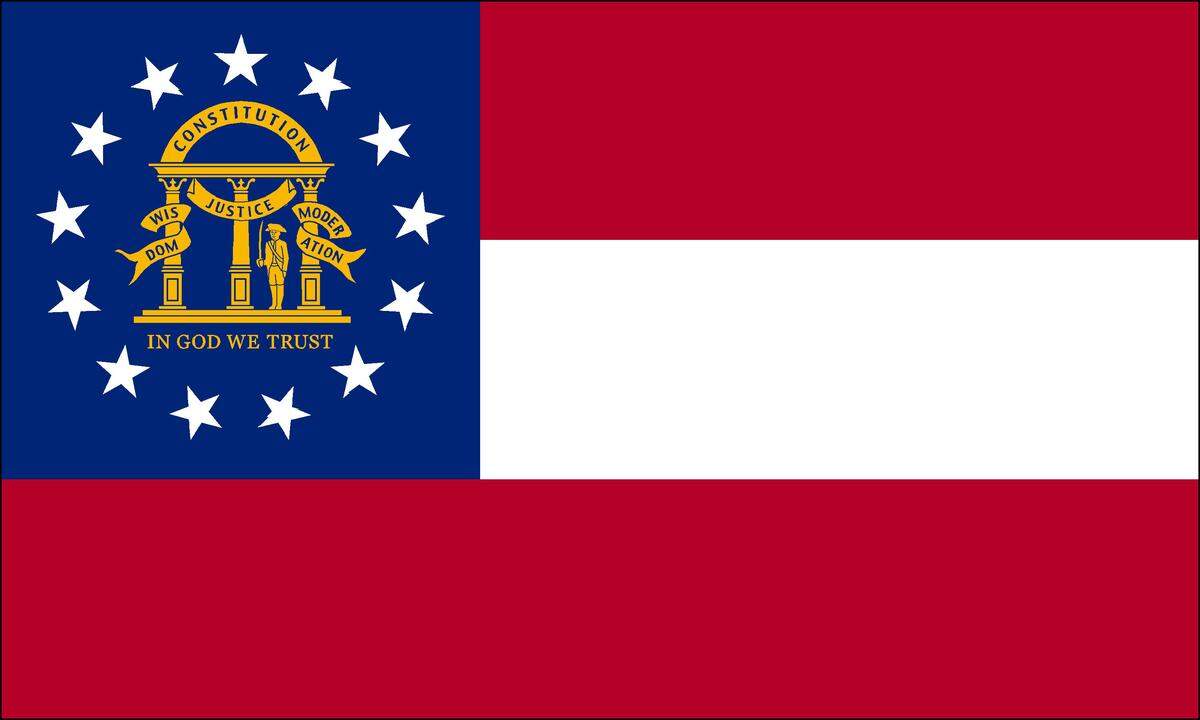
Also allowed was what’s called a state “regimental flag,” a blue banner bearing Georgia’s coat of arms, an arch under three pillars entwined with the motto “Truth, Justice, Moderation.” The gold coat of arms is encircled by stars in the blue corner of the state flag.
Those flags were allowed, but not the battle flag nor anything similar, including the Confederacy’s white second and third national flags, which have the battle flag emblem in the upper left corner.
Undeterred, the SCV vowed it would fly battle flags, and dared city leaders to intervene: “The city should govern itself accordingly,” its letter said.
The standoff ended in just a few days: The SCV flew battle flags from Oct. 18 through Oct. 22, when council rescinded the 1994 resolution and had the 35-foot poles removed. Each pole slid into a metal sleeve secured in a concrete base, so public works crews pulled the poles out and hauled them off to storage.
“The property of the Sons of the Confederate Veterans will be treated with respect and removed in a manner so as not to damage it or adjacent grave sites,” Henderson said at the council meeting. “This property will be available for pickup by that organization at the main office of the department of public works.”
The law
So far, no one has come to get the poles, and no one has filed suit.
“That is something that is in the works,” said attorney T. Kyle King of the Jonesboro firm Hodges, McEachern & King. Representing the SCV, King authored the Oct. 11 letter threatening a lawsuit.
He said the group will sue under what some call the “monuments act,” a state law protecting war monuments such as those memorializing the Confederacy.
King believes the flag removal is precisely what the law aims to thwart.
“The legislature gave monuments additional protection in the law,” he said, and the law is clear that local governments are prohibited from removing Civil War monuments.
That’s exactly what city leaders did, he said: “We think it’s pretty straightforward…. We don’t believe they have the authority to do that under the statute.”
Thomas Gristina disagrees.
Gristina is with the Columbus firm Page, Scrantom, Sprouse, Tucker & Ford, which frequently represents the city on contract. Named for his ancestor Thomas B. Schley, a Confederate soldier buried at Linwood, Gristina’s now on the front line of the city’s defense.
He said the law protects “public monuments,” and the SCV flags and poles never were publicly owned, as was specified in the 1994 resolution that allowed them at Linwood only on condition the SCV alone would provide and maintain them.
The SCV also had exclusive control over the 6-by-10-foot flags, because each pole had an internal halyard secured by a lock to which only the SCV had keys, Gristina said.
The land upon which the poles stood belongs to the city, however, and Columbus Council has the authority to decide what is placed upon its property, he said.
King said the city is welcome to try that maneuver: “We’ll let them make that argument when we get there,” he said of going to court.
The law states no one shall damage or remove any “publicly owned” monument, and no one “acting without authority” may remove a privately owned Confederate monument donated to the public.
It says no “person, firm, corporation, or other entity” may “mutilate, deface, defile, or abuse contemptuously any publicly owned monument, plaque, marker, or memorial which is dedicated to, honors, or recounts the military service of any past or present military personnel of this state, the United States of America or the several states thereof, or the Confederate States of America or the several states thereof.”
It also says “no officer, body, or representative of state or local government or any department, agency, authority, or instrumentality thereof shall remove or conceal from display any such monument, plaque, marker, or memorial for the purpose of preventing the visible display of the same.”
Anyone injured by a monument’s removal may recover damages as a result of the “unlawful actions,” the statute says.
Legislators gave it extra heft by allowing a court to award triple damages and attorneys’ fees to those suing over a monument’s removal, King said.
Battle line
The SCV would rather resolve this with city leaders out of court, King said: “We tried to walk through it with them.” But they would not waiver on the battle flag.
“They’ve drawn a line in the sand here,” King said.
Now they’re waiting to see whether the SCV will cross it.
The city has a U.S. Supreme Court precedent it believes is applicable, Gristina said: the 2009 case Pleasant Grove City v. Summum, which addresses private monuments in public spaces.
The court unanimously ruled a Utah city had no obligation to allow an obscure religious monument in its Pioneer Park, where proponents argued it should be permitted because a Ten Commandments monument was there.
Summum followers claimed the park was a public forum, as evidenced by its Ten Commandments monument, and therefore their First Amendment right to free speech had been violated.
The court ruled unanimously that the city park’s 11 permanent, privately funded displays constituted “government speech,” signifying the government endorsed each, so the government had a right to decide which monuments represented it.
“Even if a monument is privately financed and donated, it becomes government speech if it becomes a public display, just as if it had been commissioned and financed by the government,” the court wrote.
King said that when his clients file suit in Muscogee Superior Court, they will not ask that the city replace the poles and flags it removed, but that it pay triple the cost to install new ones, and triple their attorneys’ fees.
This story was originally published December 2, 2019 at 8:29 AM.