
Columbus could lose millions due to poor 2020 census response. There’s still time to take part
Hurricanes, wildfires and epidemics make a dramatic census undercount seem less of a looming crisis.
So few stop to imagine a Columbus that houses far fewer than 200,000 people, loses millions in federal revenue for a decade and ranks not second but third or fourth among Georgia’s largest cities outside Atlanta.
That’s where Columbus is headed, if it can’t get its 2020 census numbers up before the Sept. 30 deadline.
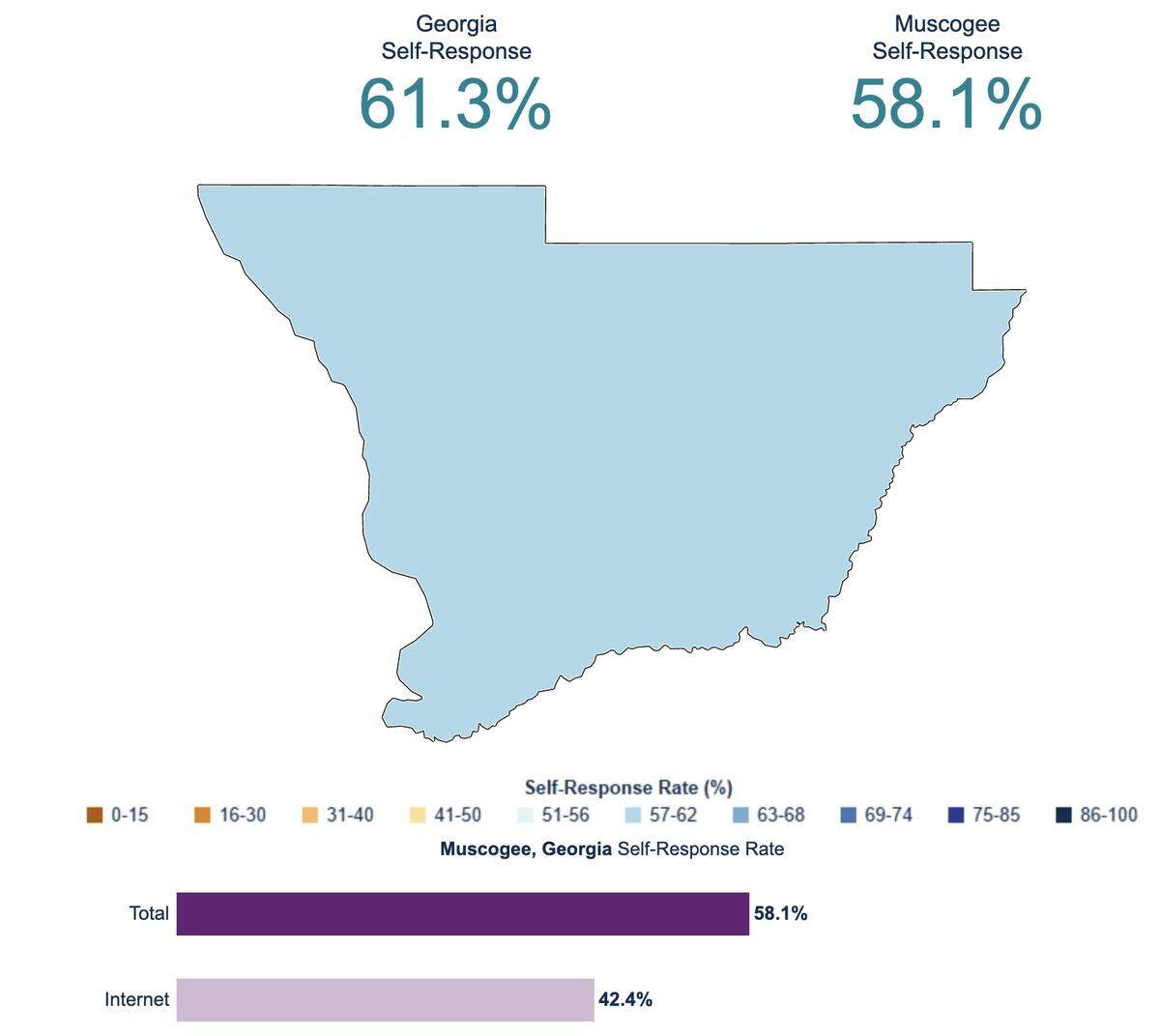
This week the census participation rate here was 58.4%, versus the overall Georgia rate of 61.5% and national rate of 66%.
Civic leaders desperate to boost the response rate say an undercount of up to 40% means Columbus could lose $120 million a year in federal funds over the next 10 years.
That funding covers a broad range of programs, including health care, school meals, road improvements and other infrastructure, said Rick Jones, city planning director.
And that money’s not a gift sent from Washington, D.C.: The people here paid taxes to provide that revenue.
“I tell people this is the best way to get your money back,” Jones said. State and federal funding for road projects, in particular, are based on census data.
“That makes a big deal,” he said. “If the numbers aren’t there, we get shortchanged on our road projects.”
‘A substantial hit for Columbus’
The participation rates are based on numbers from the last census. Columbus’ population in 2010 was counted at 189,885. A 2019 census estimate put it at 195,769, an increase of 2.7%.
Were Columbus’ 2020 census count calculated at 58% of 189,885, the result would be 110,133. That’s fewer than Muscogee County’s registered voters, now at 135,170, according to the elections office.
This census will affect the annual distribution of $900 billion in federal funding nationwide, involving 325 different programs, according to a study from the Institute of Tax Policy at George Washington University.
Officials here believe Columbus will lose around $1,500 a year for every resident who’s not counted.
Jones said Columbus likely is getting shortchanged already, from a 2010 undercount: “We know for a fact that number was low in 2010.”
Columbus’ census response rate in 2010 was 64.3%, according to the census bureau.
Among those leading Columbus’ census effort is local advertising executive Bill Becker, whose rough math indicates a 40% undercount this year’s going to miss around 80,000 people.
“That’s going to be a substantial hit for Columbus,” he said.
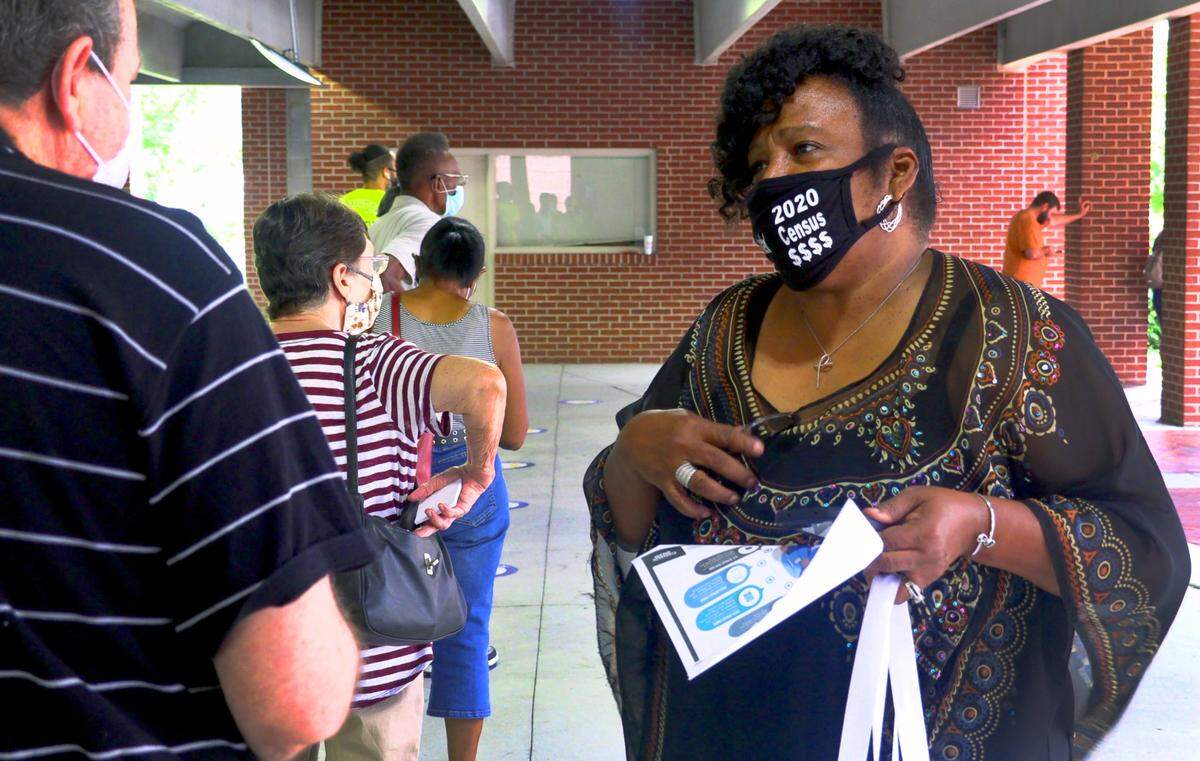
Gloria Strode, a specialist with the Atlanta Regional Census Center Partnership, was among those staffing a table at Columbus’ City Services Center off Macon Road, asking residents in line to renew their car tags whether they’ve been counted.
Some just flat out refuse, she said: “People have said they don’t want folks to know their business. We respect that, but what’s going to happen is someone’s going to knock on their door.”
Census takers now are going door to door, following up on mailouts that first were sent out in early March, she said.
Filling out a census questionnaire typically takes only a few minutes, with inquiries about residents’ names, ages, ethnicity, race and home ownership. The information cannot by law be used against anyone.
People can take the census by calling 1-844-330-2020, where anyone speaking one of 23 languages can get help. They also can go online to 2020census.gov.
Of the Columbus residents responding so far, 42.6% did so online.
Tracking tracts
Anyone can follow response rates by census tracts through an online mapping tool at the bureau’s website. It measures rates of “self response,” meaning those who participated without a census worker visiting them.
In the census tracts within Columbus, response rates vary widely.
One of the best response rates, at 78.7%, with 73.3% percent responding online, was in midtown Columbus, an area between Hilton Avenue and Interstate 185, stretching from Macon Road north to near Warm Springs Road.
In 2010, its response rate was 80.6%.
Among the worst response rates, at 24.1%, was a tract that runs along the Chattahoochee River from downtown Columbus to the Fort Benning border. Its online response rate was 10.1%.
Its 2010 response rate was 58.3%.
The borders of that tract encompass much of Columbus Council and Muscogee County School Board District 7, one of nine such districts dividing the city.
Strode, who’s familiar with the area, is not surprised at its undercount. “That historically even in 2010 was a hard to count tract,” she said.
Many of the residents don’t own their homes. “They’re transient,” she said, moving frequently, with less emotional investment in any particular neighborhood.
“We have a lot of people who speak a second language,” she added. Those residents may not feel comfortable taking the census, she said.
An Urban Institute survey in February showed that despite assurances the census endangers no one’s citizenship or other status, about a third of U.S. residents suspect the information can be used to harm them.
Strode said changes in public housing also may affect the response in District 7. Since the last census in 2010, the Columbus Housing Authority has eliminated the Booker T. Washington complex that once stood along Veterans Parkway.
Nearby the authority built a new, mixed-income housing area called Columbus Commons, but that did not pull back the same population, Strode said, because some people didn’t qualify for those units.
Cathy Williams, who represents District 7 on the school board, is familiar with the city’s housing patterns through her work with the nonprofit NeighborWorks Columbus.
Many residents in her district are low income, and move often, to find the best deals on rent, she said: “We have kids who’ll be in six different schools in one year.”
For those families, joining the census likely is not the first thing on their minds, because they have so many more pressing concerns, such as finding work, feeding their kids and paying their bills, she said.
They may not be living where their first census mailing was sent. “They may have moved, or it’s the last thing on their priority list,” Williams said.
The midtown tract with the high response rate is a stable, settled neighborhood with longtime homeowners, those most likely to take part in government, be it taking the census or voting, she said.
“Homeowners more often than not participate in the social experiment,” Williams said.
Redistricting
A low census count also raises fears Columbus could lose representation during redistricting for federal, state and local offices.
Residents who aren’t counted won’t be a factor when that process resumes, based on the census.
For example, if the response remains low in census tracts within District 7, that could force dramatic changes to the area Williams now represents, as its borders are redrawn to gain population. The number of residents in each council and school board district must be balanced to meet the “one person, one vote” principle that no vote is worth more or less than another.
It will be as if the residents who weren’t counted don’t exist.
“What will happen is those people will become invisible in the redistricting,” Williams said. “The lines will be redrawn to accommodate those who chose to be counted.”
During redistricting after the 2010 census, District 7 expanded north and east to take in parts of the Overlook and Lakebottom areas, she said. It currently runs through downtown up to 23rd Street, she said.
Another fear is that Columbus could lose one of its two congressional representatives. U.S. Rep. Sanford Bishop represents parts of Columbus in House District 2; Rep. Drew Ferguson represents another portion of the city in District 3.
Columbus Mayor Skip Henderson said he does not think that will happen, during the next redistricting.
‘Momentum killer’
Henderson said he doesn’t feel the census undercount is a crisis, yet, but, “I think it could be.”
He believes Columbus has gained population since 2010. “I don’t think we’ve lost any,” he said. “We’ve added households over the past four or five years.”
He bases that on an increase in the number of households the city’s public works division is serving for garbage pickup — an additional 500 homes, at least, not counting growth in multi-familiy housing units such as apartments.
Henderson said Columbus’ census response is improving, as the deadline nears: “I think we’ve edged up a little bit.”
He lamented that so many residents don’t understand all that the census affects.
Sometimes people complain that a certain brand of restaurant has no location in their neighborhood, but that may be because an undercount in the local population doesn’t make a restaurant there look profitable, he said.
“It really affects so much of the citizens’ lives in so many ways,” he said.
With the last days of September dwindling toward the census deadline, those involved in the effort grow increasingly worried.
“We really need all hands on deck, because this is going to cost us a lot of money,” said Strode, who wishes restaurants would promote the census on their marquees.
Becker said he considers all the progress the city has made in revitalization and development over the past 30 years, and worries an undercount will create a lingering burden that holds it back.
“It will be a momentum killer for us,” he said.