City manager. State legislator. School board leader. All in one Columbus family
They had different childhoods, but they learned the same values: family and faith, education and ethics.
Those values informed and inspired their long, barrier-breaking careers in public service.
In the 194-year history of Columbus, their list of firsts goes like this:
Isaiah Hugley, 64, is the first and only Black city manager of Columbus and the longest-serving one, with 17 years spanning five mayors. He was inducted into the Georgia Municipal Government Hall of Fame last year.
His wife, Carolyn Hugley, 63, is the longest-serving woman currently in the Georgia House, at 30 years, and the first African American to serve as whip.
His sister, Pat Hugley Green, 55, is the first Black woman to chair the elected Muscogee County School Board, where she has represented District 1 for 17 years. She also was the first and only Columbus resident to have served as president of the Georgia School Boards Association.
So how did they overcome biases to fill prominent leadership positions, making countless decisions affecting thousands of residents in Georgia’s second-largest city? The answers, they told the Ledger-Enquirer, begin down a dirt road in Alabama and in a small town in Arkansas.
Crawford, Alabama
Raised by a single mother who had her first child at 15, Isaiah is the second-oldest of four siblings; Pat is the youngest. They lived their earliest years in Crawford, Alabama, about 15 miles west of Columbus.
Their home didn’t have an indoor bathroom. Their only drinking water came from a well. They walked to church every Sunday morning.
“If the doors of the church were open,” Isaiah said, “we were going to be there.”
Their mother, Rozell Hugley Wilborn, was a domestic worker earning $25 per week. She also served her church.
“My mother instilled a faith that to whom much is given, much is required,” Pat said. “She understood she had to depend on other people, work with other people, serve other people in order to help her family succeed. There were so many people who were always giving to Mama. … That taught me how to pay that forward, and I carried that on.”
Although their mother didn’t go to school past the sixth grade, she was an advocate for education.
Attending school, behaving and earning good grades were the children’s duties.
“If the teacher called or there were any problems at school,” Pat said, “I would rather take the punishment or detention rather than call my mom because it was going to be a whole other issue.”
Isaiah added, “The teacher was always right.”
As was mama.
“Though she was challenged as a single female head of household with no education, domestic worker, we were disciplined,” Isaiah said. “There were expectations. . . . I didn’t want to face my mom if there was trouble, because there is no explanation.”
Pat sparked a round of laughs when she cracked, “That was the beginning of zero tolerance.”
Their father, Isaiah said, “was not educated as well. … He was out there in the street, alcohol and so forth.”
Forrest City, Arkansas
Carolyn grew up the seventh of eight children in a middle-class, two-parent home of educators in Forrest City, Arkansas. Her father, Walker Fleming Jr., was a principal; her mother, Ruby Lee Smith Fleming, was a first-grade teacher and taught adults how to read.
Whether it was school, church or community, Carolyn said, “it was instilled in us as a requirement that we had to help others.”
Even if it were in the middle of a family drive, Carolyn’s mother would stop the car when she saw somebody walking along the road and ask whether she could provide a ride into town.
“You can’t do that now, but that was part of our everyday,” Carolyn said. “She had a bunch of kids in the car — ‘Move over and make way for somebody else.’”
Carolyn’s father was a strict disciplinarian but with a giving heart. He chaired the deacon board at their church.
“Everybody respected him,” she said. “… He didn’t talk a lot, but he did a lot. He was always making a way for others.”
And that nonnegotiable way was through education.
“One of my sisters was having a hard time in school, and my father said to her, ‘Now, if you can’t cut it in college, your grandparents have cotton that needs to be picked and a lot of chores on the farm that you can certainly do,’” Carolyn said. “And so those were the ways he would motivate and encourage you to do better and to do more.”
Along with education came an emphasis on hard work being good for you. Carolyn and her siblings were expected to find jobs while attending college — and pick that cotton on their grandfather’s farm during the summer.
“It was an incentive for us,” Carolyn said, “because when you were doing the farm work, you didn’t get paid. So when you got to be 16, you found a job.”
Isaiah appreciated that approach. He called Carolyn’s father “a strong man of faith, family and then work.”
Ending up becoming a deacon and trustee at his church, Isaiah thought, “If I ever get married, that’s the kind of man I want to be for my family.”
Columbus

Isaiah was 11 and Pat still a toddler when their mother left their father and took her four children to Phenix City, where they lived in the Frederick Douglass public housing complex.
“She realized early that she had made some bad decisions,” Isaiah said, “and I think that’s when she really, really got grounded in her faith.”
They moved to Columbus when Isaiah was in 10th grade and lived in other public housing complexes, Farley Homes and Baker Village.
Their mother later worked in the environmental services department of the former Cobb Memorial Hospital in Phenix City, then The Medical Center in Columbus, where she was the housekeeping supervisor.
“They knew that if you wanted it done right,” Isaiah said, “you would get Rozell Hugley Wilborn to do it.”
And she insisted on high standards for cleanliness at home as well. When she instructed the children to clean up, that meant nothing out of place.
Isaiah learned from his mother’s work ethic, “It’s not where you come from; it’s where you’re going. It’s not where you start; it’s where you finish.”
Talladega
As a senior at Spencer High School, Isaiah worked part-time at a dry cleaning store. One day, a customer named Ray Griffin saw him mopping the floor. Griffin asked what he planned to do after high school. Isaiah replied he intended to join the Army. Griffin suggested an alternative path: attend his alma mater, Talladega College.
“Just to get this guy off my back — because, every time he came in, he would ask me did I apply to the school — I went ahead and applied, with no intention of going to college,” Isaiah said.
Isaiah was accepted. Griffin, who had worked in the financial aid office at Talladega, helped Isaiah receive a full package. Isaiah now chairs the Talladega College Board of Trustees, and the college awarded him an honorary doctorate.
As a first-generation college student, Isaiah said, “I was scared to death. … Had I not gone to a school that nurtured its students in such a small, family-type environment, I probably would not have stayed.”
Isaiah explained his motivation.
“Each of my siblings coming along behind me,” he said, “I wanted to make sure that it’s not a question of if you’re going to college; it’s where you’re going.”
Pat vouched for her brother’s impact.
“I’m glad that he had been to college because I didn’t know how to pursue that,” she said. “I was a project kid, right? And so, although educators are absolutely wonderful, … I don’t recall anyone in my high school (Central) who was concerned or looking out for me. So, had it not been for Isaiah’s experience, I would have struggled with trying to pursue that opportunity.”
Mississippi State
All of Carolyn’s sisters became teachers. She chose government as her version of public service.
“It has such an effect on what we do,” she said. “Every aspect of our lives, somebody’s making decisions for that.”
Carolyn earned a bachelor’s degree in political science at the University of Arkansas-Pine Bluff. She wanted to go to law school, but she chose a more affordable career option after she received a fellowship to pursue a master’s degree in public policy and administration at Mississippi State University.
“It was a great opportunity for us because they were recruiting African-American students for their program,” she said.
The day she arrived, Carolyn recalled, “my dad was trying to decide if he was going to let me stay there or not because, as the story goes in my family, the last Fleming that came out of Mississippi came out floating on a log, trying to get away from people that were chasing them.”
Carolyn and Isaiah met that first day on campus while in line to register for classes.
“She was right behind me,” he said.
While chatting, Isaiah learned Carolyn not only was smart but also could type — a skill he didn’t have then — so he decided, “I want to be her friend.”
He figured he could save money by not buying books for himself and just borrow hers for the classes they were in together.
Isaiah also initially wanted to attend law school, but being awarded an assistantship made this program at Mississippi State more affordable.
While they competed against each other for better grades, they fell in love with each other — and the idea of striving for positions of influence.
“As we studied public policy and administration, it became more and more evident that representation was important,” Carolyn said. “There was a lack of representation in all levels of government on the professional side.”
City manager

After graduating from the program, they worked for the state of Mississippi. Carolyn worked for the legislature’s Performance, Evaluation and Expenditure Committee. Isaiah worked for the Council on Aging and the Department of Transportation. They married in 1981.
Isaiah’s mother asked him to move back to Columbus. He applied for the city’s vacant assistant director of Metra position, but It took two years for him to receive a response. It came with a job offer, and it tested his relationship with Carolyn.
“She was willing to quit her job to allow me to come home for a job that didn’t pay me more money than I was earning in Jackson and paid me less money than she was earning,” he said. “… That’s love.”
When they moved to Columbus in 1984, Carolyn didn’t see any job openings for her in the city’s government.
“Where there’s not an opportunity,” she said, “you create something else to do.”
Carolyn worked for the Lower Chattahoochee Area Planning Agency and the Lee County Council of Governments. State Farm recruited her in 1988 to become an agent as the insurance company tried to increase its diversity.
Promotions lifted Isaiah to Metra director and deputy city manager before Carmen Cavezza retired as city manager in December 2004. Noting he heard rumblings that some influential folks didn’t want a Black city manager, Isaiah appreciates the February 2005 recommendation from then-Mayor Bob Poydasheff and the unanimous approval from Columbus Council.
“Any time you go into a position like that, you want that support,” he said. “... I think I had proven myself. I think I had the education and the experience. It was preparation meets opportunity.”
Poydasheff was “bold enough and had the courage to do the right thing,” Isaiah said, “and I will forever be grateful to him.”
Johnson C. Smith
Pat attended Johnson C. Smith University in Charlotte, North Carolina, on scholarship. Isaiah and Carolyn took her and stayed there the first week to ensure she was OK.
She would go to the cafeteria — but called her brother and sister-in-law to take her out to eat after seeing what was on the college menu.
“It was hard leaving home,” she said.
Isaiah advised her to try out for the cheerleading team as a way of getting involved in campus life. Now, Pat encourages underprivileged youth in the community to attend college and shows them how to apply.
“Had it not been for Isaiah’s and Carolyn’s being ahead of me, it would have been difficult,” she said. “So I try to pass that along to students.”
Pat and Carolyn sponsor an annual ACT boot camp and college fair.
“We still have to do that for young people in this day and age because, oftentimes, they’re also first-generation high school graduates and first-generation college students,” Pat said. “That is paying it forward.”
Georgia General Assembly
In 1992, reapportionment created a new local Georgia House District (133, now 136). Despite being busy with her State Farm agency, Carolyn still volunteered for the Chamber of Commerce. Some political insiders who were impressed with her leadership skills asked her to run for the new seat.
“Anyone who works with Carolyn, they’re certain that whatever she says she’s going to do, she’s going to do it,” Pat said. “She has the work ethic, and she’s incredibly smart.”
Carolyn originally declined.
“I was still relatively new by Columbus standards,” she said. “… Columbus is a place where everybody is connected in some kind of way. So that was a concern.”
They asked Isaiah to change her mind. He promptly called Carolyn’s siblings to help him convince her.
One of her sisters asked her to pray over it. The next day — one day before the end of the qualifying period — Carolyn decided she indeed would run.
“She talked about our values growing up and our responsibility to give back and to help others,” Carolyn said, summarizing her sister’s sales pitch. “She talked about the fact that representation matters, and people need to have their voice. In ’92, there were not a lot of woman legislators.”
Indeed, early in her political career, when they attended public gatherings together, some folks would approach Isaiah as if he were the state Rep. Hugley.
Carolyn has been re-elected ever since.
“I remind myself and others that the districts belong to the people,” she said. “They have allowed me to be their voice in this particular arena, and I have to do that work with fidelity.”
Muscogee County School Board
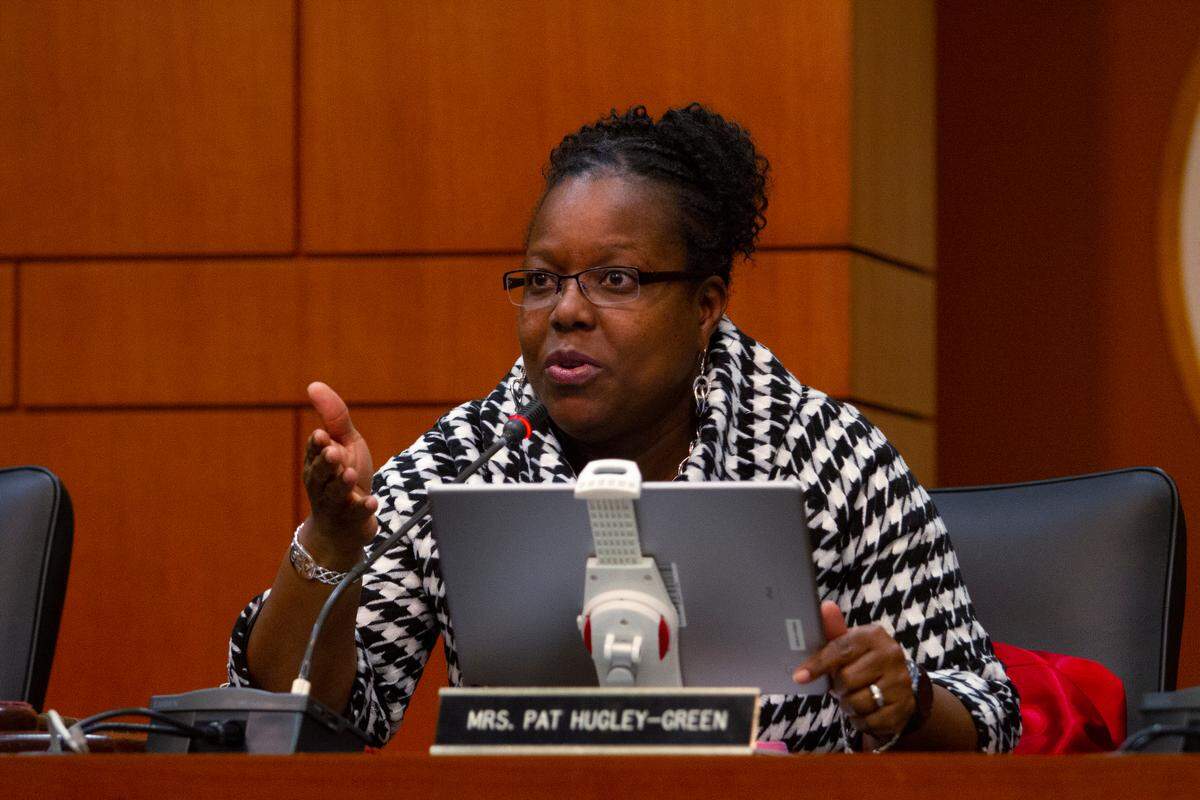
By 1993, Isaiah convinced another family member to make a big move. Pat returned to Columbus from Atlanta to work with Carolyn. Pat helped disadvantaged high school students with college and career planning by offering them positions in the office so they could get a head start on learning business-world skills.
But nobody recruited Pat to run for the school board when she started her first campaign in 2004.
“I just wanted to serve,” she said.
It was an opportunity to expand her mentoring on a larger scale.
“Ministry is a passion for me, and that’s why I do it,” she said. “This is a calling. There’s nothing glamorous about it. … It’s truly public service. You have to be committed to giving up yourself when it’s inconvenient, when it’s not profitable, when it’s not fun, when it’s not popular, to be focused on the greater good.”
Seeing the success Carolyn had in elected office motivated Pat as well. Although his position is appointed, Isaiah also is a role model for Pat.
“Both are leaders in the community and making decisions that impact so many people,” she said. They show her how to “remain true to making sure I’m representing the underrepresented.”
Pat especially admires Carolyn for the constructive way she handles folks who disrespectfully express opposing views.
“She’s always managed to do it gracefully,” Pat said. “If they want her to listen to them, they have to listen to her. That was a valuable lesson.”
Hearing or reading criticism of his wife and his sister is difficult, Isaiah acknowledged, even after all these years with them in politics.
“I’m protective,” he said. “… You can’t not like my wife or not like my sister and want me to think you like me. … I can blow it off and move on, but I don’t forget.”
Racial issues
Race sometimes seems to factor into the tension, Carolyn said.
“Race is always there,” Carolyn said. “It’s on a continuum. Sometimes it’s higher, and sometimes it’s lower, but it never goes away.”
Her experience has taught her, Carolyn said, “I was born to be an African-American woman, and anybody who has a problem with that, it’s their problem, not mine. It’s not for me to internalize biases that others have, but it is for me to try to be the person that I can be.”
Pat agrees that race always is part of the equation, especially for a politician who describes herself as “bold about saying what I mean and meaning what I say.”
“It’s easy for people to take me as an angry Black woman, which in itself is offensive,” Pat said, “or to dismiss me because of speaking out about an issue, which is also offensive to me.”
So, she reminds herself, “We all bring a different perspective. … We’re just trying to work on this issue at hand so that we can approach this together and hopefully work through it for the greater good.”
When the person talking to her gets loud or disrespectful, Pat has a reaction plan.
“Make sure that I don’t lower myself or respond at that level because people won’t hear what you’re saying,” she said. “The point will get lost. The opportunity to make a difference will get lost. … I can’t do anything about the distraction or the obstruction, but I can bring the issue back.”
Carolyn calls the family’s nature to not shy away from arguments “Hugley-itis.”
“The Hugleys have this thing where they have got to tell you about yourself,” Carolyn said as Isaiah and Pat laughed. “They’re going to have the last word. It’s genetic.”
Isaiah also has seen race affect his interactions with people as city manager.
“There’s some who have issues with a Black man doing what I do,” he said, “and others thought the time was right. … I still experience it to this day. But, for the most part, others have accepted the fact that, after (17) years, they know me. … They know my work ethic. They know that I’m fair, they know I’m firm, and they know I’m going to tell you when you’re wrong, and I’m going to tell you when you’re right. I don’t care who you are.”
“We’ve got good people in Columbus who don’t think like that,” he continued. “But unfortunately, we’ve got some who do think like that. And those people, because their hearts are not right, will have to answer to God.”
Public service and diversity
Through his public service, Isaiah tries to give back to the city that gave him and his family chances for meaningful and joyful lives.
“You’re making a difference in your community,” he said. “You’re making your community better. At the end of the day, in our work, we can see the impact that we’ve been able to make as a result of a team effort.”
Whether that’s as simple as a repaved road or as complex as a new public building, the legacy is gratifying.
“Each of us brings the sum total of our life experiences to whatever it is we do,” Carolyn said. “… That is why it’s important for people from all walks of life who are drawn to public service, whether it’s elected office or in professional capacities, because that’s what makes us better. That’s what makes our communities better, where we have a variety of voices working at the table.”
Public service for Pat is a tough commitment but worthwhile.
“You sacrifice your family,” she said. “You sacrifice career, personal health. It’s a tremendous sacrifice, but it’s also rewarding. It’s bittersweet. . . . It’s rewarding when you can see the progress of the fruits of your labor. You can see the community growing. You can see young people reaching their potential. That’s why I continue to do it.”
Carolyn advises those considering public service to “really search themselves and to see if you think this is a calling. Would you do it anyway because you’re not going to get paid very much? Do you feel compelled and called to do this work? And keep in mind that you’re going to have to give up a lot in order to do it. But, if you do it well, then the benefits will be rewarding — not only to yourself but to your community.”
This story was originally published February 19, 2022 at 7:00 AM.