How ‘a great vision’ could transform Phenix City’s downtown and riverfront
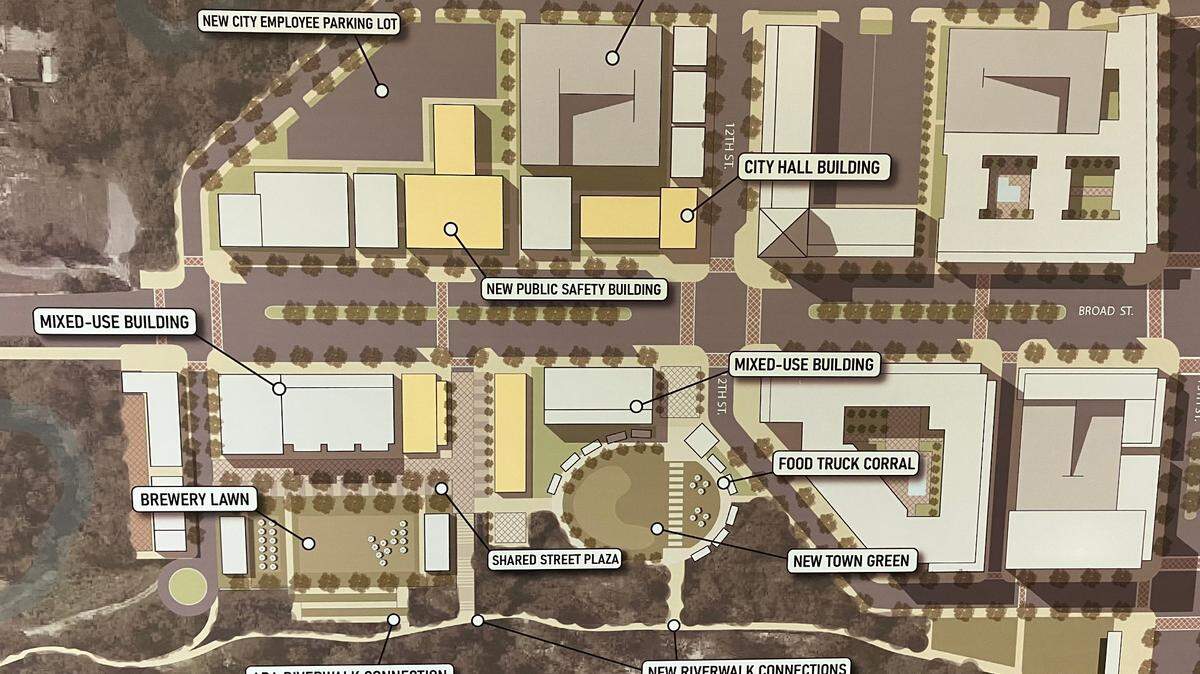
Consultants from Birmingham presented the Phenix City Council and other leaders with a new plan to redevelop downtown Tuesday.
On March 15, the council approved paying urban planning and development company Orchestra Partners an amount not to exceed $30,000 to create a vision for downtown revitalization.
The boundaries of the designated area include South Railroad Street to the north, the southern portion of Dillingham Street, the western side of Broad Street and the Chattahoochee River. Special attention would be given to city-owned property between 11th and 12th streets.
The plan is focused on improving the city’s walkability, business recruitment, green space, retail and entertainment.
On the Sept. 7 council meeting agenda is a resolution to authorize as much as $50,000 for Orchestra Partners to design the plan’s first phase, dubbed the Lively District. This is in addition to the $30,000 approved to create a vision.
The Lively District would comprise green space between the Riverwalk and Fifth Avenue and connect 11th and 12th streets to the Riverwalk. The contract also calls for Orchestra Partners to gather due diligence information about the properties involved, communicate with necessary third parties and provide a construction budget and timeline.
No timelines or cost estimates were in Tuesday’s presentation.
Phenix City economic development manager Shaun Culligan told the Ledger-Enquirer this initial plan produced the overall vision. Yet details are to come. A seed fund with a goal of raising $2 million will be established to spark investments in the revitalization, he said.
“This is a new approach,” Culligan said. “We’ve had some great plans in the past. Some, I think, are still valid, but this gives us the extra impetus to move forward with implementation.”
Orchestra Partners intends to boost the chances of its plan actually being implemented by offering an unusual model for urban planning.
John Boone, cofounder of Orchestra Partners, said during his presentation that his company fills a gap by being an urban planner that is also a real estate developer, helping cities establish seed funds with local investors to implement plans.
The seed fund sponsors the early phases of development activity. Investors can put their profits back into the fund for additional projects or cash out.
“It gives us the right momentum to getting some of those actual, physical, tangible projects completed and involving the community in the process,” Culligan said.
Boone noted Phenix City has better potential than most cities to implement such a plan for urban density because it has plenty of open spaces, especially along the riverfront.
“So much of this can be done from scratch,” he said.
The plan envisions creating more pedestrian-friendly streetscapes, where folks can live, work and play without needing to drive from place to place.
Orchestra Partners senior development manager Caroline Jenkins said during the presentation the plan is divided into districts, each designed to be walkable within five minutes over a quarter-mile, such as:
- A necklace of parks could connect green spaces to the Riverwalk.
- An urban core could have buildings ranging from 2-8 stories high.
- An old town center could preserve and renovate historic buildings.
- The northern part of the riverfront could capitalize on the recent development of the Troy University campus and the Marriott hotel.
- The southern part of the riverfront could put the parking lot around the amphitheater to a more dynamic use with stalls for folks to get something to eat and drink.
After the presentation, Phenix City Mayor Eddie Lowe told the L-E he likes the plan’s connectivity.
“It’s a great vision,” he said. “We all know what we have to do and what we need to do. Whether any of us see it, which we hope we do, it’s important we do it for the next generation. That’s ultimately any leader’s job.”
This story was originally published September 7, 2022 at 10:26 AM.