
How does Columbus’ new judicial center plan look now? Public finally sees the redesign
The public finally got a look Tuesday at fresh designs for Columbus’ $200 million judicial center that city leaders said was reconfigured when the original plan proved to be too expensive.
City administrators lately have been tight-lipped about the new design, refusing last month to answer some Ledger-Enquirer questions about the project.
The city once had intended to clear the entire Government Center block downtown, demolishing both the 12-story tower and its two wings. The city later determined that would boost the price tag by around $50 million because of inflation in building material costs.
The design team then proposed the city preserve and remodel the east and west wings, and connect them to a new eight-story tower on the 10th Street side of the block bordered also by Ninth Street and First and Second Avenue.
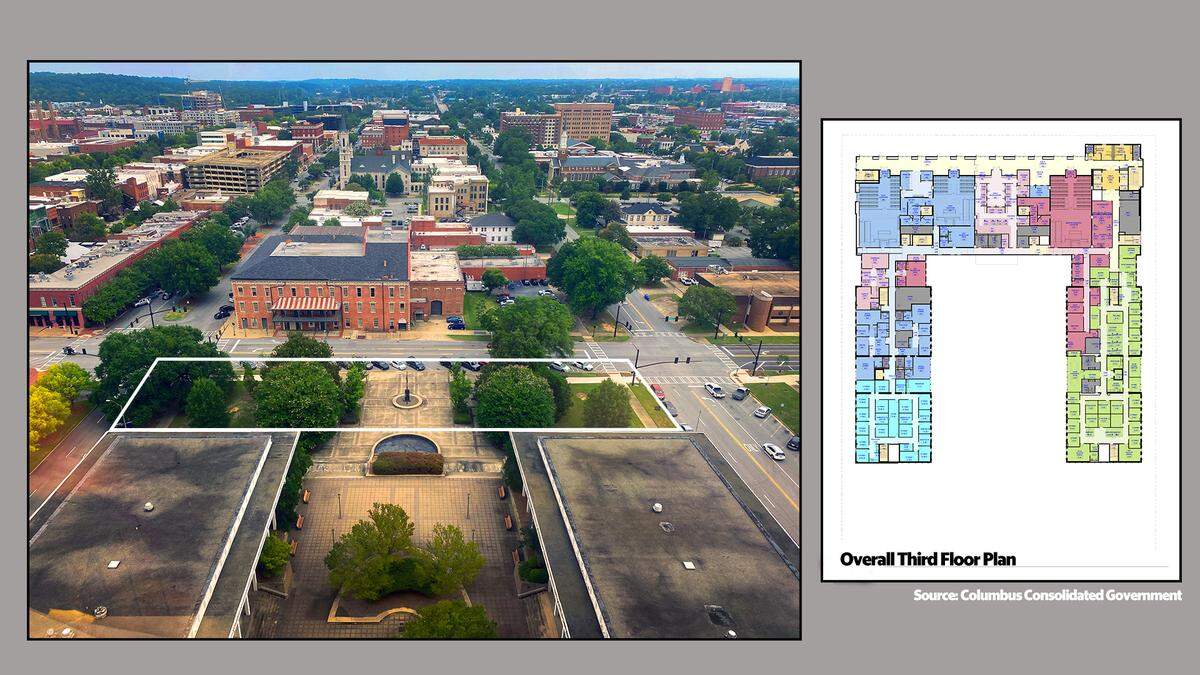
That was among the proposals presented to Columbus Council during its Tuesday meeting, along with artist’s renderings and other details previously undisclosed to the general public, and to some councilors.
The redesign has raised worries that the building that is intended to serve the justice system for decades will be inadequate from the day it opens, lacking space for expansion as Columbus’ judicial circuit adds judges.
Though the existing 12-story tower is to be demolished, the Superior Court judges in Columbus’ judicial circuit asked the design team Aug. 10 to consider saving and “repurposing” it, if it will provide more space than a new building.
The judges repeatedly have been briefed on the plan, and got another presentation Sept. 6. They have not said whether their position on saving the current tower has changed.
Also the historic 1871 Springer Opera House on the north side of 10th Street wants to know how an eight-story building across the street would affect it, and has asked for input into the city’s plan.
Meanwhile, some councilors have suggested the project needs its own independent manager, as that task has been assigned to Ryan Pruett, the city’s director of buildings and codes, who also has overseen the shifting of city administrative offices from the existing Government Center tower to other sites downtown.
That’s the background leading councilors to ask city administrators to give a public presentation on the new plan at Tuesday’s council meeting.
Where it stands
The plans as depicted in a slide presentation generally called for a building of at least 315,000 square feet, with 14-15 courtrooms and office space for these divisions:
- Superior court.
- State court.
- Magistrate and municipal court.
- Probate court.
- Accountability courts for defendants needing mental health or drug addiction treatment.
- District attorney.
- Public defender.
- Jury pool room.
- Sheriff’s security office.
- Law library.
The plans included parking spaces for about 500 vehicles.
Council saw several options, including a proposal presented by Douglas Kleppin of the SLAM Collaborative architectural team that showed a 342-square-foot, eight-story building with 18 courtrooms, four of them unfinished “shell” courtrooms for expansion, with conference rooms adjacent to the courtrooms.
Chief Superior Court Judge Arthur Smith III has said each courtroom needs a next-door conference room for backstage meetings with attorneys. The judges want those rooms close by, because such meetings are so frequent that moving between floors would hold up court.
Kleppin said the proposals that included adjacent conference rooms with expansion space were “well received” by the judges at their Sept. 6 briefing. One plan, reducing the number of floors to seven, was estimated at $198 million. Another with eight floors was projected to cost $205.5 million.
After the council briefing, Kleppin said the design team has been in touch with Springer Opera House representatives, to keep them updated on the design plans, which included projections showing the new judicial center rarely would cast a shadow over the three-story theater.
Mayor Skip Henderson said Tuesday that the final decision on which design to choose will be up to council.
Besides the SLAM Collaborative, the team working on the project includes the local architectural firm Barnes Gibson Partners. The construction firm is the Gilbane Building Company, working with the local firm Freeman & Associates, Inc.
Council on Tuesday did not delve into whether the project needs an independent manager, but asked for more regular updates as the work proceeds.
This story was originally published September 12, 2023 at 3:05 PM.