
Sunday Interview with Marshal Greg Countryman: 'This is a ministry to me'
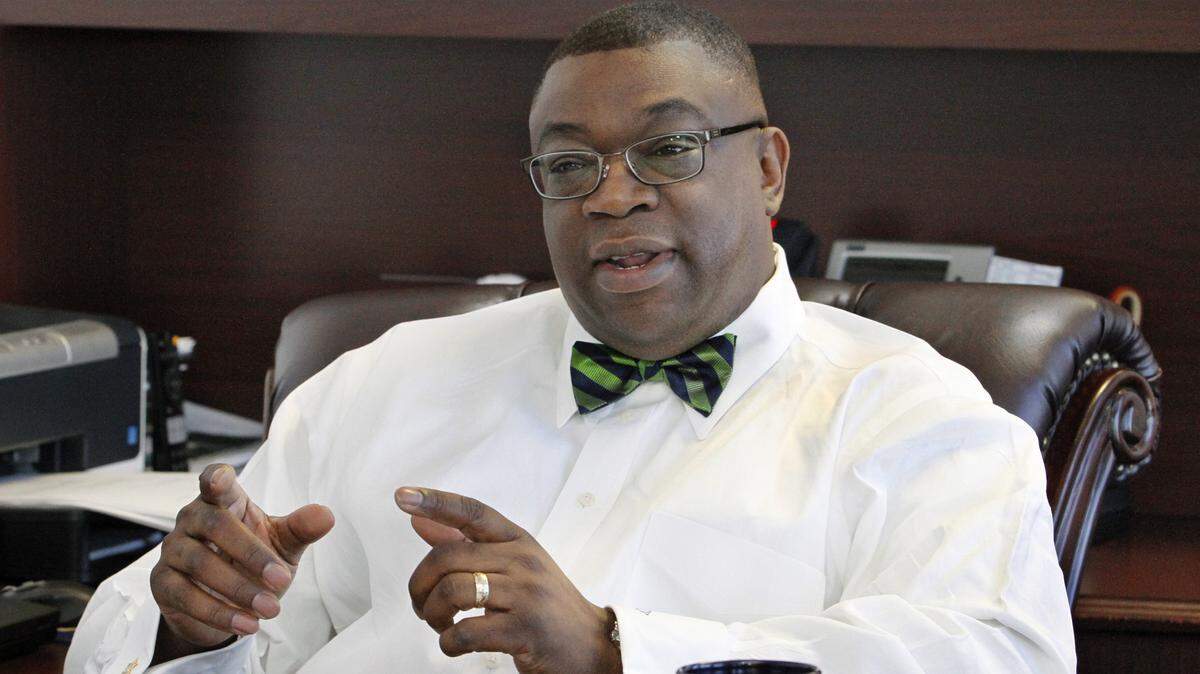
Muscogee County Marshal Greg Countryman has been controversial and outspoken at times.
He has been in public disagreements with other elected officials, including Columbus Mayor Teresa Tomlinson. The Georgia Bureau of Investigation investigated and did not pursue claims of financial wrongdoing with a federal grant in the Junior Marshal Program. Countryman, along with three other elected officials, is suing the city over budget concerns.
Elected 10 years ago, Countryman speaks his mind and speaks openly about his Christian faith.
Recently, he sat down with Ledger-Enquirer reporter Chuck Williams.
You are currently in a lawsuit over your budget and your financial resources. You are suing the city, the mayor and city council. Why?
Well, I’m not going to comment on that presently because it’s in active litigation. As you know, I sent a letter to the Ledger because there was a lot of misinformation out there that I wanted to clear up. The case is in the court system. It’s in the best place possible. I am going to allow the court system to do what the court system does best.
So, you don’t want to talk about that now. One question on that is the point you made in your letter (about) what your office does, right? That was what you were trying to get across in that letter was the responsibilities your office has and financing those responsibilities, right?
That is correct.
What is the primary job of the marshal of Muscogee County?
Our primary duty is to handle civil process through the Municipal Court. We carry out all the precepts of the Municipal Court. We work in conjunction with the clerk of Municipal Court’s office, too. As you may not know, the marshal’s office was revamped August 12, 1915. The marshal’s duties were changed a lot. In the early stages of the marshal’s office, the marshal did everything in the city.
... The marshal’s office and the sheriff’s office predates the police department and the marshal gave an official proclamation to the Georgia census as 1,152, in 1830. If you go back and look at the history, the marshal and the sheriff have pretty much done the same thing for the past 185 years. If you go back and look at the history of the marshal’s office, in the 1840s, if the city levied a fine — which they had aldermen back then, they didn’t have city councilmen, they had five aldermen and they had a mayor — but if the aldermen levied a fine against a person for taxes or for anything of that sort, the marshal would go out and deal with that. If it was $100 or less, the marshal dealt with it. If it was $100 or more, then the sheriff would deal with it. But the marshal did everything from tax collections, and we have to consider the times in which we’re talking about — we’re talking about the 1800s.
The frontier days?
Yeah, frontier days, but there were also some things that are very sensitive to talk about now, even, dealing with the African-American community. Because back then, if an African American had his porch light on past a certain time of night, then the marshal or his deputies had to inflict 20 lashes on them. So, the marshal has gone from issuing lashes to really issuing love in the community.
The marshal carried such a great impact in the city until Nov. 29, I believe, 1898. The city had a legislative act done to just take the name marshal away from police and they established the office of chief of police around that time.
Modern day marshal’s office — the bulk of your work is eviction work, right?
We do 31 different types of civil process, everything from levy to garnishments, evictions, dispossessory warrants. Evictions is what we handle the most. For the past years, it’s been pretty consistent. We’ve received over 5,300 evictions per year; some years it has gone up to almost 6,000.
How many deputies does it take to handle 5,300 evictions in a year?
Currently we’ve been doing it now with about 14 in the field, but we have narrowed things down to a science. Before I got here, it took around eight to nine weeks to deal with evictions. Under my administration, it takes between two and three weeks.
From the time the landlord walks in and files the initial paperwork?
No, sir. Once a defendant has filed an answer to an eviction, then they can go into the court and then the Municipal Court judge will deal with from there. If he issues a writ to the plaintiff of the case, then the plaintiff has to pay $5 to the clerk’s office and then they come to the marshal’s office to set up an eviction. So, from the time they get the writ from the judge, once the judge deposes of things, it comes to our office.
How big is your department now?
Counting reserve, civilian and full-time, it’s probably about 30.
How many full-time?
We have about 20 or 22 on the road.
And 14 of those are used ...
In the field. And then we have deputies here that work in the office. Those are the ones who handle the admin part, answering the phones, answering questions about evictions, entering the documents into the system. Every document that comes into our system from the clerk’s office, let’s say we get 30,000 documents, those two deputies have to run every name through GCIC (for criminal history of outstanding warrants).
So, they have to run those names through to make sure that when we get those documents out in the field, those deputies are not going to encounter someone that has a warrant. The deputies have a very, very dangerous job. Marshal deputies do more building clearing than anybody in the city. It’s a good training too for “shoot, don’t shoot,” if you will, because when we go do an eviction, the landlords can’t go into the house.
We have to go into that house to render that dwelling safe. So, that means we have to take out our weapons, we have to hold traffic on the radio, we have to go in and clear every room and render that dwelling safe, and then we can let the landlord know it’s safe to come in. Because we’ve done evictions before where we knock on the door and the next thing we know we hear “Hold on a second” — Bam! — and someone has committed suicide.
How many times has that happened?
I can think of maybe twice that has happened. ... So, those things happen; it’s not anything pleasant. We get a lot of intel. We walk into evictions, and based on our training, we know that this may be a meth lab or marijuana growth lab, or it may have something in it that may interest another agency. So, we’ve had other agencies to come in because we look at the mail people leave, so it’s a good tool for us to create a database.
Of the three law enforcement agencies in the county — marshal, sheriff and police department — you’re far and away the smallest, right?
Yes, correct.
You are elected, the sheriff is elected, police chief is appointed by council. As a leader of a law enforcement agency, are you on par with the chief of police and the sheriff?
Yes. Yes, I am.
Why do you say that?
Because the chief tells me constantly, “If you ever need anything, give me a call.” If I ever needed something I could call Chief (Ricky) Boren. He has never said no to anything that I’ve asked for. And understand, Chuck, we complement each other. With the chief, the sheriff and myself, experience alone is almost 100 years. So, there is an inner genius in everybody. There is a different experience level in everybody. So, sometimes I can pick up the phone and ask the chief about a certain procedure that I’m not familiar with. If I create a different policy for something, I may have to ask him to send me his policy in order to get me his take on things because I trust him for that.
You and the chief have had some issues, but y’all are working well together now, right?
Even if you have an issue, it’s sort of like a relationship because you can consider us sort of brothers in this, because this is a family. Even in your family household, the family will go through problems, but you don’t cease talking. If we ceased communication, it doesn’t affect us, it affects the community. Because if he calls and asks us for help, which that happens from time to time, if there is bad weather and they are tied down with calls, guess what?
The marshal’s office will go out and answer 911 calls and assist the police department to get their calls down. Once we get their calls down, then we get what we call “1080,” we get back in service.
So, you respect Chief Boren.
A great deal. I think he is a very, very brilliant man, and I’ve said to my chief deputy a number of times, I respect Ricky Boren and his knowledge and I think he’s a good chief.
What did you learn at the sheriff’s office?
Well, when you’re coming from an agency like the Columbus Housing Authority police, my experience was based on what we had to deal with. We were referred to by some police officers as renegades because we had to have a certain mindset going in to public housing. Public housing is not a bad thing, but we’ve done research and back then 95 percent of the arrests that we made were of people that didn’t even live in public housing. Public housing has a negative image, but it seems to draw a certain kind of people.
What kind of people?
Well, there were a lot of drugs in public housing. And when you have people that have been arrested two or three times for drugs and they know what’s going to happen to them, it’s normally a fight if you have to arrest them — it’s normally a foot chase. So, things can get highly dangerous. When Baker Village was there when I worked evening shifts, they would shoot out the lights.
Street lights?
Street lights. So, if we had a call, we had to hold our flashlight a certain way because we didn’t want to get a brick thrown at us. So, our minds were conditioned for a certain type of call or a certain type of fight that we had to go into.
How did that concept change when you joined the sheriff’s office?
I finally saw the way that an agency operates, and I had a great lieutenant at the time, Lt. Mike Massey. I give a lot of credit to Maj. Massey now, that I say I proudly respect more than anybody because (he) took up the most time with me. And I’d like to say that he helped to develop me, and he saw something good in me.
Was Maj. Massey one of your mentors?
Yes, big time. He is somebody that I look up to, somebody I can call on, and somebody that I do call on. Lt. Mike Farley, who worked in field services with me, he’s here now. He was Deputy Mike Farley and then he was promoted as a sergeant in the sheriff’s office and I brought him over here with me when my lieutenant left.The sheriff’s office is a great agency. Just like my agency, we are people-oriented and when you work in an elected office you understand the importance of an elected official because you understand that the decisions that you make are the decisions that will affect your boss.
As an elected official, who is your boss?
The citizens of Columbus and the governor of this state.
What’s the difference in the marshal and the sheriff?
The marshal was created through a legislative pact. The marshal handles the precepts of the Municipal Court and some Magistrate Court. The marshal has a distinctive duty, as the sheriff has a distinctive duty. When the office was created, it gave the marshal the same authority of Municipal Court that the sheriff would have in Superior Court.
Correct me if I’m wrong, the sheriff is a constitutional officer of the state. Are you a constitutional officer of the state?
No, I am not. I’m a municipal elected official. There are only four constitutional offices other than many elected officials: the probate court, the clerk of Superior Court, the sheriff and the tax commissioner.
You were in the sheriff’s office and you had to resign your position to run for marshal, and you ran against Ken Suddeth, correct?
That is correct.
First of all, that was a leap of faith to resign from that job of how many years at the time?
I think it was a little over six years, maybe going on seven.
Did you have any kind of safety net when you did that?
I’m glad that you asked that question because my faith is what sustains me. Even before this interview, I had to fast just to get my mind cleared because when I communicate with God, I don’t want there to be any type of blockage. It was not a full fast, but I did fast from certain things because I want to give up something in order to get something in order to give you a great interview.
My faith is what drives me. Every morning I get up and I do my daily devotional. I send out right at 80 messages each morning to other fellow citizens in the community. So, when I decided to run for the office, it’s funny because I can remember me sitting in my living room on the couch and I had just gotten off of the phone and it just came out of my mouth, “I’m going to run for marshal.” I don’t know where it came from, and as I did that, I saw doors just opening.At the time the marshal said that I was campaigning on the job, and that was not true. So, what I did, because the sheriff had talked with me about it and said he got a call about it and he said it wasn’t true because if it were true, he would know.
Sheriff Ralph Johnson?
Sheriff Johnson. And I can appreciate him because even at the time he called the sheriff in Harris County, and the sheriff in Harris County hired me, but I never took the job because my wife worked out of town and we had a 5-year-old at the time and we had a newborn. So, with her working out of town, I was not going to work in another county and something happen to my children and I couldn’t get back to them.
So, yeah, it did take a leap of faith. However, I know my wife and I came together and prayed over it and I moved forward with it. So, I wasn’t worried about what was going to happen because I had the assurance within. And when God communicates with you, you know when He communicates with you. So, I knew I had to go through the motions.I knew there were going to be some tough times because there was some tough times going 20 months without having a full-time job. You learn how to live off of ramen noodles. It’s sad because I didn’t have a safety net. We had just bought another home. We had refinanced our house to a 15-year mortgage, so things got a little bit tough. I had two car notes. We had children that were in day care. So, Chuck, it got to the point that we didn’t have money for my children to get their hair cut. As a man, wanting to provide for your family, just to watch your wife cut your kids’ hair because you can’t afford to take them to the barbershop is not a good feeling. But I can assure you of this: we never missed a mortgage payment. We never missed a car note. We would make sure our kids ate well, if my wife and I didn’t eat anything but a peanut butter and jelly sandwich or ramen noodles or anything we could, because we were in this together. It was not just me, we stepped out on faith.
Where does your faith come from?
Faith is something that grows on you. Faith is something based on your experience and that’s why I never look down on a person because you never know who that person is. You never know where your wisdom is going to come from. My mother was a Christian. She was a Jehovah’s Witness and that’s how she raised us. Faith has always been in my life and even when I have strayed, I knew how to come back because I knew my mother raised me to have a Christian conscience.
I can remember her telling me things such as “If I’m here you know God is watching you.” So, even though she told us not to do something, not to go into the cookie jar, and even if I opened up the cookie jar and put my hand in it, I knew to put the cookie back because I was trained to feel that God is watching you no matter if your mother is there. And I still tell my kids that today.
Where is your church home now?
Kingdom Metropolitan Worship Center on Airport Thruway. My faith is what drives me because every day I come here I have to ask for daily discernment for me to run this office before this office has grown. You know what this office was before I got here. We had one taser, didn’t have any carpet on the floor, had the same floors from when the building was built. It was very, very gritty and grimy.
I got with the city manager at the time, Carmen Cavezza, and said, “Look, I can’t work in a mess.” I’m not saying that the other marshals could, but I wanted to raise this office to have a standard. I wanted to raise this office to have a professional image. ... I wanted to create a spiritual atmosphere for me to allow God to come in to work through me, to work through this office.
So, you believe your job as marshal is a mission and a calling?
Right, this is a ministry to me. That is one reason I formed the Junior Marshal’s Program. I made a covenant with God that if you get me here, I’ll use my authority for the good, and I wanted to reach back to kids that were just like me. A lot of people may not know this but when I graduated from ... Baker High School in 1984, I graduated as a special ed student. I had a learning disability. I had a very bad stuttering problem. I had problems trying to comprehend.
You don’t stutter now.
I do stutter. You just don’t pick up on it. I’ve learned to say words that are easy to say. That’s why I don’t use a lot of big fancy words because I will fumble over them. I couldn’t enter college because I couldn’t pass an entrance exam. I had problems reading, I had problems writing. I could not write a structured sentence. People knew that I stuttered because they use to make fun of me.
Do you remember some of the names they use to call you?
They used to say I sounded like a car trying to crank up. Even my grandmother would make jokes from time to time, but she knew I was a very sensitive person about that. Even when I get with kids now I try to look at the best in every child that I see to give them the opportunity that I had, because even though I had those challenges, I had a mentor in my life, and I would hate to know where I would be if I didn’t have a young man by the name of Tony Alexander. Tony Alexander was older than me. His mother was not my grandmother but we called her grandmother; she was the neighborhood grandmother. He was a very mature person for his age.
What neighborhood did you live in?
Willis Plaza, off of Cusseta Road. I grew up on Swan Street. My neighbors were Judge Albert Thompson and A.J. McClung. But even with that I couldn’t enter college, but now I teach on a college level. So, I understand how far God has brought me because every step I move I can look back and I can look at how far he’s brought me.... But where we are today, I’m grateful because I could not have done this on my own. There’s no way, because even when I was supposed to fall, when people tried to make me fall, I couldn’t fall because I would never abandon God because I never want Him to abandon me. A lot of people may say, “You’re this guy that talks all of this...” Well, guess what? I have a right to do that because I understand where I am, I understand who I am, and I understand more importantly whose I am, because this office has been a ministry to me. I have had people ask me to do different things, but I am going to stay here until God speaks to me.
What verse is your Bible open to?
It should be Ephesians and I have my devotional here, which is written by Jack Countryman, no relationship.
You contend that it is on par with the other agencies, and you have asked for the equipment to make it such. Why do you need police cruisers for your deputies?
The question would be why don’t we need them. If you say that we are equal — and to which I say that we are equal, we go through the same training, we get the same pay, we get the same retirement... — marshals should have the same thing because although we have a prominent duty to be civil processors, we also have a secondary duty to protect and serve.
The police can’t be everywhere. The sheriff can’t be everywhere. That’s a mindset, and as an elected official I have a budget, and as an elected official, I get to utilize my budget to buy the type of cars that my deputies need to fulfill their duties, because if a police officer has to have a certain car for their purpose and the sheriff outfits his people with a certain car, what is the difference in the marshal doing the same thing? If we are the three law enforcement agencies, then we should be able to drive the same car.
(Councilor Gary Allen’s) Ford Fusion remark still bothers you, right?
It was very degrading,
Did you tell Councilman Allen that?
I did. I told him it was very, very degrading. This is it: I have three boys and my oldest son is not of my loins, but he has never heard me call him stepson. I have three boys. I’ve raised them all, they are my sons. When you start to imply certain things, it creates a certain prejudice, it creates a certain mindset, it puts misinformation out there. You can’t say we have a public safety and you say one agency is the primary public safety agency. We have three law enforcement agencies. You don’t hear the President of the United States say we have a great Marine Corps or we have a great Coast Guard. He says we have a great military. Because we are military, that although we have a distinct mission, we all train the same way, we have to meet the same requirements, we have to meet the same requirements to maintain our arrest powers.
Do we need three law enforcement agencies in Columbus?
We do need three law enforcement agencies. We’ve had two where we had the marshal and the sheriff, but we need a police department, we need a marshal’s office and we need a sheriff’s office. We all complement each other. What would you think would happen if we had two agencies that did the same thing and thought the same way, and nobody could check the other agency — it’s checks and balances. The marshal’s office is a crucial part of public safety.
Do we have a crime problem in Columbus?
If you have one house broken into, that’s a crime problem. Do we have a crime problem? I think we can do better when we come together and work together for one common cause, and that is for the citizens. That is why from where I sit, my deputies have to go out and have to communicate with three citizens every day, list their names and bring that back to this office, because that is part of community policing.
Before I took office I met with Jim Wetherington because I wanted to pattern my leadership after him. One thing that I watched and have seen over the past 20 years is community policing is necessary to reduce crime. Traffic enforcement is necessary to reduce crime. A lot of people may not know what the studies say, but when you can involve the community and build that trust with the community, because in the wake of things happening in Ferguson and New York, public safety law enforcement is going to be forced to do things in a certain way anyway.
I’m going to ask you the same question I asked Chief Boren: Are you a cop or are you a politician?
I’m a public servant that happens to be a law enforcement official. I believe that everybody that commits a crime should not have to be arrested. I believe that. Once upon a time I had a problem drinking. I knew I did; I’m not a perfect person, but I can appreciate where I am now. But even then, my conscience would bother me because I knew I had drank and drove. If I went to the club in my single days to drink and made it home but I was never pulled over, but I was never to the point where I couldn’t drive, I made a bad decision.
Sometimes people make bad decisions and that officer has the discretion to arrest or not to arrest. Some people’s philosophy may be different because of the agency they work with, and they may feel like everybody needs to go to jail.
So, does that make you a cop or a politician?
I’m a public servant. Every law enforcement officer, whether you’re Columbus State (University) Police, sheriff’s office, everybody is a cop. Because if you wear that gun and that badge and you have arrest authority, you are a cop. It’s a mindset. So, I’m a law enforcement officer who happens to be elected and a public servant.
I’d like to talk to you about your relationship with Mayor Tomlinson. When she was elected four years ago you worked very hard for her, right?
I did.
In the most recent election, you were very vocal and very high profile against her. You were sitting on the front row...
Sitting on the front row does not make you vocal, and if you ask anyone, my concern — and even my comments were in your paper — is public safety. And my concern now is still public safety. My concern will always be public safety.I absolutely have no disdain in my heart for Mayor Teresa Tomlinson. I have no ill will in my heart for Teresa Tomlinson or anybody in city government. I believe I had the right to my opinion and as a public safety agency here, I worry about how public safety is being handled. In 2008-2009, as you know, we had a 1-percent sales tax, and don’t think that all of this was a sudden change. I’m the type of person, Chuck, that likes to communicate behind closed doors before I have to take anything public. I don’t believe in being a radical person, although I think sometimes you have to take radical actions to make your point known. Even as a child, I never saw my mother and father argue.
They never argued?
Yes, but not in front of us out of respect. My kids can never say they heard my wife and me argue even if there is a fundamental difference. We wait until there is a time and place for us to communicate. With the Mayor, you never saw me publicly go out and argue about something she has done. We’ve communicated via email, and I’ve told her, and I will tell you because we’re doing this interview, that this should be a partnership and not a dictatorship.
Do you think it’s a partnership right now?
Well, I think that time will tell. There is always time to heal. Certain things have to happen, but that’s why you have some marriages that will break up and some marriages that will get back together; you see people remarrying.
So, do you plan to remarry the mayor?
I’m already married and I’m happily married. (Laughter)
Do you plan to politically remarry the mayor?
I have no problem working with Mayor Teresa Tomlinson on any project that she needs my help on. I absolutely have no problem with that, but understand this, Chuck, public safety is my heart. I watched Mayor Wetherington and I sat in the room with him, Fire Chief Jeff Myers, Sheriff Ralph Johnson, City Attorney Clifton Fay, and the city manager, and when (they) came up with the concept of a percent sales tax, I remember the city manager say “dream big.”I’m thinking we can’t even hope big. So, “dream big,” we would have x-number of dollars coming in that we can fund these different functions of public safety. And initially it was for the police department, the sheriff’s department and the marshal’s office. ... But, we haven’t been able to dream because now the Civic Center is getting part of the LOST, METRA, Parks and Recreation is getting it. So, the number of people that receive the LOST who benefit from it has spread. That means that the money is drying up.
Do you think Mayor Tomlinson has protected the sales tax that was primarily for law enforcement?
I’ll give you an example. If I had to maintain $6,000 in my checking account, no matter what in order for me to have a good credit rating, the bank has to see $6,000. If I for some reason don’t have $6,000 and I all of a sudden have $3,000, but in my savings account which is for maintenance for my vehicles, if I could move that to over here, technically you have $6,000. But you have exhausted $3,000 over here so you can no longer perform maintenance on what his money was originally for.
Money is just being shifted?
Councilman (Mike) Baker, who has just been sworn in, has said one of the things he wants to do is to build back the city’s reserves. We don’t have a true reserve, because any time you have to combine money to make one then the money is not being used properly. I have asked and I have communicated and I will not call the councilman’s name, but I have asked several councilors to explain how the money is being used, because it’s talked about quietly amongst pubic safety. Even now, the police department wants cameras. The marshal’s office is looking at different types of cameras. The sheriff’s office is looking at cameras. There should not be an alternative funding for the needs of public safety. The money should be there to where we can purchase those types of things because that’s what the taxpayers voted for. I think that’s what we should give them.
Do you think Mayor Tomlinson has acted in the best interest of public safety? Yes or no?
No. If you ask me point-blank, no, because the money should be there and I think that the taxpayers deserve to know where the money is. I think the taxpayers need to know how they’ve spent the money. I think it would be good to not just to hide it into a system where you can go in and look for it. There should be a quarterly report that goes out to the public on a web site where they can see expenditures, because if you can look at an elective office and cast judgement on an elected officer and say that the sheriff misuses his budget, that’s a stretch if you’ve never worn the uniform. That’s a stretch because I can’t tell you what the mayor does in her office. I don’t know anything about the mayor’s office.
But she’s the public safety director?
She’s the public safety director for the police department and the fire department and the Muscogee County Prison. I’ve worked in the jail. I’ve worked in the sheriff’s office. That’s not an easy task. Even myself as marshal, I know how difficult the job of a sheriff is, because you can’t please everybody. And he has to have a budget, everybody has to have a budget that is going to be efficient. You can do great things when you have a great budget, but look at the agencies like the marshal’s office that doesn’t have a large budget.
So, money solves problems?
Well, just let me tell you this: When I got married I had a guy tell me that love is love but money makes it easier to love. I think that money allows you the ability to run your office or your department in a way that it should be run. We go to conferences each year and we see new technology that may come out and if we need to purchase something we can’t.Those things benefit our agencies because if you don’t have a camera now, and cameras could have been purchased... Say there is an incident. There is no independent witness. That camera system is an independent witness that will not lie, that you cannot alter. That’s why I tell the truth because often times it’s one person’s work against another. Once the public can see those kinds of things, believe me, Chuck. ...
As the NFL has taught us, sometimes it’s inconclusive.
Well, even if that happens, the level of transparency should be there, because you have to have transparency. Do I like transparency? I’ve learned to love it because this office is open to traffic. I can’t tell you the number of times that I’ve gotten open record requests for things I know I’m going to have to do all of this work.
I’ve sent a few to you.
Oh, yeah, you have. But, transparency needs to be there because it promotes integrity and promotes public trust. And if we are going to try and build a bridge from one side to the other, the most important part of building a bridge is you have to build them in sequence from left to right. But what’s most important is what is in the middle. You have to be able to build those.
You’ve got public trust and you’ve got public safety here; you have to be able to work in conjunction. So, once you get to that middle part, it can withstand the harshest weather. It can withstand the traffic that comes in the door because once the public trusts public safety... Even if you make a mistake. own up to that mistake.
Solicitor (Ben) Richardson taught me three things when I took office. He said, “Greg, let me sit down and talk with you.” He said, “If you ever encounter something in your office, first recognize there is a problem, whether you want to recognize it or not. Secondly, you have to have a solution .....
You called for an investigation of your own department.
I did, because that was integrity. That’s integrity.
You’ve called for investigations twice, right?
Right, twice. Because the first time for the Junior Marshal’s program there were some who were saying we had a ghost employee. And at the time I was seeking a job to be the United States Marshal for the Georgia Middle District, which I felt I had a great opportunity for that.
Did that investigation cost you that job?
I was asked to come off of that list. I was asked to be removed off of the list, and after it was cleared and I was cleared of no wrong doing, I was told I could go back. I didn’t want to go through that because integrity matters to me, Chuck. As I told you when I left the sheriff’s office, someone was putting out false information.My integrity means something to me. I resigned and I left and I sought this office and I got the reward. There were rumors of certain things. I called the GBI on myself and I can remember that call clearly, because they said, “You’re calling us to look into you?” They said, “You know, we have the resources to turn over every rock.” I said, “I want you to.” So, I called the state-level FBI agency to come in and look into the Junior Marshal’s program. There was no wrongdoing. I called the GBI to come in and look into another personnel issue that I caught a lot of flak for by some people.
Which one was that?
The one with Alicia Davenport.
She’s no longer in your office, right?
She is technically an employee in this office. She is on admin leave without pay. So, the GBI looked into that because when things happen in your office, one thing that I have learned is you have to act swiftly. You can’t sit back on things because I call that leading from behind. You can’t lead from behind. You have to set a standard, you have to believe in that standard, and you have to move forward based on that philosophy.
Are you considering a run for sheriff?
Chuck, I’ve had people ask me to run for sheriff since I’ve been marshal.
Are you going to do it?
I have no plans at this time to run for sheriff. I am going to be obedient. I’ve told the Sheriff to his face that I can sit here in this office and retire if God wants me here.
So, if John Darr runs, you wouldn’t run against him?
I consider John Darr a friend. I consider Ralph Johnson a friend because he hired me. When I ran for office I ran on three things: honesty, integrity and loyalty. Those things mean something to me. John is a great friend of mine, but he knows that if God puts it on my heart, then I am going to obedient to God rather than the man. Do I want to run? I have no intentions.
But if the Lord tells you to run?
If it is placed on my heart, I’m going to be obedient, but I have no plans in my heart. In my heart of hearts, I consider John a friend. This office doesn’t belong to me. Neither office belongs to either of us. It belongs to the people. I have no intentions of having the headache of being sheriff.
You’ve already got a headache, the marshal’s office.
But, I love this headache. I can deal with this headache. I enjoy being marshal. I enjoy serving the citizens of this great community, and I like where we are as an office now, because I have kept up with all of the data, the history, the photos, and you can go out and look at the monitor and it shows where we were when I first got here and where we are today.We went over to the west wing — we didn’t have the west wing. When I first started we have 14 people in 670 square feet of office space. Imagine if you had 15 children in your house and how chaotic it would be.
Based on your faith tradition, you believe judgment day is coming, right?
Yeah.
... What do you think the judgment is going to be of you?
Well, Chuck, if I die tomorrow, I feel good about where I am, because one thing about it, the Bible tells you when you know right and you do wrong that you sin.
So, I have always tried to do right because I know at the end of the day when I go shower and brush my teeth, when I look into the mirror, I’m happy. I pray when I lay down. I pray when I get up and I thank God for being where I am.Do I think we’re living in the end of time? You can look at where we are as a world, you can look at where we are as a nation. I try not to get caught up in foolish things. I got a call from a good friend this morning. He has had a stroke and he called me to say, “Hey, I love you.” We don’t have time for foolish games and we don’t have time to hate on each other, and we need to learn to celebrate each other.
I’ve been preaching that and saying that for the longest. Do I feel like I need to pick up what I do in a spiritual sense? I’m just not going to be misled or led by foolishness. And I think judgment day is near. It will come as a thief in the night, so we have to always condition ourselves, condition our minds to be where we need to be spiritually.
So, that day is going to come whether I see it or whether it is beyond me and my children see it. I’m always going to prepare for it because I just never know. If I lay down tonight and don’t awake tomorrow, I can’t say, “I’m going to get myself right.” My preacher preached last Sunday on the time is now for all of us to get ourselves together, not be consumed by foolish things, because the things we quarrel over are nothing. I think we’re all going through the motions.
Everybody’s fate is pretty much decided because if God can tell you every number of hair that’s on your head, if he can create earth and within a fraction you either burn or you freeze. We serve an awesome God and we have to get ourselves conditioned for the race. I believe in judgment day and I believe everyone will have to answer. That’s why I try to utilize this office in every decision that I make that is key. I imagine the citizens being outside of this door, and once I make my decision, I can go outside this door and justify my actions because it’s not your actions that will get you into trouble, it’s your inactions.
BioName: Greg CountrymanAge: 48Job: Marshal, Muscogee County; part-time assistant professor, Georgia Military College. He worked previously as deputy for the Muscogee County Sheriff’s Office and officer for the Columbus Housing Authority Police.Education: Baker High School, 1984; Georgia Military College, associate degree in criminal justice, 1997; Troy University, bachelor’s degree in criminal justice, 2003; Columbus State University, master’s in public administration, 2007.Wife: Angela, married 15 years; sons Christopher, 21, Greg Jr., 14, and William, 7.
This story was originally published January 24, 2015 at 9:04 PM with the headline "Sunday Interview with Marshal Greg Countryman: 'This is a ministry to me'."