
Phenix City leaders seek fee increases, cite future goals
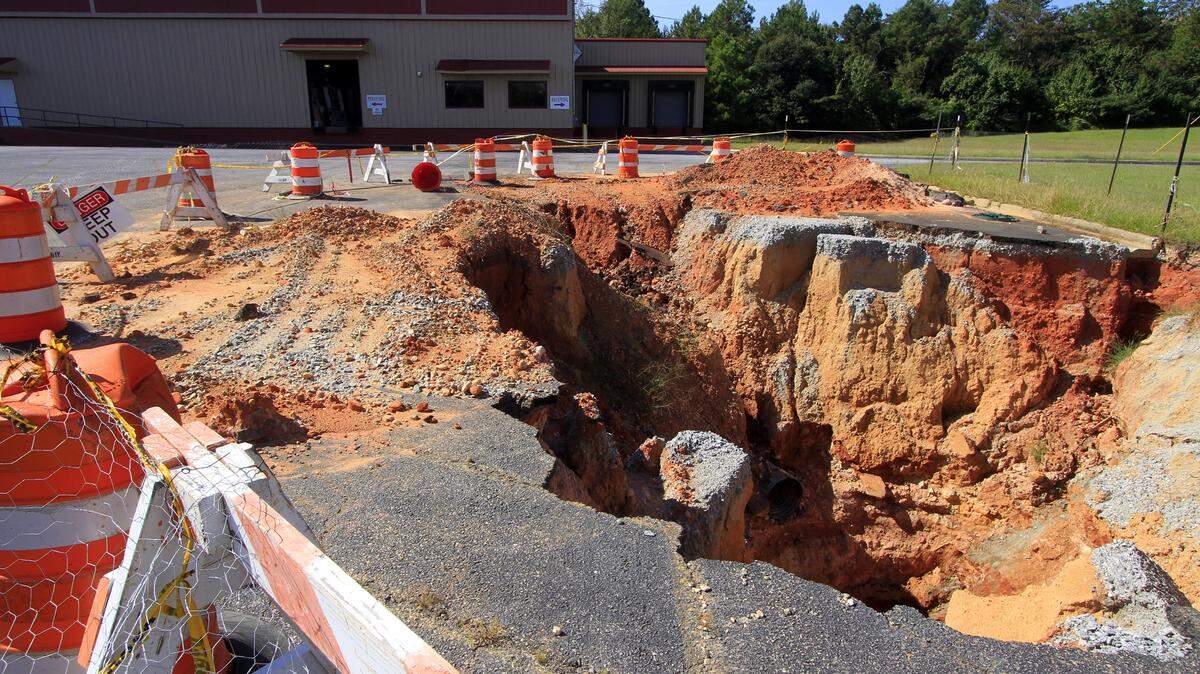
The earth has opened like the maw of a subterranean behemoth and swallowed $1.3 million of Phenix City's general fund.
A sinkhole next to Tate Furniture at 800 22nd Ave. off the 280 Bypass will cost about $700,000 to fix. Another on Eighth Street off the Broad Street Extension, where a steep hill is eroding, is expected to cost $600,000.
Those are among the issues city Finance Director Steve Smith and City Manager Wallace Hunter cite when they discuss the city's proposed $35.3 million general fund budget for the next fiscal year that starts Oct. 1. That's an increase of about $200,000 over last year's.
That is not all of the city's money. It has a separate water and sewer budget proposed to be $11.8 million the next fiscal year, a decrease of about $200,000 resulting partly from the municipal utility's losing a major customer when Johnston Textiles closed in January.
Also separate is about $500,000 the city gets from gasoline taxes -- revenue distinct from other income because it can be used only for roads, of which the city has 361 miles.
One reason sinkholes take such a bite out of the budget is that their repair eats away at the general fund alone. They're a problem with the storm sewers, not the water or raw sewage lines, so they're not covered by that utility's budget.
They're also not among the projects for which the city can get state assistance. For some major road projects, Phenix City can get the state to pay 80 percent if the city puts up 20 percent of the costs. Not for storm sewers. If one collapses, it's all on the city's tab.
That's a distinction city leaders will have to make at a town hall meeting on the next budget, which is set for 6 p.m. Aug. 25, in the Central Activities Center auditorium, 1500 14th St.
City administrators in the next budget are proposing a 3 percent increase in water rates, bumping the average customer's monthly bill of $41.40 by $1.25.
That stirs interest because the city last year instituted a 4.5 percent increase that boosted the average bill from $39.42 to $41.40.
Smith and Hunter said they had anticipated the cumulative increase, but council wanted them to bump water rates up incrementally so customers' bills didn't jump so much at once.
They also said the increases aren't moneymakers, but only cover rising costs resulting primarily from more stringent water standards, but also from the need to replace older water lines 2 inches in diameter with pipes 6 to 8 inches wide, to provide flow for fire protection.
Smith notes that at the same time the city water system lost a significant customer in Johnston Textiles, it had to borrow $6.5 million to retool its sewage treatment plant to meet new standards in wastewater releases.
It also had to fix a water-supply problem.
The problem was that chlorine used to treat drinking water breaks down into known carcinogens if the water stands too long, Smith said, so the utility had to find ways to flush or loop dead-end lines that can trap water, as well as keep stored water moving so the chlorine doesn't degrade.
He said the federal government last mandated such improvements in 2012, and since then the system's cost of materials has increased 35 percent; its energy costs are up 19 percent; and chemicals have gone up 32 percent.
The increase in water rates is expected to generate an additional $300,000 annually, Smith said.
The other increased charge to residents in the proposed budget is for garbage pickup, bumping the average customer's monthly bill from $17 to $18.40.
That's in anticipation of the vendor's charging more when the three-year trash pickup contract is up for bid again on Feb. 1, Smith said.
The current vendor is Advanced Disposal, which charges the city monthly based on trash volume, Smith said. The total for 2014 came to $2,020,757, he said.
The garbage increase is to yield an additional $160,000 annually. Part of that will cover the city's increasing costs of picking up inert waste such as downed trees and limbs, which goes into a city landfill, Smith said. The contracting company handling household garbage has to have its own landfill for that.
Though city administrators have other goals in the next budget cycle, such as a 5 percent pay raise for public safety workers, no taxes or fees will increase for that. Smith and Hunter said the city has saved $600,000 a year by switching health insurance providers, and that money will cover the public safety costs.
Public safety workers also got a 5 percent raise last year, and are to get another 5 percent in the budget that follows the one currently proposed, Smith said.
As city administrators propose these two increased charges they say are needed to pay for the services provided, they reiterate that unanticipated expenses such as sinkholes remain a general fund risk.
Beyond dealing with collapsing storm sewers that are decades old, the city still occasionally finds some with raw household sewage running into them, and those have to be fixed immediately, because such combined sewers can overflow during heavy downpours, and they're illegal, Smith said.
Capping or rerouting one can cost about $10,000, he said.
That summarizes what administrators describe as immediate needs in the budget as it's currently proposed.
Future goals
What city leaders would like to do is another set of projects that would require other methods of raising revenue -- such as raising the sales tax from 8.75 percent to 9, which council can do on its own, or instituting an occupational or wage tax, which voters would have to approve in a referendum.
That voters would welcome the latter seems unlikely, as Phenix City currently has no such tax.
Of the city's current sales tax, 4 percent goes to the state, 1 percent is dedicated to schools, and 3.75 percent goes to the city. An increase of .25 percent would generate about $1.2 million a year, Smith said.
Among the goals that could help with is giving Phenix City schools an extra $1 million annually, which they want for their science, technology, engineering and mathematics, or STEM program.
City administrators say they've steadily increased funds to the schools over the past seven years, from $6.1 million in 2008 to $7.39 million last year, but in such figures they include providing security and parks and recreation facilities. Those costs combined equaled $332,186 last year.
The city's proposed contribution to schools in the next fiscal year is $7,752,688, with $335,579 for security and recreational facilities.
So, an extra million for schools is one item on the wish list.
Another is a new fire station and police substation to account for growth to the west and south. The construction cost would be $1.75 million; staffing it with 12 firefighters would produce an ongoing personnel expense of $840,000 in pay and benefits, and $210,000 more for three police officers; plus $100,000 for operations and maintenance.
In public works, the city wants to put $2 million aside to provide matching funds for infrastructure projects for which the state will pay 80 percent, if they're approved, with $350,000 set aside to maintain those improvements once they're finished.
In a few years the city will need to expand its debris landfill, which is running out of space, Smith said. It estimates 25 more acres will cost about $500,000.
The city's also running out of cemetery space, Smith said. Twenty acres for a new graveyard also could cost about $500,000, he estimates.
In parks and recreation, the city would like to have $400,000 to air-condition city gyms, $60,000 to put a new roof on the old airport terminal by Idle Hour Park, a building that's now the city arts center; $1 million to buy 40 acres for a new park on the city's west side, where the bulk of its growth has been; $250,000 to roof the city's riverside amphitheater; and $200,000 to put security cameras on the riverwalk.
Though the last two sound like amenities, Smith said the city may put up $10,000 to $20,000 to bring a big act to the amphitheater, and if that concert's rained out, the city still has to pay.
The cameras are to prevent and prosecute vandalism on the riverwalk and in the amphitheater, where someone went through and ripped out wiring. A recurring problem on the riverwalk is vandals breaking the big glass globes on the lights that line the path. Each globe costs about $400, and one weekend 19 of them were shattered.
While city leaders cite these goals in addition to increasing service costs, they can't claim to be hurting for money. Growth steadily has improved the city's property tax digest. The total value of property subject to taxation was $200,292,300 in 2006, yielding $11.8 million in revenue. In 2014, the total value taxed came to $300,061,540, yielding $17.7 million.
Though recent growth has been a modest .69 percent a year, the city saw significant boosts during the recession. The digest jumped 20.6 percent in 2007 and 12.14 percent in 2008, likely because of anticipated growth at Fort Benning.
Phenix City also expects to get additional sales tax revenue when a Walmart grocery store with gas pumps opens next year on U.S. 80, but that won't immediately create a steady cash flow into city coffers.
After the city's Aug. 25 town hall meeting on the budget, the city council will hold a budget hearing at 7 p.m. Sept. 1, in the council chambers at 1111 Broad St.
This story was originally published August 15, 2015 at 9:13 PM with the headline "Phenix City leaders seek fee increases, cite future goals ."