
CIRCUS WRECK: 100 years ago, a fiery rail crash destroyed a circus and gave Columbus a tiny hero
For just a little while, Hazel Kempf was a community sweetheart. Few people saw her, but many knew her story. A hundred years ago next month, she was orphaned after a horrendous train wreck outside of Columbus, and people followed the 2-year-old's recovery on the front page of the daily papers, smiling at reports that she was sitting up in bed at City Hospital sucking on sugar cubes.
Her father and mother, Fred and Blanche, were part of Con T. Kennedy's traveling circus. The Kempf family rode the rails in a caravan of misfits that included a cage of death, a Wild West show, Siamese twins, dwarfs, a Coney Island Side Show, wild animals, Prof. A.U. Eslick's 27-piece brass band and a Ferris wheel that made your stomach churn when it took you up above the treetops.
Fred and his brother, Irving, operated Kempf's Model City, a mechanical community that the toddler's father spent his teenage years assembling in a corner of his family garage in Capac, Mich., 62 miles from Detroit. Fred's tiny village became a popular attraction in Kennedy's sideshow.
Four days before Thanksgiving, the 1915 season was coming to an end, and the circus was on its way from a stint downtown at the Atlanta Exposition, where it set records for money and attendance.
Next stop: Girard, Ala., across a newly opened bridge from Columbus, Ga.
The train and its array of offbeat performers were six miles out of town, and the tracks ahead were believed to be clear. A Central of Georgia passenger train headed to Macon had left Columbus and was supposed to wait at Muscogee Junction.
Only orders were ignored.
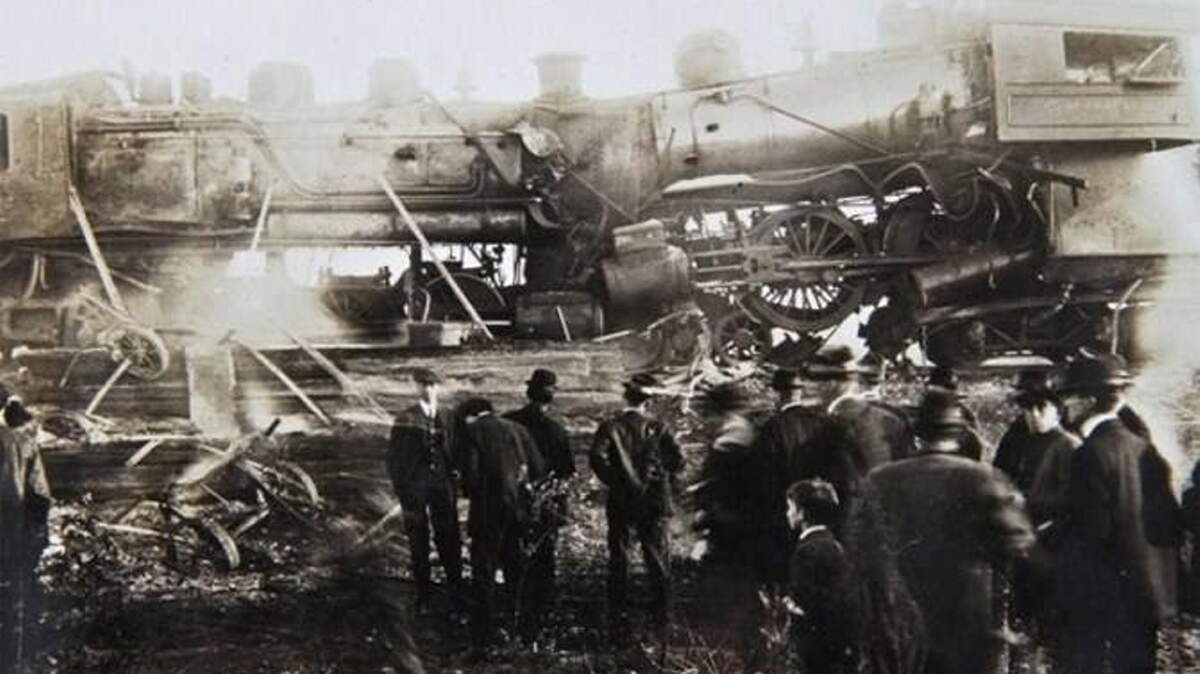
The Central of Georgia train barreled onto the main tracks and, near a bend at Bull Creek, it collided head-on with the unsuspecting circus train. They were going 30 to 35 mph when they plowed into one another at 26 minutes past 1 -- 9 minutes before the regular train was supposed to pull out.
Flames as hot as a furnace moved through the circus train, which was made of metal and wood and loaded with oily tents that fanned the flames. Twenty-four circus people died, including little Hazel's parents. His brother identified Fred by his engraved watch and Blanche by a necklace around her neck.
More than 50 survivors ended up in an overrun City Hospital, and the most adored patient there was Hazel Kempf, who was accepted, clothed and fed by a community that wished her well.
Nearly a century has passed, and the story of the loving parents that helped save her has become legend as much as fact. Hazel's story will highlight a ceremony marking the 100th anniversary of the Con T. Kennedy crash on Oct. 24. It will be held at Riverdale Cemetery, where the circus community long ago erected an unusual monument to the people who died and those who lived to do another show.
Now it's time for children of all ages to hear their story.
Glamor under the Big Top
When the circus came to town, cares were forgotten. Children ate candy and corndogs and shared caramel apples. When night came and oil lights sparkled, magic was in the air. In those years, hundreds of shows were on the road bringing entertainment to even the smallest of American cities.
P.T. Barnum had been to Columbus, featuring the wedding of Tom Thumb and what was billed as the Freak Monsters. The Greatest Show on Earth employed 1,000 men and featured three bands and a calliope.
Circus bands provided more than music. Barnum & Bailey's band chariot was crescent-shaped and was pulled through downtown streets by 40 white horses. When performers unloaded at the train station, they marched all the way to town. Bringing up the rear was the calliope, burning coal to supply its steam. Pedals were hot enough to blister a musician's hand.
Seeing only the glamor under the Big Top, it was more than a cliché to say that small-town boys dreamed of running away and joining the circus.
That was never Fred Kempf's dream, though. His family worked with their hands. His father, a cobbler, came to Michigan to make work boots for loggers. The Kempfs were friends with the Dodge Brothers and Henry Ford, and Thomas Edison grew up in nearby Port Huron.
Born in 1884, Fred was a natural-born tinker. He spent five years creating the attraction known as Kempf's Model City. A 1911 article in Popular Electrician magazine praised his patience and skills: "One can well conceive of the many obstacles that confronted the young fellow, the disappointments he met with and probably the criticism and discouraging comments of those who watched his slow progress."
When Fred and his brothers saw lines of local people willing to pay a nickel to see his creation, they took it on the road.
On a visit to the Motor City, Fred was fascinated by a K-R-I-T-T touring car he saw at the 1911 Detroit Auto Show. Ads in the Saturday Evening Post promised a dollar's worth of automobile for a dollar's worth of price, but his plans went beyond its ball-bearing motor.
Spending nearly $8,000 in 1912 dollars, Fred converted the vehicle into living quarters for him, his wife, Blanche, and later their baby girl. Rolling down the tracks, the K-R-I-T-T was their comfortable home. On the night of Nov. 21, they packed for the trip to Columbus.
Regulars knew that the place to be was at the rear of the train, away from the engine's clatter, dirt and rumble. But that spot would cost you. Being a frugal German, Kempf didn't bribe the trainmaster, so their touring car was on a flatbed car just behind engineer W.R. Vittick and his crew.
And death rode with them on that flatbed.
Monkeys in the trees
When the engines telescoped into one another, they never left the track. Cars on the Central of Georgia train were much more sturdy, and there were no fatalities among the passengers. That was not the case on the circus train. Cars at the rear carrying an assortment of wild animals were untouched and free from the flames. In between, nine cars were consumed in less than two hours.
Though trapped in the wreckage, Fred and Blanche were able to pass their baby girl to an injured circus roustabout who rushed Hazel to safety.
R.B. Peterson, a tuba player in the circus band, described the scene on the side of Macon Road where hundreds of rescuers assembled -- led by Con T. Kennedy himself:
"He knew what was concealed under the wreckage; the mangled and charred remains of men who had been with the company for years still reposed. A flame of blast-furnace intensity had swooped down over the train, and in its course it ate its way over and into the vitals of the showmen, caught like rats in a trap. The eye of the director of this monster organization was dimmed with a tear. Not a year ago, he buried his wife, now he was forced to stand idly by and see his co-workers burn to death. 'Rather my whole train go up in smoke than that one of the people who worked for me should have lost his life,' Kennedy said."
Work continued and by the light of a harvest moon, a badly burned Irving Kempf used jewelry to identify the remains of his brother and his sister-in-law. Only then did he go to City Hospital.
Word that an angry circus bear was on the loose lured young hunters from town, but the fate of the animal was never reported. Colorful parrots flew away, but a gaggle of monkeys did not escape. Frightened and frantic, they jumped into trees next to the rail bed. Circus people, knowing they would hamper rescue efforts, got guns and shot the monkeys out of the trees.
The show in Girard did not go on, and circus people were left without places to stay or money for food. Columbus people rallied around them, and a group of Women's Club ladies fed them a Thanksgiving meal on the first floor of the Murrah Building on First Avenue.
Changes in Columbus
The circus catastrophe was not the only thing going on in Columbus. The Dillingham Street Bridge was newly opened, and the circus was scheduled on the Alabama side. The impressive Ralston Hotel opened the week before, and a newspaper ad for a Thanksgiving feast in the ballroom featured possum and sweet potatoes ahead of the turkey and dressing.
Secretary of State William Jennings Bryan was speaking Wednesday night at the Springer Theater. When his train arrived, admirers of the three-time presidential candidate lined the route between the depot and The Ralston where he attended a pre-speech reception.
That was also the week that the Rotary Club of Columbus was chartered. Dr. Luther Rice Christie, the pastor of the First Baptist Church, was elected president, and he led the club's first meeting at the new hotel across from his sanctuary.
Thanksgiving morning, Christie -- pastor at the city's oldest Baptist church from 1909 to 1917 -- led an unusual funeral cortege down 12th Street before presiding at a service unlike the city had ever seen. Behind him were musicians from Prof. Eslick's band, some playing borrowed instruments.
They played a somber version of "Rock of Ages" as they crept down the street to the church.
Every pew was filled as Christie preached about God's omnipotence and about the haven He offers in the darkest of hours. When he was done, members of the Masonic Order took charge of the bodies of Fred and Blanche, and Worshipful Master Early Johnson performed the order's ancient rituals before their bodies were taken to Riverdale.
The day after the services, what was left of the Con T. Kennedy Show went to Albany, Ga., then to Jacksonville, Fla., where their season officially closed. The close-knit circus community rallied around them and provided equipment and acts for the remaining dates.
Instead of being laid to rest at Riverdale, Fred and Blanche's remains were stored in a vault at the cemetery. Later, when Irving Kempf and little Hazel were able to travel, they took their loved ones home to Michigan.
Thirty-four years later, during a planned layover at the train station, Hazel and her husband, actor Lester Mack, came to Columbus. Their visit was front-page news. Joined by Dr. Frederick Porter, a former pastor at First Baptist, they visited the memorial that Kennedy had built.
Across her face was a scar reminding her of what happened in 1915.
An actress and an adversary
Hazel's life was comfortable. Family members in Capac gave her a home, and a younger cousin remembers pictures of her taken with a pony she loved dearly. She received a $30,000 settlement from Central of Georgia along with proceeds from an insurance policy on Kempf's Model City, which was lost in the wreckage.
After high school, Hazel went to acting school in Detroit and, like most aspiring actors, she headed for New York. She worked in a variety of roles, appearing on stage and also becoming New York City's first airborne traffic reporter. She became treasurer of the New York Screen Actors Guild and served on the board with 1950 luminaries such as Walter Pidgeon, Ronald Reagan and Paul Harvey. She later retired as manager of the New York Convention and Visitors Bureau.
Her husband, Lester Mack, was a magician, a teller of corny jokes and a popular character actor.
He appeared in early TV dramas such as "The Naked City" and had feature roles in films such as "Funny Girl" and "The Night They Raided Minsky's."
Mack died in 1972, and Hazel returned to Michigan where she would die in 1999 at the age of 84. She and her husband are buried in Imlay City. Ian Kempf, a much younger cousin, said she was always interested in the wreck that took her parents' lives.
"When Lester was on the road, he visited local newspapers and checked their files for clippings from 1915," said Ian, the manager of the Lampeer County Fair and a member of the county commission.
Hazel became a community activist. She raised money to buy local firefighters a Jaws of Life, led a campaign against a state prison being built in the county and helped the local museum buy back a replica of her father's Model City that his brothers built. After her death, friends described her as an elegant lady who never got old.
"Remember Maude?" Ian Kempf asked. "If you knew Hazel, you would swear that character was her. Hazel was a very formidable adversary. And through it all, I never heard her curse. She was always a lady."
-- Richard Hyatt is an independent correspondent. Reach him at hyatt31906@knology.net
This story was originally published October 10, 2015 at 10:40 PM with the headline "CIRCUS WRECK: 100 years ago, a fiery rail crash destroyed a circus and gave Columbus a tiny hero ."