
Foster Care Crisis: Muscogee County officials look to churches, families as number of foster children rises
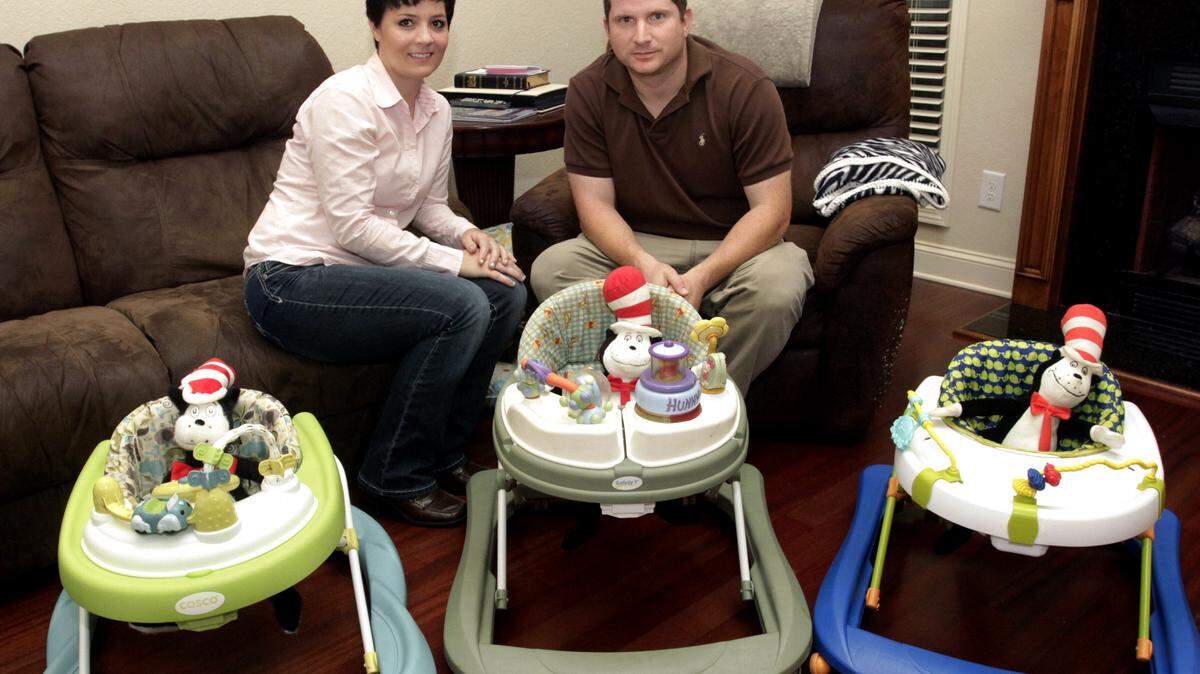
When Bethney Sikes and her husband, John, got married three years ago, they immediately began talking about expanding their family.
Bethney already had two biological children from a previous relationship, but there was still room for the family to grow. So the couple became foster parents.
"We decided this would be the route we would go, since I can't have any more biological kids without a lot of medical work," said Bethney, who lives in Harris County. "At this point, even if we could, we wouldn't, because so many children need homes."
Now, the couple is caring for 1-year-old triplets through the Muscogee County foster care system.
Foster parents such as the Sikes are very much needed in Muscogee County, where the number of foster care children is rising while homes willing to accommodate them remain in short supply, according to local judges and officials at the Georgia Department of Family and Children's Services.
"It was somewhere in the 300s last year, and now we're at 520," said Juvenile Court Judge Warner Kennon, who handles such cases. "It seems to be growing exponentially. About every six months, we see a big jump in the numbers. We only have about 100 beds in Columbus, so Judge (Andrew) Dodgen, Judge (Joey) Loudermilk and I have being trying to augment those beds any way possible, through church involvement."
Kennon and other judges have already enlisted FaithBridge, an Atlanta-based program, to help engage local churches. The organization already has a coordinator in town and is planning to set up an office near the courthouse early next year.
Susan Boatwright, communications director for DFCS, said Muscogee County has 524 children in foster care and only 67 homes available. About 275 of the children are placed in nearby counties and 250 are scattered throughout other parts of the state. And the problem is growing statewide, she said.
"We are seeing an increase in the number of children in care," Boatwright said. "We think it's connected to the opening of the 1-800 number to report child abuse. We've seen an 80 percent increase in the number of reports that we received. I think last year we received just shy of 195,000 reports from July of 2014 through June of 2015. That's up significantly."
Boatwright said parents who are addicted to drugs such as meth, prescription pills and heroin are another contributing factor, and judges throughout the state are seeing the numbers increase.
Far from home
In Muscogee County, the number of local children in foster care has been growing steadily over the past few years, according to statistics provided by the county's juvenile court.
It jumped from 162 the first quarter of 2012 to 227 the first quarter of 2013, then to 331 the first quarter of 2014.
Chief Judge Gil McBride said the number has nearly doubled over the past 12 months, and the situation is becoming a local crisis. He said the problem is compounded by the lack of foster care beds available in Muscogee County.
"So these kids who are seeing their world disintegrate around them are suddenly shipped off to Chickamauga, they're sent to Brunswick, they're sent to Savannah, they're sent to Glynn County, they're sent to Augusta," he said. "They're being shipped all over the state.
"And there is no way that you will convince me that this is not just bad for the kids," he said. "It may be better for them than letting them stay in the house with the drug-addicted mother or father, but the real crying need here is for more foster beds in Muscogee County."
Boatwright said DFCS tries to keep children close to home, but local homes are just not available.
"It's sort of like a tier," she said.
"The highest goal would be to keep the child in the same school, to keep the child in the same community. When that's not possible, we definitely want to keep the child close to home and within the region. Having to go outside of the region just adds trauma on top of trauma."
She said staffing levels at DFCS started to decline in 2008 due to the economy and the elimination of positions specifically designated to work with foster families.
"Prior to the Great Recession, our foster families were our greatest source of recruitment (of other families)," she said. " Part of the formula to move toward a different outcome is to restore those positions, and that's being done right now; $5.8 million was allocated in the budget this year, not only for recruitment, but for support of foster families.
The statistics
Bill Hancock, CEO and cofounder of FaithBridge, said it's a Christian-centered nonprofit that helps churches launch foster care ministries, train foster families and volunteer and contract with the government to place children in stable and supportive foster homes.
Hancock said Kennon and other judges invited the organization to Columbus about a year ago after hearing about the work that it was doing in Glynn County. FaithBridge representatives met with local church, school, judicial and nonprofit leaders, and then conducted a study of the foster care landscape in the Chattahoochee Judicial Circuit. Researchers used foster care statistics from October 2013 to September 2014.
What they discovered was troubling, Hancock said.
"Columbus, Georgia, has one of the highest (foster care) populations per capita rates in the state," he said.
Hancock said there are several social indicators that drive the number of children who go into foster care.
They include the rates of teenage pregnancy, high school drop-outs, homelessness and joblessness.
"When those numbers are trending up, particularly when you see arrest records around drug abuse, you're going to see an increase in children coming into protective custody," he said.
According to the FaithBridge study, 37 percent of the foster care children in Muscogee County were removed from their homes because of neglect; 21 percent because of caretaker drug and alcohol abuses; 14 percent because of caretaker inability to cope; 15 percent because of inadequate housing; 13 percent because of child behavior; 14 percent because of abandonment; 7 percent because of physical abuse; 7 percent because of incarceration; and 3 percent due to sexual abuse.
"Muscogee County greatly exceeds the state average in caretaker inability to cope, child behavior and abandonment," according to the study.
"For all three of these, the evidence of this issue exceeds the state average by more than 300 percent, creating a challenge for the foster care system around hard-to-place children and youth."
Sixty-one percent of the children were placed in non-relative foster care, 25 percent in relative foster care and 14 percent in institutions, the study found. When it came to race, 59 percent were black, 30 percent were white, and 5 percent were Hispanic. Half of the children were under the age of 10.
Socioeconomic issues that made children most vulnerable included poverty, unemployment, domestic violence and drug use.
Muscogee County far exceeded state averages when it came to the percentage of children with a single parent (45.6 percent), teen pregnancy (32.1 percent), babies with a low birth weight (11.5 percent). The rates in Muscogee County in those three categories also exceeded those of rural counties.
The average length of stay at a foster home in Muscogee County was 11.7 months, compared to 10.3 months for the state.
Engaging the churches
To address the problem, FaithBridge is setting up an office near the Muscogee County Juvenile Court to help recruit foster families through churches. Hancock said the organization already has a coordinator in the area and is in the middle of an end-of-year fundraising campaign with a goal of $150,000.
"To date, we have raised $110,000, and are trying to reach the goal by Dec. 31, so we can make two hires in the first quarter and start the (foster family) recruitment process by second quarter 2016," he said.
FaithBridge will take the ZIP codes of the county's 524 children and put them on a map that shows the neighborhoods where they come from, he said. Then the organization will overlay the map with the location of churches, and the number of regular church attendees.
"And then we build a marketing campaign showing that there's a solution to the foster care crisis in this county, and that solution is churches collaborating together as a safety net for children in these stable, loving families. "We train those churches and we educate them on the demand," he added. "And we're able to give them a good snapshot of where those children are in their community."
FaithBridge also helps the churches develop a "community of care" so foster families are not isolated. The support system includes child care, transportation, tutoring and other services.
Hancock said seven out of 10 children will return to their biological parents or a family member. So FaithBridge continues to work with families even after the children leave foster care.
"The need for a permanent family is the goal, and whether they return home or they need a permanent family through adoption or guardianship we manage that process on behalf of the court and the Department of Family and Children Services," he said. "Our goal is to support (foster) families so well that we maintain a 98 percent retention rate."
Boatwright, with DFCS, said organizations such as FaithBridge offer a great collaboration of support for foster children and families by engaging the church communities and recruiting both foster parents and those who want to support them.
"Throughout the state, we have a few organizations that are working in the same manner," she said. "It really is best when government, nonprofit organizations and the community come together to take care of the children and families in need. We're so thankful for the work they're doing."
Boatwright said people such as Bethney and John Sikes also are making a difference.
Making the sacrifice
Bethney, 33, once worked for the Child Advocacy Center, where she encountered many children who were victims of neglect and abuse. She is now a full-time foster parent. John, 36, is deputy warden at the Harris County Prison. The couple is also raising Bethney's children, ages 12 and 15.
Several foster children have come through their home over the years. They also took in their 4-year-old nephew when his mother passed away, and he has since reunited with his father.
Sikes said the triplets came to the family about five months ago with developmental problems. She couldn't identify them or divulge too many details for privacy reasons.
Sikes said she takes them to therapy several times a week and they're beginning to thrive. It's an experience that has changed their lives.
"The first month was a challenge," she said. "Basically every 15 minutes we would start a new feeding cycle because they were having to eat every two hours. So we didn't sleep for about a month.
"But after that, a behavior therapist came in and started working with us," she said. "The first day she came and showed us how to do it, the babies slept through the night and they've slept every night since then."
In September, the family celebrates the triplet's first birthday with a party.
Sikes and her daughter also recently launched a program called "Operation Birthday Buddy" for other children whose foster parents can't afford to throw them birthday party. The family is also encouraging friends and church members to become foster parents.
Sikes said the demand is so great that her family might even consider taking in a few more.
"We have one more spare room, and one more spot in our car," she said. "Anything more, and we're going to have to get a bus, which is not out of the question."
Alva James-Johnson, 706-571-8521. Reach her on Facebook at AlvaJamesJohnsonLedger.
HOW TO BECOME A FOSTER PARENT
Today, there are more than 500 children in foster care in the Chattahoochee Judicial Circuit with a large concentration in Muscogee County. The Muscogee County Department of Family and Children's Services works to locate relatives to support the birth family in reunification efforts and/or who are willing to let the child stay with them while the birth family works with the agency on reunification. If relatives are not an option for placement, there are other options for permanency including foster homes. If you are interested in becoming a foster parent, call 1-877-210-KIDS. The DFCS website provides information on the approval requirements and process: http://dfcs.dhs.georgia.gov/.
WHY THE FOSTER CARE SYSTEM IS IN CRISIS MODE
Capacity: Foster children radically outnumber caring foster families.
Stability: 1 in 3 foster children live in more than three homes per year.
Quality: Foster children often do not receive the appropriate services and the foster care system has disparate balances and measures in place.
Source: FaithBridge Group
GEORGIA CHILDREN IN FOSTER CARE
In Georgia, there are approximately 9,000 children in the foster care system. These numbers have oscillated over the years but, recently, seem to be on an incline.
2008: 9,984
2009: 8,020
2010: 6,895
2011: 7,591
2012: 7,671
2013: 7,642
2014: 9,124
Source: datacenter.kidscount.org, Children in Foster Care report and fosteringcourtimprovement.org/ga.
This story was originally published November 28, 2015 at 9:38 PM with the headline "Foster Care Crisis: Muscogee County officials look to churches, families as number of foster children rises ."