
Pearl Harbor survivor recalls the 'Day of Infamy'
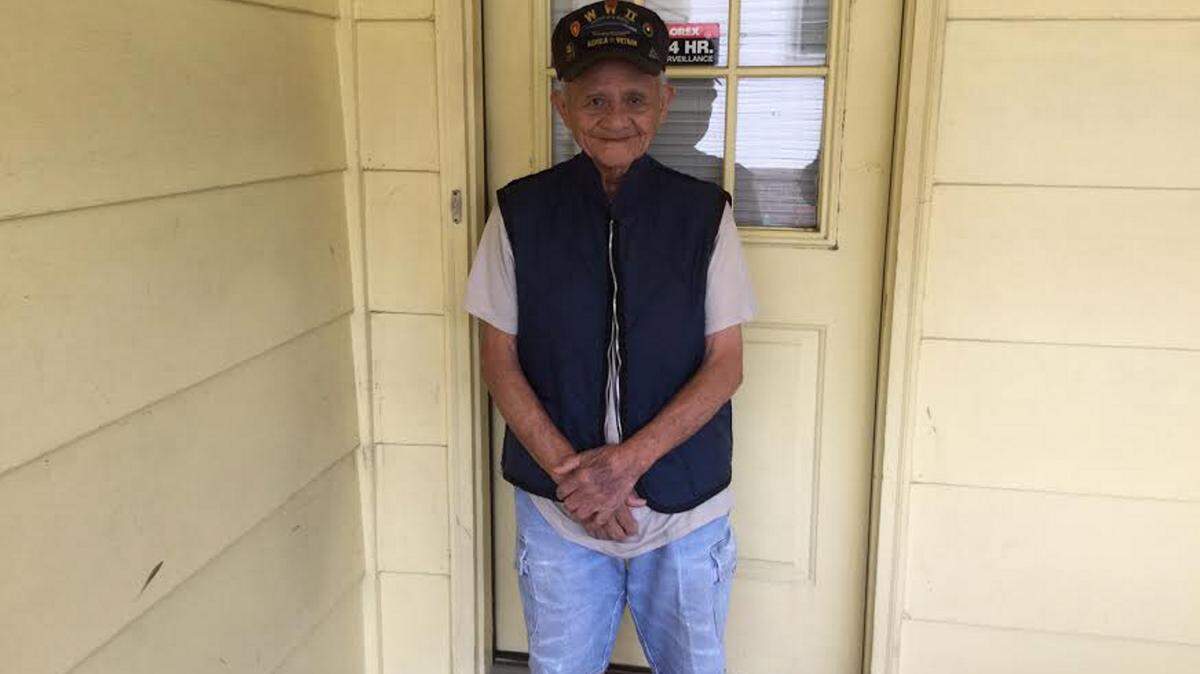
As a 15-year-old, Paul Ancheta pedaled his bicycle toward burning ships at Pearl Harbor, Hawaii, on Dec. 7, 1941, but he was turned away by the Navy shore patrol.
"When I got to the shore, I could see nothing," said Ancheta, who now lives in Columbus after retiring from the U.S. Army. "I could see the smoke. I could see the planes, but I couldn't see the ships."
At age 90, Ancheta still remembers the destruction he clearly saw after climbing a hill near his home in Aiea, Hawaii, overlooking Pearl Harbor. On the 74th anniversary of the Japanese attack against the Pacific Fleet, the nation remembers the "Day of Infamy" that left 2,403 military personnel and civilians dead and 1,178 wounded. It was the first attack on American territory since 1812 and propelled the United States into World War II.
Sixty-eight civilians were among the dead. Before Ancheta was chased away to the hills, he said a Navy patrol ordered him to go home before he was killed. That Sunday morning was like
most for Ancheta until he heard the loud noise and realized the harbor was getting bombed. "There was a lot of planes," he said. "But there was none of ours."
With 183 bombers and other aircraft, Japan launched its first attack at 7:55 a.m. on Oahu, the main island of Hawaii. A wave of 168 planes followed with a second attack.
Ancheta had a good view of the harbor from atop the hill near his home. "You can't see Honolulu from there, but you can see Pearl Harbor and Pearl City," he said. "You could see Hickam Field."
There were bombs falling and explosions bursting in the air. You couldn't see which ships were damaged, but he later learned the USS Arizona was sunk. At the bottom of the harbor, a memorial is dedicated to 1,177 officers and crewmen who died during the attack.
The harbor wasn't the only target during the attack. Hickam Field and Schofield Barracks also were damaged. When the attack ended almost two hours later, 19 ships had been disabled or sunk, 164 aircraft were destroyed and 128 damaged on the airfields.
The Japanese attack was commanded by Vice Admiral Chuichi Nagumo. His plan called for a third wave to knock out repair facilities and fuel tanks, but he decided against it. Fearing a counterattack, he headed for home.
After the attack ended, Ancheta recalled how his family painted their windows black to block out light at night. "When you turned the lights on, you see black," he said. "We did that. Outside you couldn't see the light. You had to close the door when you turned the lights on."
Ancheta was young but still wanted to serve his country. In early 1945, he enlisted into the Army and completed basic training at Schofield Barracks, where the planes attacked. He saw action in the Philippines towards the end of the war. "We were mopping up," he said. "That was the only campaign I had."
He later served two tours each in the Korean War and Vietnam. During the Korean War, he earned a Purple Heart. He was among the first to see action there. "I was there when it started, and I was there when it ended," said Ancheta, who retired as sergeant first class in 1973.
A day after the attack, President Franklin D. Roosevelt described the day as "a date which will live in infamy" in a speech to a joint session of Congress where the Senate approved a Declaration of War.
Nearly four years later, the war officially ended on Sept. 2, 1945, shortly after the United States dropped atomic bombs on the Japanese cities of Hiroshima and Nagasaki.
Thomas Dolan, a political science professor at Columbus State University, said every generation has moments that define it. Among them are the assassination of President Abraham Lincoln in 1865, Armistice Day as the end of World War I and the attack on Pearl Harbor for people alive in December 1941.
During the 1960s, President John F. Kennedy and Dr. Martin Luther King Jr. were assassinated before the most recent 9/11 terrorist attacks in 2001.
"The people who died in these wars, and the individual people like Presidents Lincoln and Kennedy and Dr. King, who were killed for their actions and beliefs, died for us," he said. "Our lives are better for their sacrifices. The 2,403 people killed at Pearl Harbor were victims of a sneak attack, very much like the ways Presidents Kennedy and Lincoln and Dr. King were; while we Americans remember Pearl Harbor, the Japanese remember Hiroshima and Nagasaki."
To ignore Pearl Harbor would be to deny the past, Dolan said. "We need to remember these events not to embrace hatred of those who were responsible for them, but so that we can honor those who died because of them," he said.
This story was originally published December 6, 2015 at 10:43 PM with the headline "Pearl Harbor survivor recalls the 'Day of Infamy' ."