
Chattahoochee flooding the highest in 12 years
The Chattahoochee River is overflowing, but not as much as it has before, according to data from the National Weather Service.
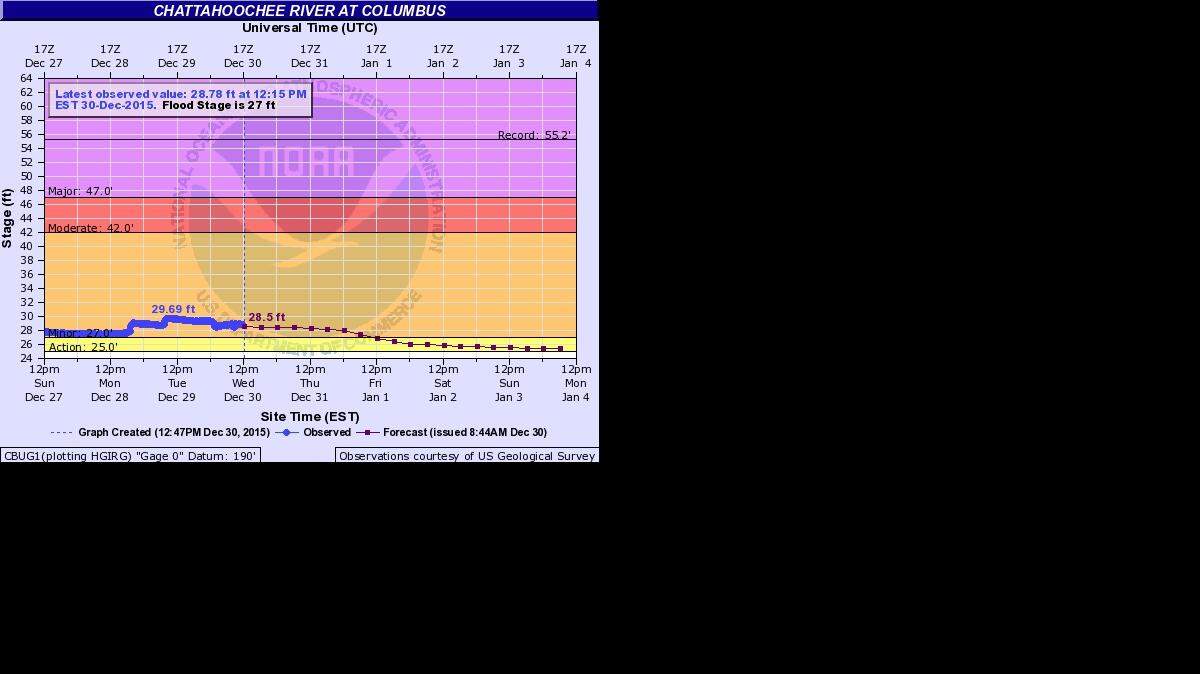
Their water level gauge said the Chattahoochee has been above 27 feet for several days, the official minimum for "flooding." As of this writing, it is at 28.5 feet, more than enough to put parts of the RiverWalk underwater.
"It is by all means the most significant flood Columbus has had in 12 years," said Kent Frantz, a service hydrologist with the National Weather Service. "
Historical data from the NWS reveals the current levels of flooding are comparable to other floods in the last 25 years with water levels such as 35.84 feet on at 12:30 p.m. on Christmas Day. Frantz said this year's surge was the 18th-highest on record.
The highest crests, according to the records, were:
- 55.20 feet on March 15, 1929
- 52.60 feet on Dec. 12, 1919
- 49.80 feet on Feb. 26, 1961
- 48 feet on Jan. 19, 1925
- 45.89 feet on April 8, 1964
Those numbers have dropped in recent years because of development from the U.S. Army Corps of Engineers and Georgia Power.
"The biggest thing is all of the dams that were built," Frantz said, citing the Buford and West Point Dams.
According to the NWS site, "moderate" flooding occurs at 42 feet. The flooding is rated is "major" once it crosses 47 feet. The river is "flooding" when it gets above 27 feet.
Frantz said 34 feet used to be the minimum for a flood until it was lowered to 27 to accommodate the Riverwalk and Phenix City Ampitheater.
Floods are rated and tracked by their potential to cause damage to the city, Frantz said. The NWS site includes a damage chart that estimates the costs of every extra foot of water. For example, the NWS guesses that 35 feet of flooding would expand upstream and downstream from the 14th Street Bridge. It would also put the Riverwalk under 8 feet of water and flood the maintenance room under the Trade Center up to 3 feet. "Portions of the Oxbow Creek Golf Course in south Columbus will be flooded," according to the chart.
At 45 feet, portions of Bay Avenue and 14th Street in Columbus and Second Avenue in Phenix City start flooding. Homes in low-lying areas of the Valley start seeing water from the Weracoba and Bull Creeks. The Phenix City Ampitheater would be completely flooded and large portions of the Alabama Riverwalk would be under 7 feet of water.
"That was very close [to causing more damage] at 36 feet," Frantz said.
55 feet of flooding is considered "catastrophic" with "most bridges closed with extensive damage to homes and businesses." Thankfully, the Chattahoochee does not appear to often reach those levels.
The forecast for the next few days' flooding has the river hovering around 28 feet through the New Year before dropping down to 25.3 feet by noon Jan. 4, depending on weather. A high pressure buildup and a few days' break from rain should lower the water levels.
"Everything should finally have the chance to flow out," Frantz said.
Tim Chitwood contributed to this report.
Columbus floods throughout history
1929: The 1929 flood, according to Wes Owens' article in a 1961 issue of the Sunday Ledger-Enquirer, saw waters rise more than halfway up the fence around Golden Park and flood the stands. Bay Street and Front Avenue were covered with several feet of water. The flood also knocked out the city's gas.
1919: The 1919 flood was known as the "Pershing Flood" because it coincided with Gen. John J. Pershing's visit to Fort Benning. The area flooded again when Pershing visiting in 1922, causing him to quip, "I thought all along Columbus would make a good Army post, but I'm beginning to think it could also be used by the Navy."
1841: The Dillingham Street Bridge gave in to a flood in March 1841 locals called "the Harrison freshet" after the new president, William Henry Harrison. Two days of rain lifted one end of the bridge from its pier and floated ti downstream. The newspaper reported, "...never was there a more majestic sight seen, than the departure of that noble bridge, on its remarkable voyage. Its course was uninterrupted as we learn, until it reached Col. Woolfolk's plantation, eight miles below, where it took up new moorings, in the centre of a large cotton field."
--- Virginia Causey
This story was originally published December 30, 2015 at 1:29 PM with the headline "Chattahoochee flooding the highest in 12 years."