
He helped design, construct prominent Columbus buildings. Turning 90, he retires again.
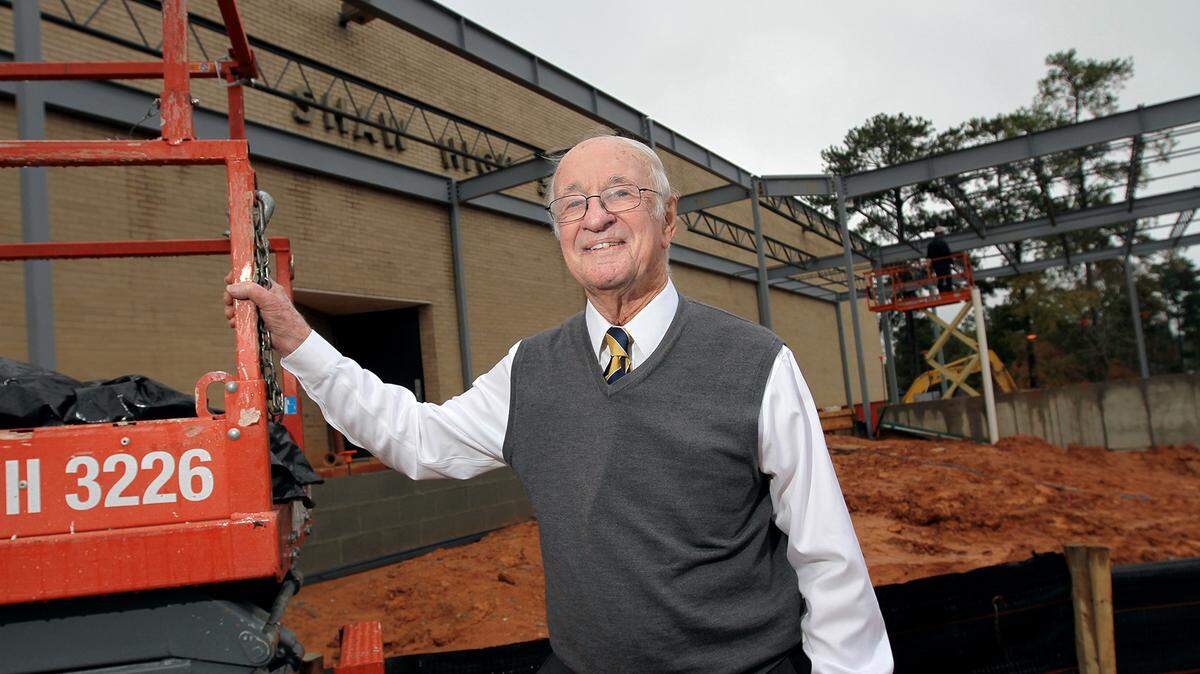
Bobby Hecht has been involved in designing or constructing some of the most prominent buildings in Columbus for nearly seven decades, mostly with the architecture firm now known as Hecht Burdeshaw. For the past dozen years, he has been the Muscogee County School District’s construction director.
Hecht will retire from MCSD Nov. 16. Ten days later, he will turn 90.
“I don’t want to wear out my usefulness,” Hecht said. “In your own mind, you get to a place where you think it’s time to go, and I reached that period. . . . Nobody has forced me.”
MCSD superintendent David Lewis called Hecht “a valued member of our district staff. It is rare for a school district to have someone of Mr. Hecht’s knowledge, experience and expertise on staff. He is highly respected both personally and professionally for his many contributions to our community, which is evident through his work and service.”
MCSD chief operations officer David Goldberg will take on Hecht’s responsibilities, Lewis said.
Hecht’s predecessor as MCSD construction director, Leon Siegel, retired in 2006. That’s when Hecht was retiring from Hecht Burdeshaw, based on the firm’s method of transitioning leadership as partners age.
“It was time for me to get out of the way,” he said.
So when Siegel told Hecht that he would put in a good word for him if he were interested in the position, Hecht pursued the opportunity.
“I wanted the job,” Hecht said. “I like to stay involved. I like to stay active. I like to do work that I think is constructive and worthwhile and challenging.”
Then he added with a laugh, “And I’ve experience all of that.”
Hecht, a 1945 graduate of Columbus High School, was a doodler while growing up, often drawing cartoons. He went to Georgia Tech to become a mechanical engineer, but he quickly switched to architecture, following in the footsteps of older brother Jesse, who died at 21 from cancer.
Asked whether a part of him has designed buildings to memorialize his brother, Hecht said, “That sounds too maudlin, but I liked him and I respected the fact that he wanted to be an architect.”
After graduating from Georgia Tech in 1949, Hecht worked in New York City for several months. The following year, Columbus architect Wilbur D. Talley, for whom Hecht worked during the summer, asked him to return. It also was a chance to help care for his ailing father, named Jesse as well.
Hecht didn’t yearn for the big city again. He found value in being among those who developed his hometown.
“Most people are proud of where they grew up, and they would like to be a part of the fabric that builds their community,” he said. “I’ve always been proud of Columbus.”
Being an architect, Hecht said, allows him to “create shelter that functions for what it’s intended to do.”
Hecht became a partner with Talley, who died in 1960. Talley & Hecht eventually morphed into Hecht Burdeshaw Johnson Kidd & Clark, then simply Hecht Burdeshaw.
When he was with Hecht Burdeshaw, he worked on projects that produced facilities as varied as the Columbus Public Safety Center, the Columbus Public Library and the RiverCenter for the Performing Arts.
MCSD facilities he helped design with Hecht Burdeshaw: Baker Middle School, Columbus High School additions and alterations, Eddy Middle School, Fort Middle School, Georgetown Elementary School, Jordan Vocational High School additions and alterations, Reese Road Leadership Academy and Wynnton Arts Academy additions.
MCSD projects the construction division managed under his leadership: Aaron Cohn Middle School, Carver High School, Dorothy Height Elementary School, Eagle Ridge Academy, Kinnett Stadium improvements, North Columbus Elementary School, Northside High School auditorium and additions, Rainey-McCullers School of the Arts, Rigdon Road Elementary School, Shaw High School additions and alterations, Spencer High School and Veterans Memorial Middle School.
“From a prestige point of view, you always like to be doing public institutions,” Hecht said, “whether they’re school buildings or government buildings, and they’re interesting.”
Those structures will outlive him, although he doesn’t like to talk about such a legacy.
“I don’t dwell on that type of thinking,” he said, “but it’s always nice to know that you’ve been a part of a community and have left some mark that was constructive and useful.”
Those structures also can play a major role in revitalizing depressed areas, such as the economic development around Baker and Dorothy Height.
“They reflect positively on a neighborhood,” he said, “particularly when they are well designed. . . . A school that’s well designed, the children and teachers are proud of it, and the neighborhood becomes proud of it.”
Asked which MCSD project makes him most proud, Hecht recalled his first one: Eddy Middle School, in the 1950s.
“It was a pretty big project for me at the time,” he said. “The board and the superintendent thought enough of my ability to feel like I could handle it.”
Hecht put that project in perspective.
“I think it was less than $12 per square foot,” he said, “and you can multiply that by three and come up with what mechanical work would cost in a school today.”
School design also has changed during his career. MCSD has gone away from the hub-and-spoke design, for example at Veterans Memorial Middle School, in favor of the multistory design, used at Aaron Cohn Middle School.
“(Hub-and-spoke) takes up a lot of space,” he said, “and if you’ve got a topography that’s hard to deal with, it might mean a lot of additional money going to grading. What we prefer to do is to get our architects to design buildings that are sympathetic to the orientation, to the topography and a number of things other than just being a prototype. That doesn’t mean we can’t take the best ideas and the best details from other schools, and we encourage that.”
Hecht emphasized the importance of a school building’s design incorporating the needs of the students, faculty and staff.
“That should be done in considerable detail,” he said.
And when that detail comes to fruition as folks gather for the ribbon-cutting ceremony, Hecht said, “I could say I’m bursting with pride.”
At the same time, he acknowledged, design and construction are a team sport.
“I’m always glad to have been a part of it,” he said.
Hecht has led MCSD’s construction division in three series of capital projects funded by the 1 percent Special Purpose Local Option Sales Tax voters approved in 2003, 2009 and 2015. They amount to scores of projects totaling approximately $500 million.
As the person directing those projects, funded by public money, Hecht must answer questions from the school board. Some questions have come amid heated debates. Regardless, he calmly has responded to each one.
“The only thing I’ve ever known how to do is to answer the questions as honestly as I can and as directly as I can,” he said. “. . . You don’t always agree with them, but you can always answer their legitimate questions. I respect the board as an institution, I respect the board because of the hard work they put in, and I respect them for trying to be conscientious and trying to be prepared.”
Asked whether he has any regrets about any MCSD project, Hecht laughed and cracked, “I wouldn’t tell you if I did.”
Then he added, “I do appreciate the local construction community. I’m talking about everything from architects to engineers, to contractors and subcontractors. We’ve got a fine group of people in the business. They’ve been good to deal with.”
Mark Rice, 706-576-6272, @MarkRiceLE.
This story was originally published November 11, 2018 at 8:34 PM.