He’s in Columbus halls of fame for athletics and education. Why he’s leaving MCSD

Keith Seifert never reached his career goal of becoming a college baseball coach.
But when he retires at the end of June as the Muscogee County School District’s chief academic officer, he will have completed a 33-year career involving a different kind of coaching.
And his induction into two halls of fame at Columbus State University — one for athletics, the other for education — shows his alternative path was a success.
Summarizing his 14 years at Hardaway High School, first as a physical education teacher and assistant baseball and football coach, then as an assistant principal and principal, as well as his 19 years as a district administrator, Seifert equated his role to coaching.
In fact, he coached for only three years at Hardaway, but folks around town still call him Coach Seifert.
“You never lose the name of Coach,” he told the Ledger-Enquirer. “Coaching is lifelong. It’s always about the students, the players and making sure that you provide a great opportunity for them, great instruction and that they know you care. Kids can look right through you. They know if you don’t care.”
Keith Seifert’s baseball career
After graduating from Newnan High School in 1981, Seifert played catcher on the DeKalb Community College (now Georgia Perimeter College) and Columbus College (now CSU) baseball teams. He was named the team’s Most Valuable Player all four years of his college career.
During his two seasons at Columbus College, he batted .351 with 35 home runs and 135 RBI. In 1986, he was honored as a first-team All-American and went 6-for-17 in the NCAA Division II World Series, where the Cougars finished as the national runner-up.
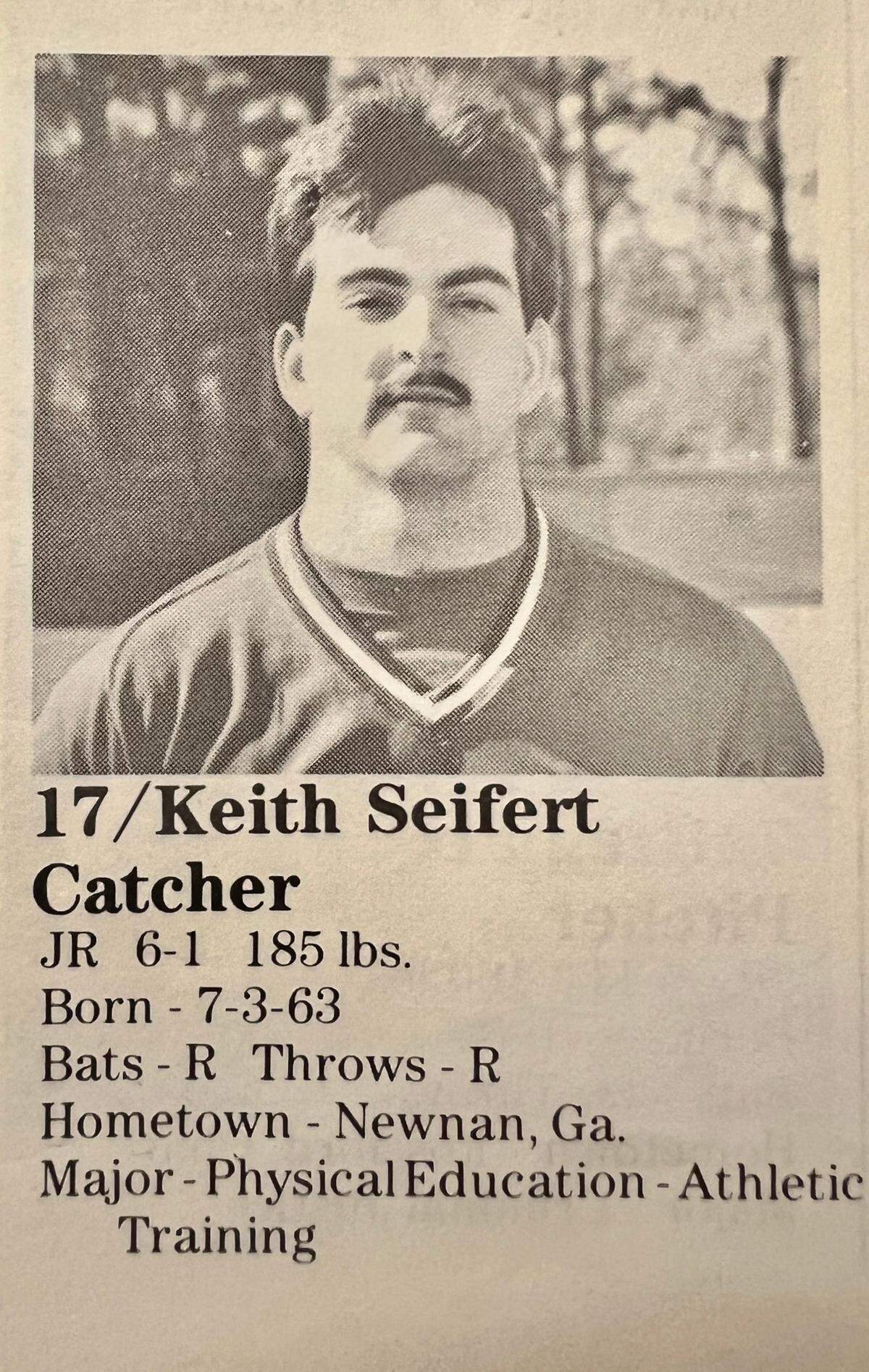
The Cleveland Indians chose Seifert in the 24th round of the 1986 MLB Draft. He was a professional baseball catcher for one game — his team won — then was moved to first base and designated hitter to make room for other prospects.
In 211 games across three minor league seasons, Seifert batted .233 with 13 home runs and 87 RBI. Then he got a letter in the mail from the general manager. The message went something like this: “Thank you very much for your time. We appreciate it, but we are no longer in need of your services.”
Seifert knew he didn’t have major league talent, and his goal was to become a college baseball coach instead, but he still was “devastated” when he was released.
“I’d been playing ball since I was 6 years old,” he said. “Because you’ve been doing it for so long and enjoyed that lifestyle, and then it’s no longer there, now life comes back in and you say, ‘What am I going to do now?’”
Seifert continued attending college during the offseason, so he could complete his bachelor’s degree in health and physical education when the Indians released him.
“That was always my mother’s and father’s wish,” he said. “They never had a college degree.”
Why Keith Seifert became an educator
In 1989, Seifert accepted a two-year graduate assistantship at Columbus College under then-head baseball coach Derek Mann while working on his master’s degree in education administration and supervision.
Two years later, then-Columbus College health and physical education department chairman Charlie Ragsdale called then-Hardaway principal Roger Hatcher and recommended Seifert for a position as a physical education teacher and assistant coach for baseball and football. He got the job.
Seifert said he appreciates Ragsdale’s “support and encouragement” and he had “the utmost respect for him.”
He didn’t realize it at the time, but his path toward achieving his goal of becoming a college baseball coach had just diverted.
“God has a purpose for you,” he said. “… This job became available, and it just propelled me.”
Seifert quickly ascended into administration. He became a Hardaway assistant principal in 1993, Hardaway principal in 1999, MCSD secondary education director in 2005 and MCSD chief academic officer in 2015.
“I’m humbled they saw in me the ability that you can do this,” he said about being an educational leader. “… A lot of this job is relating to people.”

Hatcher told the Ledger-Enquirer in an email that he promoted Seifert to assistant principal “because of his knowledge, skill and dedication to student and teacher success. These same attributes have served him well as he has been able to apply these at the system level.”
Seifert is grateful for the mentoring he received from Hatcher, now the director of CSU’s Center for Quality Teaching and Learning.
“Mr. Hatcher ran just a wonderful school,” Seifert said. “He kind of took me under his wing. … He was very structured in how he ran a school, and I learned a lot from him.”
Seifert also credits Mann, who coached him at Columbus College, with helping form his leadership philosophy.
“You get the best players,” he said, “and you let them do their job.”
In education, whether it’s coaching students, teachers or administrators, the key to coaching them is listening to them well, Seifert said, especially when a problem arises.
“Even when it’s difficult, you sit down and talk about it,” he said. “You engage. … We hire good folks and let them do their job. I’m not going to micromanage you. … They’re all learning opportunities. You learn by your failures.”
Seifert remained an educator because he saw the positive impact he made.
“I enjoy working with kids, … being able to talk to them and counsel them and support them,” he said. “… It was encouraging to see kids kind of turn the corner and graduate from high school. That’s what internally gives you pride and the ability to say I made a difference in that kid’s life.”
Regret and pride
Asked whether he has any regrets about his career, Seifert said, “You always have second guesses. Did I do right by this particular student? Did I provide every opportunity? … You want all kids to graduate. There are some you work with, and you work with, and you work with, and they still fall short. … But I feel pretty confident in what my career turned out to be. It was a combination of mentors and support. … It’s a team sport.”
Asked what he is most proud of about his career, Seifert mentioned two accomplishments:
- Hardaway implemented the International Baccalaureate program when he was principal
- While he has been MCSD chief academic officer, the district’s metrics for academic achievement have improved to levels above the state and national averages on graduation rate, Advanced Placement tests and SAT scores.
“I remember when our grad rate was in the 60s, and now it’s in the 90s,” he said. “That tells me we’re doing something right.” … You look at all of our magnet programs, we offer so much to so many, and it takes a lot of planning and coordination, from operations to student services to teaching and learning. Ultimately, we want them in May to walk across that stage and say, ‘I’ve earned a diploma, and now I can move on to the next stage of my life.’”
For example, as an assistant principal at Hardaway, Seifert counseled a student who struggled with attendance and academics. They met in his office several times each month until the student improved enough to graduate after earning his remaining credits in summer school.
“This kid eventually walked across the stage because they put forth the effort, did what they were supposed to,” Seifert said with a smile.
Seifert paused to consider what having such influence means to him.
“I didn’t become that coach who may have won a national championship or a state championship, but I’m very pleased at how my career turned out,” he said.
Keith Seifert’s impact on MCSD
In an email to the Ledger-Enquirer, MCSD superintendent David Lewis called Seifert “a true servant leader.”
“In both daily routine and complex projects, he displays a tactful, collegial administrative style,” Lewis said. “He is positive, honest, empathetic and treats everyone with dignity and respect. As a result, he is liked and respected by peers and subordinates alike.”
Nobody has been hired to succeed Seifert. Lewis said he plans for the next MCSD chief academic officer to start in the position July 1.
Why is Keith Seifert retiring, and what’s next for him
Seifert, 60, said he is retiring to spend more time with his family.
“There are things in my life that I think are calling me,” he said. “I have a new granddaughter. She is 2½ years old. My wife, she’s doing some things with her four days a week. Just getting engaged with that. As an educator, you just kind of lose yourself in the job. Unfortunately, . . . sometimes the sacrifice is family. I don’t want the last years of my life thinking I really didn’t spend time with my family.”
In retirement, Seifert said, he hopes to volunteer more in the community. He already serves on the local Goodwill Industries of the Southern Rivers executive board.
“I’ll take some time, reflect on where I am,” he said, “and then, if there’s a calling down the road, look at it if it’s interesting.”
This story was originally published March 20, 2024 at 11:57 AM.